Norway's state-controlled Equinor will defer some gas production from this year into 2021 and beyond as part of its value-over-volume strategy.
Equinor is focusing "even more than ever" on "value over volume" given the low gas price environment, its chief financial officer Lars Christian Bacher said. The firm is "pushing some gas from 2020 to 2021 and in some cases beyond", with the decision based on "market conditions and the prices we see further out in time", Bacher said.
It is even more important to "make the right long-term decisions" in the current situation, with Equinor seeking to exit the economic downturn in a "strong position" so that it can have even more of a "competitive advantage", Bacher said.
Equinor confirmed today that it has already deferred some gas production from the first quarter "into periods with higher expected gas prices". The firm had also deferred some production from the fourth quarter of last year and the preceding summer.
Bacher's comments suggest that Equinor may have sold ahead deferred production, as it has on previous occasions.
Most of Equinor's production flexibility comes from the giant Troll swing field, while the firm has also operated the Oseberg field as a form of mid-range storage.
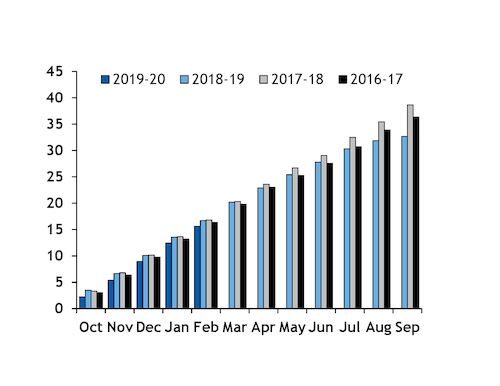
Troll production staying weak over the remainder of 2020 suggests that output could fall well short of the 36bn m³ quota for this gas year, after 2018-19 output had been well below the 38bn m³ permit (see graph).
Northwest European prompt prices have held a wide discount to forward contracts so far this year, providing an incentive to defer production. And NBP and TTF prices have moved into an even steeper contango in recent weeks, as social distancing measures to contain the Covid-19 pandemic have cut into weather-adjusted consumption and LNG imports have stayed quick. And storage facilities across Europe entered the summer at their fullest in recent years, which would have curbed summer injection demand even before accounting for coronavirus.
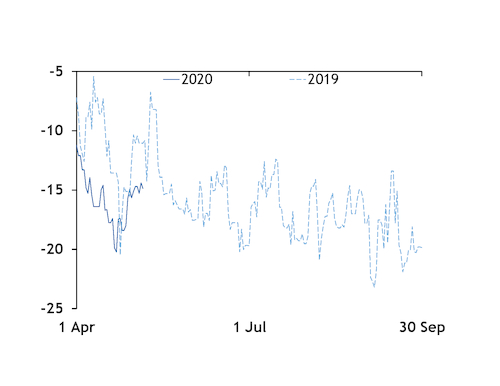
The NBP everyday market averaged a 15.8p/th discount to the summer 2021 contract on 1 April-6 May (see graph). This was not far off the average NBP everyday-summer 2020 spread of minus 17.6p/th in August-October 2019, when Troll output was cut the most.
Aggregate Norwegian exports to Europe have slumped since the start of April, suggesting a turndown in Troll offtake. And flows have been cut exclusively to the UK, with NBP prompt prices dropping well below the TTF.
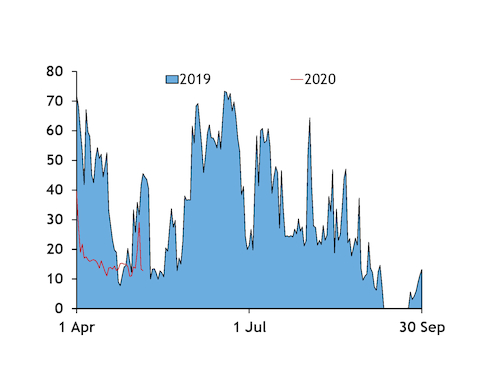
Flows through Langeled — which receives Troll supply after it has been processed at Kollsnes — slipped to 18.8mn m³/d on 1 April-6 May from 37.8mn m³/d a year earlier (see graph).
Oseberg output may have also been weak so far this summer, judging by minimal deliveries along Vesterled, which transports supply from the field to the UK. That said, it is also possible to redirect Oseberg supply away from the UK, by exporting it to Draupner and on to the continent.
Equinor may have had to adapt its sales strategy more to European prompt gas price movements since the start of this year, after it shifted to shorter-term indexes in its supply contracts.
The firm said last year that it planned to change the way it priced into the market from the start of 2020, with around two thirds of its indexes to be on a day-ahead basis and the rest on a month-ahead basis.
Equinor has suspended its 2020 oil and gas production guidance, citing its value-over-volume approach, market uncertainties and oil production curtailments imposed by the government.
The Norwegian government has proposed temporary changes to Norway's petroleum tax system to help maintain activity in the oil and gas industry. But Equinor does not expect the proposal in its current form to have the intended affect, saying that ongoing discussions between the industry and the government will "hopefully" result in a more appropriate solution.
Deferrals cut into first-quarter output
The deferral of flexible gas production contributed to a fall in Equinor's Norwegian output in January-March from a year earlier.
The firm's Norwegian equity production slipped to 147.3mn m³/d from 158.9mn m³/d in the first quarter of 2019.
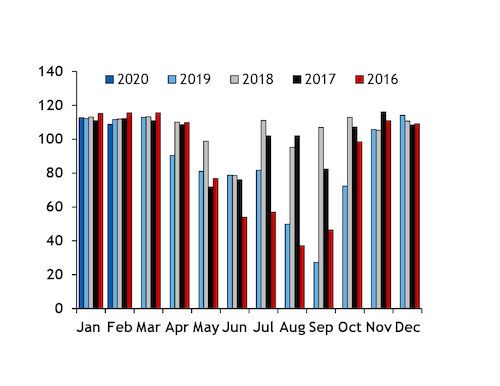
Troll production stayed quick in January-February, the latest months for which individual field data are available, but it may have fallen in March. Output was 110.8mn m³/d, only just down from 111.9mn m³/d a year earlier and not far off technical capacity of 120mn m³/d (see graph).
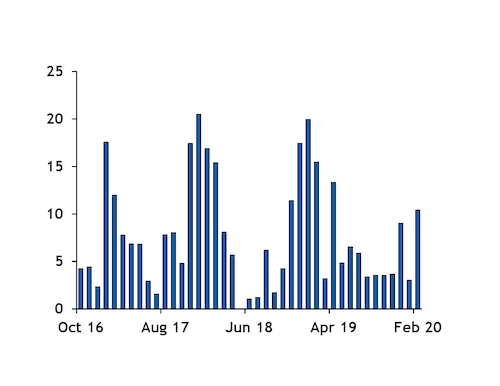
Production from Oseberg, Equinor's other flexible field, fell more sharply in January-February to 6.7mn m³/d from 17.7mn m³/d a year earlier (see graph).
The "expected natural decline" of some fields further cut into Equinor's first-quarter production, the firm said.
Offtake from Kvitebjorn and Ormen Lange — in which Equinor holds 39.6pc and 25.3pc stakes, respectively — continued to slide in January-February.
Output deferrals and weaker output from ageing fields was partly offset by the ramp-up of new fields, Equinor said.
Johan Sverdrup, which mostly produces oil, started up in October 2019 and has reached a higher initial plateau than previously estimated, the firm said.
And production from Aasta Hansteen, which was commissioned in December 2018 and reached its plateau around February 2019, was up in January-February from a year earlier. Equinor operates the field with a 51pc stake.
Equinor's averaged invoiced price in Europe was $4.06/mn Btu (31.3p/th) in the first quarter, down from $6.89/mn Btu (22p/th) a year earlier. NBP everyday prices fell more sharply to 24.8p/th from 48.2p/th.