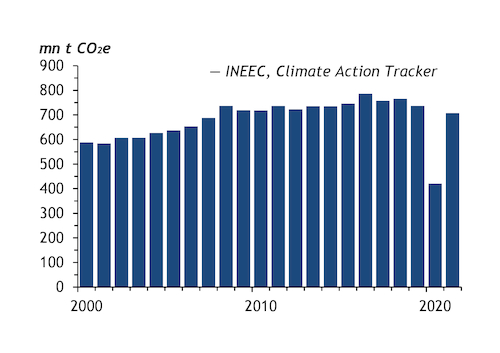
The growth of emissions trading systems in Latin America is inconsistent — Mexico already has one, while Brazil, Chile and Colombia are all at different stages, writes Jacqueline Echevarria
Emissions trading systems (ETS) are expanding globally, boosted by the rapid implementation of systems in the US and EU, a report by the International Carbon Action Partnership (Icap) says.
But growth in Latin America is moderate and patchy. Mexico is the first regional country to have an operational ETS, while Brazil and Chile are in the early stages.
The Mexican ETS, launched in 2020, consisted of a pilot phase in 2020-21 and a transition phase in 2022. The project aims to help the country reach its emissions reduction goals under its nationally determined contribution (NDC).
The scheme covers direct CO2 emissions from entities in the energy and industrial sectors that produce at least 100,000 t/yr of CO2. The programme covers around 40pc of national greenhouse gas emissions and 90pc of emissions reported in the country's national emissions registry Rene, the report says.
The third emissions allocation in Mexico took place last year. The environment ministry analysed and revised the first compliance period and found that participants achieved a 93pc compliance rate, Icap says.
The ETS programme will start a new operational phase later this year. The rules for this phase will be announced by June, Icap says.
Mexico is developing other mechanisms that can be linked to the ETS. The country is expected to implement a domestic crediting mechanism and is considering the development of offset protocols in priority sectors. The environment ministry is also developing eligibility rules for the use of offsets based on a mapping of activities and projects that could be used for this purpose.
In South America, Colombia is analysing setting up an ETS that is expected to be fully operational by 2030. Creating the system is stated in its climate change law, which outlines the provisions for the establishment of an ETS.
The environment ministry will determine the number of allowances in line with Colombia's national mitigation targets. The ministry will also be in charge of allocations, which will take place primarily through auctions. Non-compliance will be punishable by a fine of up to double the auction price.
Colombia currently has a carbon tax with an offsetting programme, both of which have been in place since 2017.
Joining in
Chile and Brazil are looking at the role that an ETS can play in their climate change policies to help them comply with their respective NDCs.
The Chilean government in August published its 2022-26 energy agenda, which states that a pilot ETS project for the energy sector will be developed to evaluate the role that this instrument will play in achieving emissions reductions and a just transition in a cost-effective manner.
Chile currently has a $5/t carbon tax that will reach $35/t CO2 by 2030 and $80/t by 2040, under its updated national energy policy.
In Brazil, the government in May last year published a decree that established national greenhouse gas emissions reduction system Sinare, requiring the environment and economy ministries to develop sectoral climate change mitigation plans — including concrete emissions targets — and calling for establishing "integration mechanisms with the internationally regulated market". The decree was published in parallel with draft bills aiming to regulate emissions trading.
A group of leading companies has been participating in a voluntary ETS simulation — co-ordinated by the Centro de Estudos em Sustentabilidade at the Fundacao Getulio Vargas in Rio de Janeiro — since 2013 to gain experience and develop proposals for an ETS in Brazil.