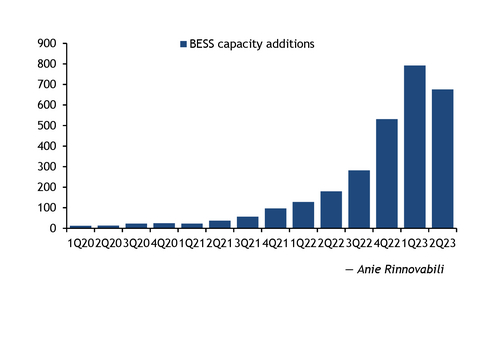
Italy's battery storage additions declined in the second quarter for the first time in two years owing to the recent repeal of credit incentives, but additions in the first half of 2023 surged on the year, according to Italian renewables association Anie Rinnovabili.
Total installations of battery energy storage systems (BESS) in the second quarter amounted to 676MW, nearly three times higher on the year but down by 14.6pc on the quarter — the first decline in nine quarters, according to Anie (see capacity additions chart).
Just over 69,520 units were added in the second quarter for a combined storage capacity of 914MWh, rising from 370MWh in the same period last year but below a record 1.14GWh added in the first quarter. A monthly average of 23,174 battery storage units were installed in April-June, down from around 27,000 in the first quarter.
Anie attributed the quarterly decline to the Italian government's decision in February to halt the "superbonus 110pc" credit scheme for small-scale energy interventions. Finance minister Giancarlo Giorgetti at the time cited the negative impact of the scheme on public debt as a reason for it ending.
But the credit halt applied only to units that had not already signed up to the scheme prior to February 2023, many of which were installed during the first six months of the year. Owing to this delayed effect, battery storage capacity added in the first half of 2023 almost quadrupled on the year to 1.5GW, with average monthly additions doubling to 26,000, according to Anie.
Italy's total BESS capacity reached 3.1GW/5.1GWh at the end of June, up from 1.6GW/3GWh at the end of 2022 and including grid operator Terna's additional BESS units totalling 60MW/250MWh.
The northern region of Lombardy remains the region with the highest battery storage capacity at 583MW/930MWh, followed by Veneto for 414MW/722MWh and Emilia-Romagna for 307MW/470MWh.
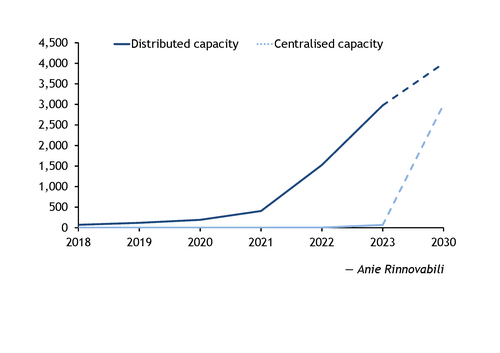
Around 99pc of Italian battery storage capacity is "distributed", meaning that units are dispersed throughout the distribution network of households and businesses. About 92pc of the country's storage units have a capacity of less than 20kWh, of which 33pc falls in the 5-10kWh range and 36pc in the 10-15kWh range.
Italy's current distributed storage capacity stands at 2.98GW, three-quarters of a targeted 4GW required under its national climate and energy plan by 2030. By contrast, centralised storage capacity stands at a mere 68MW, 2.3pc of a targeted 3GW by 2030 (see trend chart).
Around 50 large-scale battery storage projects have been presented to Italy's energy ministry for approval since 2021, representing 3.8GW of capacity. And Terna aims to increase its installed BESS capacity by 6GW in 2025-30.