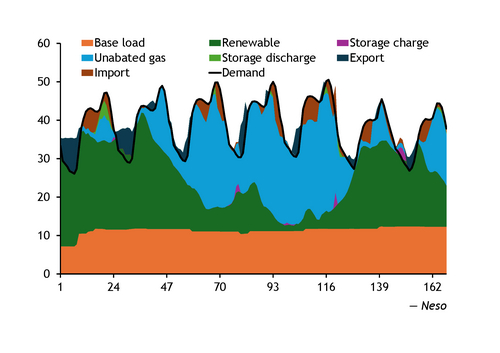
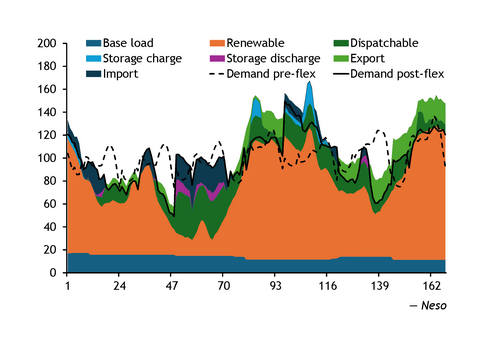
The UK must accelerate investment and planning in clean energy systems over the next five years or risk falling behind its 2050 net-zero targets, the country's grid operator Neso said in its Future Energy Scenarios 2025 report.
Neso outlined four stages, or "waves", of the UK's transition to a low-carbon energy system — "foundation" (pre-2025), "acceleration" (2025-30), "growth" (2030-40) and "horizon" (2040-50) — representing a timeline from early-technology deployment to full-system decarbonisation.
The report identifies the 2025-30 period as a critical "acceleration wave", when the UK must significantly scale up renewables, electrify transport and heating, expand grid capacity and invest in hydrogen and carbon capture infrastructure. Neso warned that without this acceleration, the country risks falling into a high-cost, fossil fuel-dependent pathway which fails to achieve net-zero.
All four stages could play out along four possible scenarios, three of which achieve the UK's climate goals by 2050 through varying combinations of electrification, low-carbon fuels, consumer engagement and infrastructure development, according to the report. A fourth scenario, described as "falling behind", reflects slower action and results in continued reliance on fossil fuels, greater costs and missed targets.
Across all successful scenarios, electricity demand more than doubles by 2050, driven by the widespread adoption of electric vehicles (EVs), heat pumps and electrification in industrial processes. Installed renewable capacity must increase by at least four times, with offshore and onshore wind and solar generation providing the backbone of the future power system. In the most hydrogen-intensive scenario, low-carbon hydrogen production reaches 119 TWh/yr by mid-century, supporting decarbonisation in sectors that are harder to electrify, such as heavy industry, freight and aviation.
Energy efficiency and flexible demand will play a "critical" role in balancing the system and reducing peak loads, Neso said. The operator projected active consumer participation — through measures such as smart EV charging and time-shifting of heat pump usage — could reduce peak electricity demand by over 50pc compared with unmanaged consumption patterns. Whole-system energy use could fall by 18pc if efficiency technologies and behaviour changes are fully realised.
The report also highlighted the shift to a decarbonised energy system requires significant capital investment, particularly over the next two decades. Neso estimated system-wide investment will rise sharply, but notes that these costs will be offset by lower operational expenses and reduced exposure to fossil fuel markets.
The report does not include full costings, but the operator committed to publishing a technical annex with financial modelling later in the year.