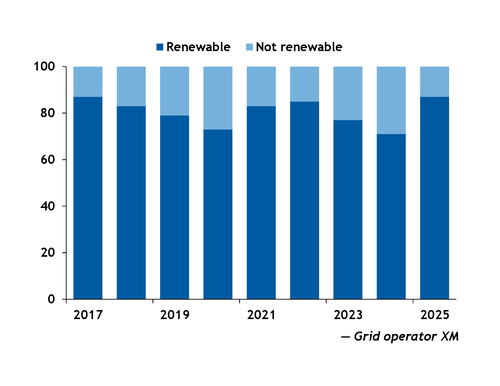
Colombia will need to speed expansion of mostly non-hydropower renewable energy such as solar and wind power to achieve deeper emissions cuts and meet climate targets, the OECD said in an environmental performance review.
Colombia, a member of OEDC, has relatively low greenhouse gas (GHG) emissions, at 3.7 t/capita compared with the OECD average of 10.7 t/capita. It has taken some steps towards mitigation policies, but reaching its ambitious targets will require further actions, the review found.
GHG emissions grew at an average rate of 1.7pc/yr from 2005-2020. Achieving Colombia's target of a 51pc reduction in net GHG emissions will require average reductions of 5.4pc/yr, the review said.
Colombia pledged to cut emissions by 51pc by 2030 compared with a business-as-usual scenario — up from a previous 20pc target set in 2015 — and to reach net-zero emissions by 2050. It accounted for 0.43pc of global GHG emissions in 2021, according to the most recent data.
In September, Colombia reaffirmed the 2030 target of not exceeding 169mn t CO2 equivalent (tCO2e) in 2030, and set a new target to limit GHG emissions to 155mn-161mn tCO2e in 2035.
Despite recent progress, the mitigation policies, actions and measures outlined in Colombia's nationally determined contributions — a global pledge of emissions reductions — remain insufficient to achieve net-zero emissions, the OECD said.
Energy transition challenges
Colombia continues to rely heavily on fossil fuels, despite having a relatively high share of renewables in its total energy supply, largely because of hydropower.
Colombia ended 2025 with 21,028MW in installed power generation capacity, of which 63pc — 13,209MW — was hydropower, according to data from electricity market operator XM. Meanwhile, renewable capacity other than large hydropower reached 2,685MW in 2025, including projects in commercial operation and testing, following the commissioning of 27 new plants totaling 925MW, renewable energy association director Alexandra Hernandez said.
Despite recent additions, Colombia will likely miss its target of reaching 6,000MW of renewable capacity by August and 50pc of supply by 2050, as pledged by President Gustavo Petro, Hernandez said.
Investment trends remain misaligned with climate goals. Colombia attracted an average of $2.3bn/yr in clean energy investment from 2020-2023, while investment in unabated fossil fuels averaged about $6bn/yr over the same period, the OECD said.
Clean energy investment accounted for just 4pc of total gross fixed capital formation in Colombia from 2020–2023, compared with a global average of 7pc.
High financing costs remain a major barrier, at 13pc-14pc/yr, said Alejandro Castaneda, president of thermoelectric generators association Andeg. In addition, a 2022 tax reform also increased levies on electricity sales from renewable sources to 6pc from 1pc, aligning them with taxes on fossil fuel-fired generation.
Separately, the government has expanded renewable capacity through distributed generation in more remote zones, but additional financing and new business models are needed to reduce costs, the OECD said.
Other structural barriers persist. Most emissions are either not priced, priced too low or subsidized. Colombia's carbon tax, introduced at Ps15,000 ($5)/tCO2e, initially applied to fuels such as gasoline, diesel and jet fuel, as well as some industrial uses of natural gas and LPG. In 2025, the tax was extended to coal-fired power generators and coal-burning industries, rising to Ps27,399.14/tCO2e.
Even so, the tax remains well below estimated climate-related costs and below carbon pricing levels in comparable economies, the OECD said. The system is also among the few globally that allows companies to use carbon offsets to meet tax obligations.
The OECD further highlighted policy misalignment, noting that the updated National Energy Plan 2022–2052, which aims to expand solar and wind capacity, is not fully aligned with the emissions-reduction pathways required to meet Colombia's climate targets.
"While the government has progressively increased targets for renewable energy, they lack consistency across policy documents," it concluded.