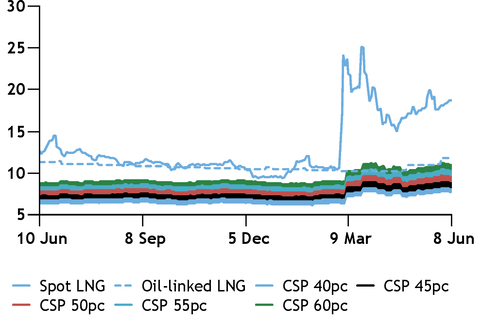
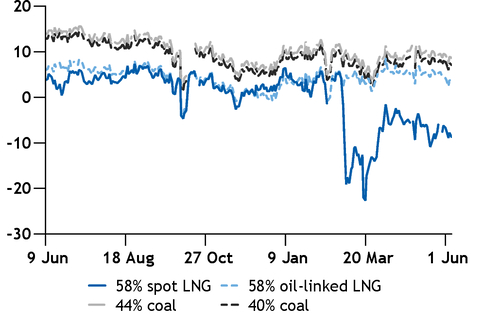
The dynamic between thermal coal and LNG in South Korea's energy mix is more relevant than ever in the wake of the Mideast Gulf war, with surging prices, supply disruptions and evolving government policy all dictating the shape of South Korea's electricity generation.
Generation margin advantage
Coal has maintained substantial cost advantages over gas-fired generation since the US/Israel-Iran war began. On 6 March, thermal coal generation costs in South Korea were estimated at 75.83 won/kWh, compared with W216.22/kWh for LNG.
Argus' NAR 5,800 kcal/kg thermal coal assessment rose by $19/t to $115.63/t cfr South Korea on 6 March, while northeast Asia (ANEA) front-month spot LNG prices more than doubled over the same period to $23.665/mn Btu from $10.715/mn Btu .
April: Full switching to coal
In April, South Korea demonstrated substantial fuel switching away from gas to coal. South Korean coal burn averaged 15GW in April, up by 42pc from around 10.6GW in 2025. Gas generation was down by 6.2pc, equivalent to an LNG demand cut of approximately 110,000t.
This marked the first full month without any Qatari LNG deliveries following the outbreak of the Middle East war.
May-June: Persistent coal support, constrained gas burn
Despite ongoing government efforts to preserve LNG stocks, coal's dominance continued. Gas-fired output fell to 15.9GW for the rolling four-week average over 27 April–24 May 2026, down by 4.4pc on the year, while coal-fired output rose by 16.5pc to about 15GW over the same period.
However, at least six LNG cargoes were diverted to South Korea in May, signalling spot demand driven by summer temperatures.
Structural constraints on fuel switching
South Korea's ability to fuel-switch away from gas is constrained by persistent grid bottlenecks. New renewable, nuclear and coal-fired power plants in coastal areas lack sufficient grid capacity to transfer power to urban demand centres.
This structural constraint has kept a higher floor for gas-fired output, particularly during off-peak hours.
Coal's balancing role
During the spring shoulder season (typically March–June), South Korea implements countermeasures forcing generators to run coal-fired units at minimum levels to maintain grid stability.
Coal-fired plants require higher minimum stable output than gas-fired units, making them far less flexible when solar output spikes in the middle of the day. As a result, gas-fired plants have been relied on as the main balancing power source during peak renewable generation hours.
Policy and energy transition
The South Korean government previously pledged to phase out coal entirely by 2040 but shifted to a more flexible stance following Middle East energy disruptions.
By 14 April, the government signalled the possibility of delaying its coal exit plan in response to the war in the Middle East, although it simultaneously reaffirmed its commitment to expand renewables to 100GW by 2030.
Near-term outlook and summer 2026 demand
South Korea is forecast to experience a hotter-than-normal summer in June–August, with its meteorological agency indicating over a 50pc chance of above-average temperatures. This could increase power demand and LNG requirements. But the country faces tighter structural supply dynamics.
Nuclear availability is scheduled to fall to 19.4GW in June–August from 20.1GW a year earlier, assuming the Wolsong reactors under maintenance stay off line.
Coal-fired capacity will gradually return from maintenance, with 4.7GW set to have returned by the end of May, but this will only partially offset the government's ability to switch away from gas.
Gas tariff and electricity price pressures are likely to persist, encouraging continued reliance on coal where operationally feasible.