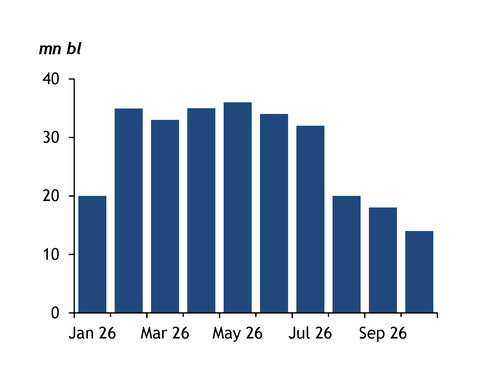
Brazilian and Guyanese grades are outperforming west African crudes in terms of price and volume in Europe and China, with the potential to turn west African crude into arbitrage rather than base-load supply in its key markets.
Brazilian and Guyanese output has been ramping up in recent years — combined exports have risen by roughly 500,000 b/d from 2025 to 3.28mn b/d this year, trade analytics firm Vortexa data show. The higher production has weighed on prices for Latin American crude, and differentials for Brazilian crude have been particularly pressured in recent weeks due to weak spot demand from key buyer China — leaving extra supply for Europe.
Chinese refiners cut their buying of Brazilian crude by more than a third for August and September delivery compared with previous months, Argus deal tracking shows, and buying has remained slow for October arrivals. If those cargoes draw a blank in China, sellers are likely to try to offer them in Europe — for September delivery, due to the shorter voyage.
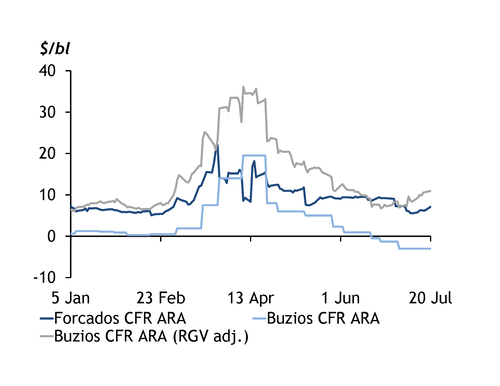
This rising amount of Latin American crude competes in its main export markets — Europe and China — with more established west African grades. Most of the time, Latin American crude is cheaper than west African shipments. Medium sweet Buzios on average has been $5.50/bl cheaper than Nigerian Forcados on a delivered-northwest Europe basis over the past year.
"Brazilian crude is way cheaper, but the gross product worth of Nigerian crude is better in this market because of higher diesel yields," a European trader says. Argus refinery gate values show that Forcados is currently around $13/bl more valuable than Buzios in terms of products output, leaving refiners having to choose between optimising runs or having lower feedstock costs. The latter often wins out. European imports of Brazilian and Guyanese crude have risen by 135,000 b/d from last year to roughly 1mn b/d this year, whereas its west African imports have fallen by around 115,000 b/d over the period.
Shifting cycles
The rising supply of cheaper Latin American crude is not only starting to oust west African crude from its core market, but is also forcing it to trade more promptly. It is increasingly common for unsold prompt west African cargoes to accumulate even as producers release fresh loading programmes for the following months. Roughly half of the Nigerian programme for August had yet to find a home in late July, when September dates were already emerging. Producers hotly contest that this is an "overhang". The cargoes still find a buyer, but only once refiners have covered the bulk of their requirements through the forward trading markets. As of late July, a European refiner can lock in a cargo of Buzios for September arrival that is roughly $10/bl cheaper than Forcados, and revisit west African purchases in a couple of weeks.
Angolan and Congolese crudes that mainly go to China have also been trading more promptly in recent months, although to a lesser extent than Nigerian grades. Subdued Chinese demand only partly explains the delay, as plentiful and cheaper Latin American supply gave refiners the flexibility to delay west African crude purchases. "There is a strong link between west African and Brazilian crude in the Chinese market. Buyers usually use delivered Brazilian prices as a reference to calculate [economical] west African fob levels," a Chinese trader says.
This slow but consistent shift means that west African grades are at risk of becoming arbitrage supply sources in their core markets, while Brazilian and Guyanese grades meet their base-load requirements. But this might change if the strait of Hormuz remains largely shut, and global supply dries up.