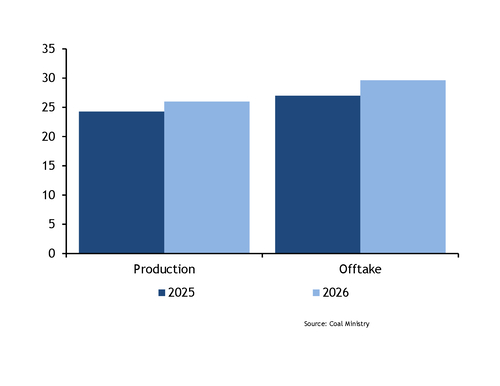
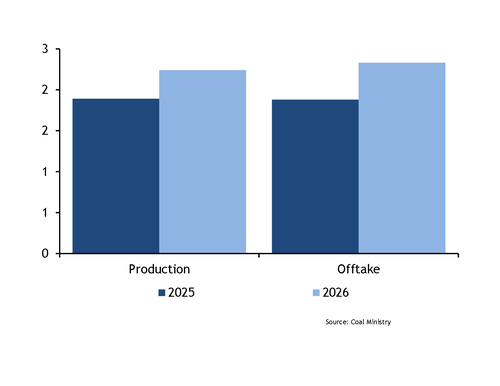
India's coal output and supplies rose in the first half of September as rainfall eased and operating conditions improved across key mining regions, with the higher domestic availability likely to help utilities replenish stocks and weigh on imported coal demand.
Coal India (CIL), which accounts for about three-quarters of India's domestic coal output, produced 25.98mn t during 1-15 September, up by 7pc from a year earlier, while its supplies rose by 9.7pc on the year to 29.62mn t, according to the latest government data. Fellow producer Singareni Collieries (SCCL) increased production by 18pc on the year to 2.24mn t and dispatches by 24pc to 2.33mn t during the period. The gains at CIL and SCCL are likely to have supported broader growth in Indian coal production and supplies, with captive and commercial mines contributing to additional domestic volumes.
The recovery in domestic coal supplies after recent disruptions could temper buying interest in the seaborne market as the higher domestic availability comes at a time of elevated international coal prices. India could import 12.54mn t of seaborne coal in September, up from 12.15mn t a year earlier, according to Kpler estimates. Indian buyers looking for post-monsoon cargoes have also largely retreated from the seaborne market after a sustained increase in prices in recent weeks led by tighter supplies. Argus last assessed low-calorific value Indonesian GAR 4,200 kcal/kg coal at $76.45/t fob Kalimantan on 11 September, its highest level since February 2023.
The increase in domestic supplies follows a drop in August, when India's coal production fell by 3.8pc on the year to 66.87mn t, weighed down by a 5.7pc decline in CIL output to 47.52mn t. National coal supplies rose by 5.5pc to 81.87mn t last month as producers drew on pithead inventories to maintain deliveries to utilities and industrial consumers.
India's coal ministry has attributed the early-September recovery in coal supplies to receding rainfall, which improved mine conditions, coal handling and transport routes. But authorities continue to monitor the domestic coal position, with the India Meteorological Department (IMD) forecasting intermittent rainfall in coal-bearing states including Odisha and Chhattisgarh. The IMD projects that seasonal rains could continue to recede and the withdrawal of the southwest monsoon from parts of western India could start from around 19 September.
The push to raise coal output and supplies is part of efforts to rebuild utility inventories ahead of the seasonally stronger October-December demand period, especially as higher power demand has eroded the nationwide utility stocks.
Coal-fired generation rose by 20pc on the year to 55.9TWh during 1-15 September, while overall electricity generation excluding renewables increased by 16pc to 73TWh, according to Central Electricity Authority (CEA) data. The growth in coal-fired output outpaced the increase in domestic coal production, underscoring the slow pace of stock replenishment at the utilities.
Thermal power plant coal stocks fell to 24.04mn t as of 14 September from 29.12mn t at the end of August and 50.05mn t a year earlier, the CEA data said. The number of plants holding critical stock levels increased to 66 from 51 at the end of August and 15 a year earlier, CEA data show. Stock levels are classified as critical when coal inventories fall below one-quarter of prescribed stock norms. Such stock requirements vary by plant location and distance from coal mines, although for a typical pithead plant the threshold is equivalent to roughly 3-4 days of consumption.
Imports
Utility coal imports fell by 13pc on the year to 16.83mn t during April-July, from 19.28mn t a year earlier, according to the latest CEA data. The decline was driven by lower receipts of imported coal at plants blending imported coal with domestic fuel. Such imports fell by 37pc on the year to 2.61mn t during April-July from 4.16mn t a year earlier.
Imports by the country's 17.77GW imported-coal-based fleet rose by 30pc on the year to 4.08mn t in July from 3.15mn t a year earlier, lifting total utility coal imports in July to 4.55mn t from 4.02mn t a year earlier. Imported coal-fired capacity accounts for about 8pc of India's overall coal-fired generation capacity. Receipts by blending plants fell by 45pc on the year to 478,000t in July, highlighting lower reliance on imports.
The gap between growth in coal-fired generation and domestic coal supplies could provide limited support to imported coal demand heading into the peak demand period ahead of the winter. Delhi has shown little appetite to revive directives requiring imported coal blending, while emergency measures supporting generation at Tata Power Mundra's 4GW plant are due to expire later this month unless renewed. Additional buying interest could also emerge following force majeure declarations and reduced deliveries from some Indonesian suppliers. Large low-calorific value coal producer Bayan Resources recently declared force majeure citing production quota issues, prompting at least one Indian end-user to secure replacement cargoes from South Africa and alternative Indonesian suppliers.
Demand from cement producers for high-CV Indonesian coal has also emerged as buyers seek alternatives to US fuel-grade petroleum coke and high-CV NAPP coal, both of which have risen to multi-month highs in recent weeks.