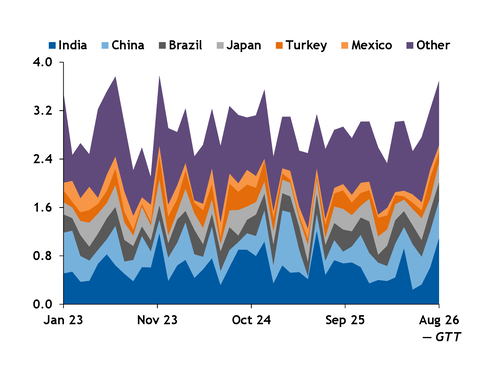
US green petroleum coke exports hit a 32-month high in August, jumping by 28pc on the year after favourable margins as a result of the Mideast Gulf conflict led refiners to maximize runs.
US green coke exports totalled 3.7mn metric tonnes (t) during the month, a sharp rise from the 2.9mn t a year earlier and 3.2mn t in July, according to US customs data compiled by Global Trade Tracker (GTT). This was the highest volume of US coke exports since December 2023, well surpassing July's 19-month high.
A rise in US coke output likely contributed significantly to higher exports in August. Coke production in the US has increased year over year every month from April-July, the latest data available from the US Energy Information Administration show, hitting a 20-month high in May. The US Gulf coast, the country's largest coke exporting region, largely led this rise, with production in the region growing by 9pc on the year in the April-July period.
In addition to the Iran war-driven increased fuel export demand driving strong refinery runs, US Gulf refiners were also spurred to run heavier crudes because of the shift in the oil trade relationship between Venezuela and the US this year. Higher availability and deeper discounts for heavy crude have led US Gulf refiners to boost coker utilization as they strive to maximize diesel output. US high-sulfur fuel oil prices also hit multi-month lows in June, which may have led more refiners to use this material as a coker feedstock and further contributed to higher coke production.
India was the US' largest export destination with 1.1mn t in August, up by 51pc on the year and by 81pc from a month earlier. This was the highest volume of US-origin coke loadings for India since June 2025. Many Indian cement makers returned to the seaborne petroleum coke market in June, when some August-loading cargoes would have been booked, after coke regained a discount to coal for the first time in 2026. An ongoing lack of Saudi Arabian coke supply has also continued to support Indian demand for US coke.
Shipments to China also jumped, rising by 86pc from the prior year and by 4pc on the month to 619,500t, despite fears surrounding a ban on greater-than-3pc sulfur imports into the country. A change in crude slates at Chinese refineries over the summer cut the country's high-sulfur coke production, which contributed to greater import demand — even with uncertainty surrounding new environmental standards that were set to take effect in mid-August. An unplanned outage also slashed coke production at the 400,000 b/d Saudi Aramco/Sinopec Yasref refinery in Yanbu, Saudi Arabia, in early July, while slow loading hindered Venezuelan coke exports, further tightening high-sulfur supply in China.
US coke loadings for Turkey fell in August, despite a greater coke-to-coal discount starting in mid-June. Exports totaled 165,600t, down by 23pc from the same month in 2025 and by 53pc from July. Several Turkish cement producers were heard to have purchased coke cargoes in June, but it is likely that many of those cargoes would have loaded in July. And some buyers seek at least a 20pc discount to coal, but cfr Turkey 6.5pc sulfur coke only averaged a 5pc discount to NAR 6,000kcal/kg coal on a delivered Turkey basis across June and July.
Exports to Latin American countries totalled 596,600t, up by 15pc year on year but down by 15pc from July. The US shipped 302,600t to Brazil, a year-on-year rise of 7pc but a decline of 11pc from the prior month.
The US loaded 107,200t of coke for Mexico, up by 17pc from a year earlier but down by 18pc on the month. Still, US exports to Mexico may dip in full-year 2026 because of higher Mexican coke production, especially with the recent startup of a coker at state-owned Pemex's 315,000 b/d Tula refinery.