India's thermal coal imports are set to rebound in October as record coal-fired generation and stronger post-monsoon industrial demand lift coal consumption in the world's second-largest importing country.
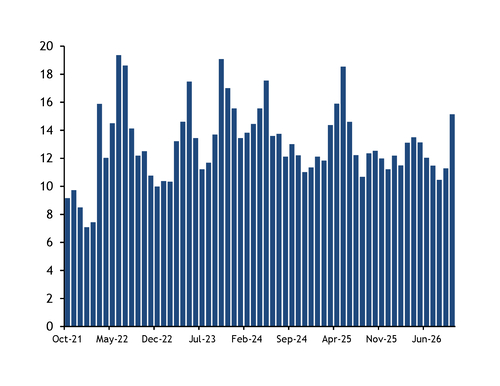
The country is estimated to import 15.06mn t of thermal coal, the highest since May 2025 when receipts totalled 18.54mn t, according to estimates from trade analytics firm Kpler. October imports could rise from 12.54mn t a year earlier and 11.29mn t in September to the highest for the month in three years. This would mark the first year-on-year increase since January, Kpler data show.
The rebound comes as India's coal-fired generation has reached a record for the month so far, drawing down inventories as coal burn outpaces domestic deliveries, while demand from industries including cement and sponge iron remains strong.
The October receipts predominantly reflect cargoes booked in late September and early October, when Indian buyers began aggressively seeking post-monsoon supplies despite prices reaching multi-year highs. Argus assessed GAR 4,200 kcal/kg coal for Supramax cargoes at $78.48/t fob Kalimantan on 23 October, little changed from a three-and-a-half-year high of $78.63/t on 16 October.
The rebound in buying reflected restocking demand as well as stronger post-monsoon consumption from the non-power sector ahead of the festive and winter seasons.
Cement makers are looking for coal cargoes as feedstock because of higher petroleum coke prices, while sponge iron makers eye high fixed-carbon coal, mainly from South Africa. Cfr India 6.5pc sulphur coke rose for the 15th consecutive week to $187.50/t on 21 October, making domestic as well as coal from regions including Asia and Africa attractive.
Power sector demand
Power sector coal consumption has surged, with nationwide coal-fired generation reaching 86.27TWh over 1-22 October, up by 27.6pc on the year and 9.4pc above the previous high for the period in 2023, according to data from the Central Electricity Authority (CEA).
Utility coal imports have been supported by demand from plants designed to run on imported coal, which have a combined capacity of 17.77GW, representing around 8pc of India's coal-fired generation capacity. Demand from domestic coal-fired utilities for imported coal for blending has remained weak in the absence of a fresh government directive, increasing reliance on inventories in recent weeks. Elevated coal burn has weighed on authorities' efforts to rebuild inventories ahead of the festive and winter seasons.
Combined stocks at Indian power plants reached 19.93mn t as of 25 October, sufficient for about six days of consumption against a norm of 19 days on an average depending on plant location, compared with 44.58mn t in mid-October last year. Combined stocks were down from 20.78mn t on 30 September, but several domestic coal-fired plants were facing severe shortages. The number of plants holding less than 25pc of their normative stocks, which the CEA classifies as critical, rose to 98 from 15.
Power sector demand has also been supported by weak hydropower output, which fell by 16.4pc on the year in September and is tracking lower in October.
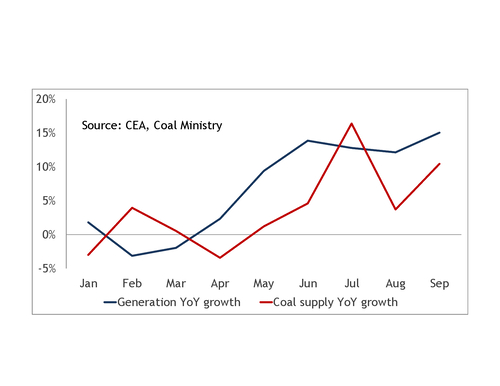
Coal-fired generation in September, by comparison, rose by 15pc on the year. Coal supplied 69pc of electricity over 1-22 October, more than four times the contribution from renewables combined, CEA data show. Coal met more evening demand as solar generation faded and wind continued to decline, and a month-on-month drop in gas-fired generation, while farm sector power demand increased.
Power sector coal demand could remain firm if warmer weather persists.
Strong El Nino conditions are expected to continue into early 2027. The World Meteorological Organization expects sea temperatures in the Nino 3.4 region to be around 3.7°C above normal in October-December, with El Nino strengthening towards a December peak and likely persisting through February 2027.
Supply
India's coal-fired generation rose by 6.6pc on the year to 1,021.36TWh during January-September, while domestic coal dispatches to the power sector increased by just 3.4pc to 636.39mn t over the same period, according to Argus analysis based on CEA and coal ministry data.
The divergence indicates that growth in domestic coal deliveries has lagged the rise in coal-fired generation, contributing to the drawdown in utility inventories.
Monsoon rains exacerbated the supply constraints, disrupting coal logistics and flooding some mines, while railway loadings also declined. Authorities are working with coal producers and the railways to accelerate coal evacuation and transportation from mines. State-controlled producer Coal India (CIL) said it had 67mn t of pithead inventories as of 30 September to meet any demand surge, while output and dispatches from its mines continue to recover.
Tighter domestic availability was also reflected in CIL's September spot e-auctions, where premiums averaged 94pc over notified prices, compared with 59pc in August, as industrial buyers competed for supplies.
Domestic supply should improve in the fourth quarter, typically a stronger period for coal production, but it remains uncertain whether supply growth will catch up with demand, a trader said, pointing to the possibility of steady imports in the months ahead.