

Who gets past the velvet rope for 2027 US steel supply?
US steel buyers face tighter 2027 contract supply, lower discounts and rising costs. Read up about market sentiment collected in a recent webinar survey.
Author

Michael Fitzgerald
At a glance
- Securing enough domestic steel supply is becoming a key challenge for US buyers negotiating 2027 contracts.
- Domestic mills hold greater leverage, with buyers expecting higher prices and less favourable contract terms.
- Webinar participants expect sheet contract discounts to fall significantly in 2027, increasing effective steel costs.
- Buyers may also face higher grade, gauge, width and freight charges as mills optimise product mix.
- Survey respondents ranked transparency and visibility into market activity as the most important factors in steel pricing.
The hottest club next year is shaping up to be the group of buyers who can secure the contract supply they need from domestic mills. The problem is that getting past the velvet rope in 2027 looks increasingly difficult. Steelmakers control the guest list and cover charges are rising.
Steel buyers in the US market have rarely faced the risk of being unable to secure sufficient steel to meet demand. The market has dealt with periods of constrained supply and elevated prices, but those have typically been temporary, following the ebb and flow of supply and demand.
The domestic steel market is now in uncharted waters, with prices steadily rising over the past year and no immediate relief in sight. This means buyers are scrambling to secure 2027 contracts, while domestic mills hold the leverage.
From the mills’ perspective, this is not just about restructuring terms to secure more favorable pricing, it is also an opportunity to build a contract portfolio with an optimized product mix that maximizes production value. But buyers have spent all of 2026 dealing with late domestic deliveries, the loss of Canadian and Mexican supply because of tariffs, and the challenge of rebuilding international supply chains amid chaotic trade policy. This means they are concerned about finding enough supply to cover their needs next year.
For service centers or manufacturers on the mills’ guest list for 2027, many said the immediate goal is simply to get through the door. Once inside, they expect everything to be more expensive than it was 12 months ago.
The most talked about change is the discount — the most widely used mechanism in index-linked sheet contracts. It is a percentage or dollar amount off the published index that mills are willing to commit to in exchange for customers guaranteeing tonnage on a monthly or quarterly basis.
Discounts on US contracts have become somewhat distorted over the years. In theory, larger buyers that commit to more tons should receive a larger discount than smaller customers. In practice, discount levels have largely coalesced around 6-10pc, depending on the product and market.
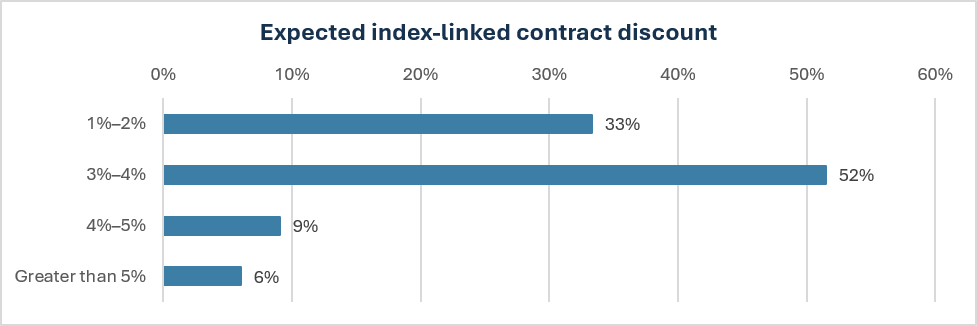
But in a recent Argus webinar expectations for 2027 discounts shifted dramatically.
Source: Argus Media
Most participants expect significantly lower discounts in 2027, based on feedback during the webinar. The effect of those cuts is amplified by the current high-price environment for steel.
View survey results infographicFor example, the Argus Steel Index US hot-rolled coil price on the second Tuesday in October was $1,285.25/st. The second print of the month is the typical settlement price used in monthly index-linked deals. A buyer with a 7pc discount in 2026 would pay a net contract price of $1,195.28/st. But if the discount were reduced to 3pc, the net price would rise to $1,246.69/st — a swing of more than $50/st.
That impact is compounded across thousands of tons and by higher interest rates.
Those buyers that do manage to get past the bouncer and agree to the reduced discount then face the prospect of higher grade, gauge and width extras, along with higher freight costs. This goes back to domestic mills’ efforts to optimize their product mix.
The advantage of being more selective with customers is the ability to determine which orders run best through the mill. For buyers, that selectivity should spur creativity, not only in finding supply but also in determining how it will be priced.
The US market has relied heavily on indexation for more than 20 years. As supply has become more closely tied to contractual agreements, the overall spot market has shrunk. The general approach to indexation has barely changed over that period, despite growing concerns about how much spot data is collected in a given week to set the price for the majority of sheet steel tons transacted in the US.
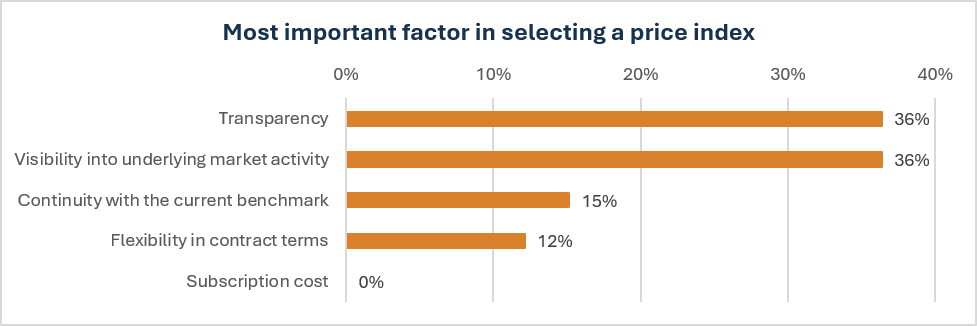
That point was reinforced by the webinar survey. Respondents placed the greatest value on transparency and visibility into underlying market activity. Those qualities become especially important in a market where fewer tons may be available under traditional contract structures and buyers are being asked to accept materially different terms.
Source: Argus Media
As market dynamics create the possibility of a significant restructuring of contract portfolios, there is also an opportunity to rethink the approach to indexation.
The Argus Steel Index US methodology does not just provide the market with another set of published prices for sheet products, it also gives users the numbers behind the numbers.
Transparency and visibility into how many tons are being traded, average order sizes and the composition of weekly data are all available through Argus. This not only helps build trust in our pricing, but also provides flexibility in contract terms. Market participants can use liquidity tests in their terms to ensure that contract settlements are based on sufficient data. At Argus, we cannot change how a market trades, but we want the market to know what is trading.
Getting past the velvet rope will be the first challenge for buyers in 2027, but both parties can have a say in how the cover charge is calculated. The US Argus Steel Index approach give buyers and sellers another option to structure contracts around transparent pricing and market liquidity.
At a glance
- Securing enough domestic steel supply is becoming a key challenge for US buyers negotiating 2027 contracts.
- Domestic mills hold greater leverage, with buyers expecting higher prices and less favourable contract terms.
- Webinar participants expect sheet contract discounts to fall significantly in 2027, increasing effective steel costs.
- Buyers may also face higher grade, gauge, width and freight charges as mills optimise product mix.
- Survey respondents ranked transparency and visibility into market activity as the most important factors in steel pricing.


