
Argus US Electricity
Physical electricity price assessments for more than 25 North American trading hubs, covering peak, off-peak, and forward markets.
Overview
Argus US Electricity is a price reporting service covering physical electricity markets at more than 25 North American trading hubs. It provides day-ahead assessments for peak and off-peak hours, forward curves, heat rates, and generation margins across eastern, southern, midcontinent, and western US markets — used by power traders, risk managers, and industrial companies to benchmark prices and manage exposure to North American electricity markets.
At a glance
- Assessments across 25+ North American hubs.
- Peak and off-peak prices for each business day.
- Forward curves for short- and long-term planning.
- Heat rates and spark spreads by location.
- Supports trading, benchmarking, and risk management.
- FERC-approved methodology and transparent reporting.
Request trial access
Key features

Day-ahead assessments
Argus assesses day-ahead electricity prices for peak and off-peak hours at more than 25 North American trading hubs, published each business day by 14:30 EST.

Volume-weighted averages
Western markets including Mid-Columbia, Palo Verde, COB, NP-15 and SP-15 are assessed using volume-weighted averages of at least three validated transactions of 25MW or more.

Non-western market coverage
Non-western hub assessments are determined using a low-high range informed by ISO/RTO prices, validated transactions, historical correlations, and known market fundamentals.

Forward curves
Forward curve data supports short- and long-term exposure management across North American power markets, enabling contract valuation and strategic planning decisions.

Heat rates and spark spreads
Argus calculates heat rates and gas spark spreads by location, linking electricity and natural gas markets to support generation margin analysis and trading decisions.

Calculated assessments
Prices in select markets are calculated using heat rates and natural gas prices. Each electricity market links to a defined primary gas hub for consistent cross-market analysis.
How Argus assesses US electricity markets
-
Timing of assessments
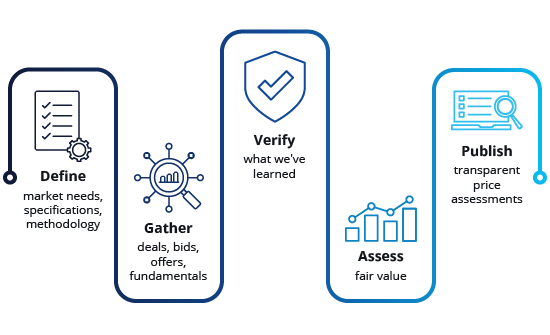
Assessments reflect trade concluded, or that could have been concluded, from the start of the trading day until 14:30 EST. -
Western market methodology
Western markets use volume-weighted averages when Argus validates at least three transactions of 25MW or more at each assessed hub. -
Non-western market range
For non-western hubs, Argus sets a low-high range using ISO/RTO prices, gas costs, heat rates, and known market fundamentals. -
Heat rates and spark spreads
Argus calculates heat rates and spark spreads per location, linking each market to a defined primary natural gas hub. -
Transaction verification
Reporters apply primary tests to all transaction data, verifying price, volume, location, and counterparty before inclusion in assessments.
Who uses this service
Power traders
- Access prior-day forward curves as a daily reference when entering the market.
- Identify locational and temporal spread relationships using validated historical data.
- Support trading decisions with day-ahead peak and off-peak price assessments.
Risk managers
- Validate forward curves against counterparties using independent third-party data.
- Benchmark internal valuations against transparent, methodology-based assessments.
- Manage exposure to North American electricity markets with reliable price data.
System and transmission operators
- Plan and value current and future electricity operational requirements.
- Use day-ahead assessments to support grid management and scheduling decisions.
- Access assessments across eastern, southern, midcontinent, and western US markets.
Industrial companies and power generators
- Secure fixed prices for fuel inputs to clear the market or retain customers.
- Benchmark process engineering and supply chain position against power market prices.
- Track market-wide electricity prices to support operational and procurement planning.