

German Power Demand From Cooling Heats Up
Explore insights on how rising temperatures and increasing air-conditioning use are reshaping Germany’s power demand and summer market outlook.
Germany’s 2026 summer heatwaves boosted power demand by 1.1GW year on year, highlighting growing sensitivity to high temperatures. Rapid growth in air-conditioning sales, imports and installations is increasing cooling demand, particularly during evening and nighttime hours. While solar expansion helped limit midday demand growth, stronger cooling is reshaping demand patterns and could drive a structural rise in summer power consumption, supporting German power prices in 2027.
Having just recorded one of its hottest summers in history, Germany — whose power demand has historically not responded to high temperatures — showed signs that it is becoming increasingly heat-sensitive in its power consumption. Air-conditioning market data suggest this may become even more pronounced next summer, which could support German summer power prices.
German power demand over June-August climbed by about 1.1GW on the year to 49.9GW, in part owing to above-average temperatures and unusually frequent heatwaves.
Maximum temperatures in Berlin, Munich and Essen were 1.76°C above average over the three months. And western Europe experienced the hottest June-July on record, according to EU earth-monitoring programme Copernicus. Demand in June-July was more than 1.5GW up on the year, recording the highest year-on-year demand increase of the summer months.
Demand and heat go increasingly hand in hand
Power demand in Germany in June-August — excluding weekends — posted increasingly positive sensitivity to maximum temperatures in Essen compared with 2023-25 (see chart).
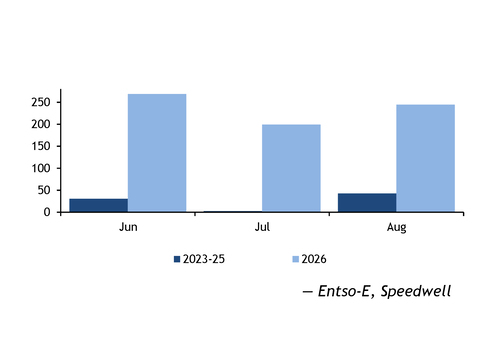
German demand sensitivity to Essen maximum temperatures, summer 2026 vs 2023-25 MW/°C
Linear regression analysis shows the slope coefficient becoming more firmly positive, indicating that each additional degree Celsius this summer corresponded with a larger increase in demand than in the previous three June-August periods.
In addition, the regression's R² value, which measures how much of demand variation can be explained by temperature, rose to a June-August high this year for 2023-26.
Germany's air conditioning market booms
The German AC market has shown a clear upward trend since 2023, according to data from Eurovent Market Intelligence.
Between 2024-25, Sales of monosplit AC units in Germany grew by about 3.4pc, while multisplit AC unit sales increased by 9pc. Indoor AC unit sales also grew strongly, up by 10pc over the same period, Eurovent told Argus.
And member companies at German air conditioning association VDKF reported 200-300pc more enquiries than usual from private and commercial consumers this summer, the association told Argus. "We are already experiencing and expect a stronger demand for air conditioning systems in the future," VDKF said.
German statistical office Destatis data show that imports of AC in buildings grew by 77.6pc in value in 2016-25 to €1bn last year, while production of AC units climbed by 66pc in 2019-25 to just under 300,000 units last year (see chart), with AC production in 2024 and 2025 almost double that of 2019-23.
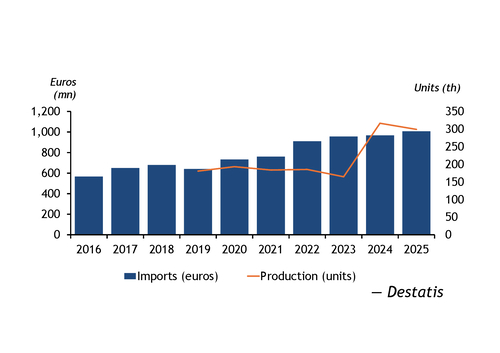
2016-25 imports, 2019-26 production air conditioning systems €mn
And the value of total air conditioner imports reached record highs in April-May, while June imports were just narrowly below the record levels of June 2020 and 2023 (see chart). Imports of AC typically peak in the second quarter, Destatis 2016-25 data show.
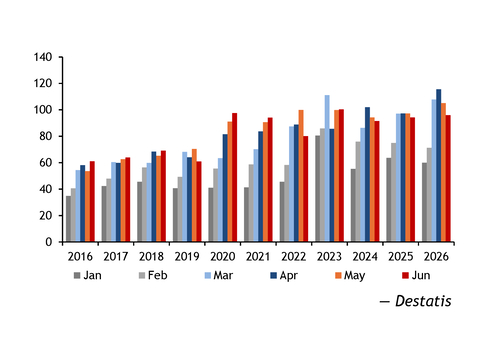
Imports of air conditioning systems Jan-Jun 2016-26 €mn
Cooling-system installations in newbuilds have also increased in recent years, rising to about 4.3pc of new residential buildings in 2025 — or 58,885 buildings — up from just 1.9pc in 2015, Destatis data show. And the share of new office buildings equipped with air conditioning climbed to 37.8pc in 2025, from 30.9pc 10 years earlier.
Combined growth in sales, import value, production and newbuild installations points to increasing interest in use of air conditioner installations in Germany, which should lift power demand during hot weather.
Nighttime demand rises fastest as solar cushions daytime demand
Demand in all hours in June-August was higher on the year, with the increase the weakest between the 10:00-18:00 midday solar peak, averaging a year-on-year rise of just 366MW. And 2026 demand was higher in all hours outside of the 10:00-18:00 period (see chart) compared with the 2023-25 June-August average. The hours of 19:00-08:00 recorded the fastest increase this year compared with 2023-25.
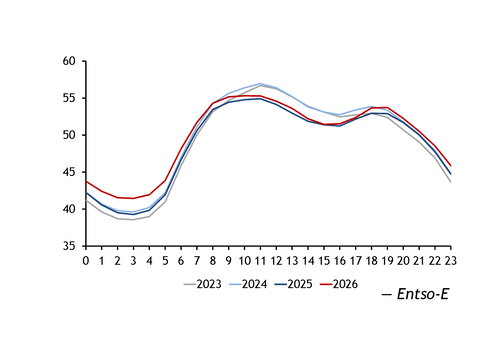
Daily demand profile for Jun-Aug, 2023-26 GW
While more cooling would be expected to lift demand across all hours compared with previous years, rapidly growing solar capacity likely cushioned the midday demand increase in June-August, as behind-the-meter solar capacity tends to reduce recorded grid load because of self-consumption. Germany recorded an approximate 17GW buildout of solar capacity between July 2025 and July 2026 alone, according to data from grid regulator Bnetza, with rooftop and balcony systems making up nearly half of the capacity installed so far this year.
And lower consumption from energy-intensive industrial actors likely also weighed on daytime demand. The latest production index for energy-intensive manufacturing sectors by German statistical office Destatis was at 80.6 for July, down slightly from last year and significantly lower than July 2023-24.
But the fact that the nighttime demand spike diverged from industrial production trends indicates factors beyond industrial activity contributed to the higher demand in 2026, pointing to stronger cooling. Several market participants surveyed by Argus agreed that higher cooling demand played a significant role in the year-on-year rise in German demand this summer.
Meanwhile, the daily profile of the year-on-year increase in German consumption has broadly followed that of France — which has stronger cooling demand — where demand in June-August was up by nearly 1.2GW on the year, also owing to hot weather, with the strongest increases also occurring during non-solar hours.
Consistently higher cooling could lead to a structural shift in German summer demand, narrowing the gap between the morning and evening demand peaks. June-August demand over 2023-25 was typically highest over 09:00-13:00, averaging 55.6GW, while the evening demand peak over 17:00-21:00 was about 3GW lower. The gap between the morning and evening peak demand periods narrowed significantly this year, with 17:00-21:00 demand only roughly 2GW below the 09:00-13:00 period.
In June-July, the demand gap between the 09:00-13:00 and 17:00-21:00 periods narrowed to only about 1.6GW, down from more than 3GW in June-July 2023-25.
Cooling could support summer prices
Stronger sensitivity in power demand to temperatures, fuelled by higher air conditioning use, could support summer 2027 prices, especially if Germany again sees an unusually warm summer.
Record-breaking heat could continue into next year, according to the World Meteorological Organisation (WMO), with the El Nino pattern expected to peak in late 2026, increasing the likelihood of above-average global temperatures in 2027. El Nino events typically "exert their strongest influence on global temperatures during the year following their onset", the WMO said in July. But Energy Weather chief executive Robin Girmes was more cautious about the impact El Nino will have on Europe next summer. He expects much of Europe to be "clearly less warm" next summer than in 2026, although he currently estimates parts of Germany may be slightly warmer than average over June-August.
Market participants surveyed by Argus were mixed on the extent to which expectations of higher cooling demand are already being priced into 2027 summer quarters, stating that it is too early to already price in high demand expectations.
Next year's summer quarters have broadly tracked gains in gas to the same extent as the front-winter quarters since 1 June. The second and third quarters of 2027 have risen by 30.7pc and 24.9pc, respectively, compared with 40.8pc and 36.2pc increases in the German THE gas equivalents. Meanwhile, the power front-winter quarters have risen by 34.7pc and 38.5pc, respectively, compared with 50.3pc and 52.8pc rises in the corresponding THE contracts since 1 June.
The market is likely to expect strong cooling demand again next summer, but drought risk and the possibility of nuclear outages across Europe may also support summer 2027 prices, one market participant said.
Given growing demand sensitivity to temperatures and steadily rising air conditioner installations, cooling demand could be significant again next summer. Stronger cooling could lead to a structural uptick in German summer demand, particularly during evening and nighttime hours, and support prices.
This blog has been created using data and analysis from Argus power services. Learn more.
Germany’s 2026 summer heatwaves boosted power demand by 1.1GW year on year, highlighting growing sensitivity to high temperatures. Rapid growth in air-conditioning sales, imports and installations is increasing cooling demand, particularly during evening and nighttime hours. While solar expansion helped limit midday demand growth, stronger cooling is reshaping demand patterns and could drive a structural rise in summer power consumption, supporting German power prices in 2027.


