The LPG industry can still help tackle GHG emissions from heating — one of the energy transition's biggest challenges, writes Waldemar Jaszczyk
The push to rapidly decarbonise heating in Europe makes the future of LPG's use in off-grid homes uncertain but not hopeless, expert panellists said during the LPG Week conference in Dubai this month.
The recent redrafting of climate and energy policy in the EU and the UK have sought to target greenhouse gas (GHG) emissions from the heating sector — considered one of the biggest challenges of the energy transition. Buildings account for 40pc of total energy use in Europe and generate around 36pc of energy-related GHG emissions. Getting buildings to move from more harmful fossil fuels such as heating oil or coal for heating, and eventually natural gas and LPG as well, faces two major hurdles — changing consumer habits, and the prevalence of old building stock with poor insulation, consultancy Gemserv's director of low-carbon Ilias Vazaios told delegates. Every household will need to be convinced to change their heating habits and incur the extra costs of installing a more efficient or renewable system, he said. And in the UK, around 50pc of residential and 39pc of non-residential buildings were built before insulation regulations were first widely introduced in 1970.
What must be avoided is a "one size fits all" approach to heating decarbonisation, particularly when it comes to rural, off-grid homes, panellists said. The UK's recently updated Heat and Buildings Strategy puts an end date for the installation of conventional boilers by 2026, to be replaced by heat pumps, despite the LPG industry's efforts to secure support for bio-LPG. Around 4mn, or 17pc, of UK homes are unconnected to a natural gas grid, and about 1.1mn of these use fossil fuels for heating, including LPG. The strategy's focus on phasing out fossil fuel use could mean an eventual loss of a 261,000 t/yr LPG market. The "direction of travel" in terms of UK heating policy "is clear and electrification will be one of the big winners", consultancy Delta-EE head of heating research Lindsay Sugden said.
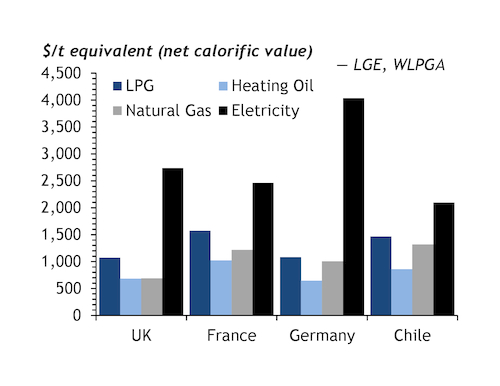
But affordability remains a critical issue often neglected in such proposals, panellists said. In Cork county, Ireland, the average cost of retrofitting heat pumps to the 85,200 off-grid rural households that use high-carbon fossil fuels would be about €56,000/home ($63,400/home), European LPG association Liquid Gas Europe president Esther Busscher said. Switching to lower-carbon alternatives such as LPG or bio-LPG would only cost around €5,000/home, she said.
Full electrification of building stock "is one of these things that seems like a great idea on paper, but when you start digging into it, some significant questions arise", UK heating system manufacturer Baxi's head of external affairs, Jeff House, said. Policy makers and the media must be educated on energy issues to prevent such unrealistic regulation, Chilean LPG distributor Empresas Gasco's chairmanMatias Perez Cruz said. A mixed-technology approach is needed to decarbonise rural homes in the most cost-effective way, panellists agreed.
Fair game
The process of moving the heating sector to net zero is "not a zero-sum game", Vazaios said. The importance of flexibility in the energy system is growing as people recognise that 100pc electrification is not possible. Using LPG in decarbonising heat for off-grid homes either as a standalone system or deployed as part of a hybrid heat pump could support off-grid households where local power generation capacity constraints exist, panellists said. LPG could eventually be replaced with bio-LPG, particularly in larger buildings with higher heating needs. But policy makers need to be aware that subsidies for LPG in decarbonisation will be needed, Busscher said.
The future of LPG in the heating sector is uncertain in Europe but the industry should not lose hope, delegates heard. If the LPG industry "can enable decarbonisation and provide a strong economic case for customers, it will have the potential for growth", Sugden said. But it must "adapt or face obsolescence", House said.