
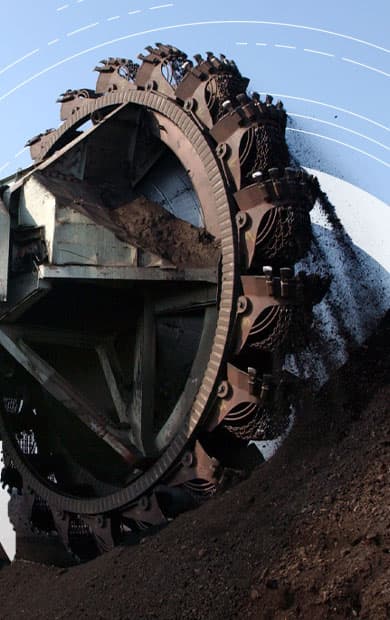
Carvão
Visão geral
Os preços globais do carvão térmico subiram para níveis recordes em 2022, vivendo volatilidade sem precedentes. Desde então, os preços começaram a cair à medida que os riscos associados ao fornecimento da Europa diminuíram. Em um nível global, a demanda por carvão permanece robusta, com a segurança do fornecimento subindo na agenda de muitos governos à luz da agitação geopolítica.
Na Europa, as sanções deslocaram a mistura de importação de carvão da região da Rússia para outros fornecedores. O ritmo de redução gradual das usinas de carvão na região deve aumentar nos próximos anos, com o papel do carvão na mistura de eletricidade se deslocando ainda mais para o uso de pico de carga, tornando o planejamento futuro mais desafiador.
Na Ásia-Pacífico, o carvão térmico continua sendo um pilar dos setores de energia e industrial. Os fluxos comerciais globais de carvão e os spreads de preços estão mudando, com fluxos de fornecedores-chave Rússia, Indonésia, Austrália, África do Sul, Colômbia e EUA penetrando novos mercados, em resposta à dinâmica de preços e barreiras comerciais.
Manter-se a par dos preços e fluxos, e de como os mercados de carvão se cruzam com outros índices de referência de energia e commodities, será fundamental nos próximos anos.
Últimas notícias
Navegue pelas últimas notícias do mercado sobre a indústria global do carvão.
Energy security backs stalled fossil fuel shift
Energy security backs stalled fossil fuel shift
The Hormuz crisis has sparked interest in quick wins that could also have long-term benefits, writes Caroline Varin Edinburgh, 23 October (Argus) — Talks on transitioning from fossil fuels are unlikely to progress in official UN Cop 31 summit negotiations in Antalya, Turkey. But energy security concerns resulting from the US-Iran war are keeping the topic firmly on the international agenda. Initiatives such as a global roadmap to move away from fossil fuels, which the Brazilian UN Cop 30 presidency will present at this year's Cop 31 summit, will largely be dealt with outside of negotiations where decisions are taken by consensus. Major fossil fuel producers, which pushed back on the topic in Brazil last year, argue the transition was sufficiently addressed at Cop 28 in 2023 and that negotiations should focus on cutting emissions and not their sources. Discussions have stalled since Cop 28 concluded with a historic agreement on fossil fuels . This year may not be the time for transition discussions to be included in official Cop negotiations, International Institute for Sustainable Development (IISD) senior policy advisor Natalie Jones says. Such talks would "toxify" agenda items and probably result in more deadlock, she says. "That is not to say that formal negotiations are devalued, but it's a realistic assessment of where we are at." Phasing out fossil fuels remains critical and will be discussed at Cop 31, Dutch climate minister Stientje van Veldhoven said, adding that more countries will announce plans in Antalya. But this will happen as part of the informal summit's action agenda, where stakeholders meet to advance implementation. Turkey and Australia — presiding over Cop 31 — highlighted the importance of transitioning away from fossil fuels, but have yet to lead by example. Australia is the world's second-largest coal exporter after Indonesia, while Turkey is the seventh-largest coal importer, according to the IEA. "It makes sense to strategically start to plan to overcome the issue of demand decline," IISD's Jones says. "Turkey and Australia could help to show the way. If there are no leaders that step up in this regard, I think it's going to be a real problem." Umit Sahin, head of climate change studies at the Istanbul Policy Centre, does not expect a push from Turkey towards major producers on the question of transitioning away from fossil fuels. "Turkey appears to have decided that [the topic] itself is not a place to go in the formal Cop negotiations and has decided to approach it through electrification — from an end-use point of view," he said. Energy crisis/opportunity But the energy security crisis stemming from the US-Iran war is supporting clean energy development because this field offers quick solutions that will ultimately benefit climate action, IEA executive director Fatih Birol says. Economies reliant on Middle East oil and gas scrambled to secure supplies and implement measures to mitigate disruption — energy conservation, direct subsidies and tax cuts, for example. The crisis has also sharpened political focus on electrification. The crisis is a lesson for consuming countries , and the resulting shift towards electrification will affect oil demand, TotalEnergies chief executive Patrick Pouyanne has said. The IEA puts the global demand reduction since the start of the conflict at more than 1bn bl, driven by steep declines in China . There will be no more turning back from clean energy, utility EDF UK's non-executive chair, Alex Chisholm, told the FT Energy Transition Summit earlier this month. This will not be enough to meet the Paris goals, Birol warned, although he said he is hopeful about an agreement on electrification at Cop 31. Turkey set a goal for its action agenda to increase electricity's share of final energy demand worldwide to 35pc by 2035 . But the call sits outside of formal negotiations. Arab countries have signalled that they see no need for a "universal" agreement under the informal action agenda. Send comments and request more information at feedback@argusmedia.com Copyright © 2026. Argus Media group . All rights reserved.
EU parliament wants three-year delay to methane law
EU parliament wants three-year delay to methane law
Brussels, 22 October (Argus) — The European Parliament today called for a three-year delay to monitoring, reporting and verification (MRV) obligations for importers under the EU's 2024 methane emissions regulation (MER), after the European Commission earlier this month proposed a one-year postponement. Parliament voted by a clear majority of 341 votes in favour, 225 against and six abstentions, signalling strong support for the three-year delay when negotiations on the final legal text start with EU member states. If adopted into law, parliament's proposal would also give crude, natural gas and coal importers until 31 May 2031 to ensure their supply contracts meet EU-equivalent MRV standards. EU producers and importers would also be required to report the methane intensity of their fossil fuels sold on the EU market by 5 August 2031, rather than by 5 August 2029 as earlier proposed by the commission. Parliament does not want to extend the proposed delay to imports from countries under EU sanctions. Parliament adopted its position under an urgency procedure. If no legal text is formally adopted before the end of 2026, MRV rules would automatically apply from 1 January 2027 for oil, gas and coal importers. Earlier this month, EU energy commissioner Dan Jorgensen urged parliament and EU member states not to make " other " demands for changes to the regulation. The three-year delay is an "absolute scandal", said German Green MEP Jutta Paulus, parliament's lead negotiator on the 2024 methane regulation. "It is utterly incomprehensible that, in the midst of an energy price crisis, gas should be needlessly flared or allowed to vent into the atmosphere," Paulus said. Oil and gas producers' association IOGP Europe called on EU states to follow parliament's lead and ensure a level playing field for domestic producers. A "rigid" one-year delay, as proposed by the commission, would only bring the industry back to the same situation 12 months later, IOGP said. Dafydd ab Iago Send comments and request more information at feedback@argusmedia.com Copyright © 2026. Argus Media group . All rights reserved.
New climate plans will not reach Paris targets: Unep
New climate plans will not reach Paris targets: Unep
London, 21 October (Argus) — Countries have submitted more than 100 new climate plans in the past year, but these will not deliver the greenhouse gas (GHG) emissions cuts required to reach global warming limits set out in the Paris climate agreement, the UN Environment Programme (Unep) said today in its Emissions Gap 2026 report. If current policies continue, there is a 66pc chance that global warming will reach 2.8°C by 2100, and increase after that, Unep found. The most optimistic scenario would limit warming to 2.1°C this century, but it relies on all climate plans — known as nationally determined contributions (NDCs) — being achieved and "similar efforts maintained", Unep said. The Paris agreement seeks to curb the global rise in temperature to "well below" 2°C above pre-industrial levels, and pursues a 1.5°C limit. A total of 124 countries, accounting for around 76pc of global GHG emissions, had submitted new NDCs as of 1 September, Unep said. This is up from 57 submissions covering 63pc of global emissions last year. The most recent round of NDCs would only cut global GHG emissions to 5-8pc below 2025 levels by 2030, Unep said. They would reduce GHGs by 11-15pc by 2035 and by 20-27pc by 2040, from the 2025 baseline, it added. The range refers to the conditionality of the NDCs — whether countries will implement the plans with no outside help or whether they need external technical and financial support. There is a "large and expanding emissions gap" of 5bn t/CO2 equivalent (CO2e) in 2030 and of 16bn t/CO2e in 2035 between the "full implementation of current conditional and unconditional NDCs and the lowest 1.5°C overshoot scenario", Unep said. The emissions gap refers to the distance between projected emissions from countries' NDCs and the reduction needed to hit Paris agreement goals. The gaps are 1bn t/CO2e and 5bn t/CO2e for 2030 and 2035, respectively, between NDCs and the "below 2°C scenario", Unep found. The gaps are wider if only unconditional NDCs are put into practice. But, owed to "decades of insufficient climate action", the world will overshoot the 1.5°C Paris goal , Unep said. "The opportunity to bridge the 1.5°C emissions gap with ‘no or limited' overshoot has been lost", it added. Unep cautioned that the emissions gaps outlined in this year's report "are not directly comparable with last year's report, which was benchmarked against scenarios that are now unachievable". There is an "unbridgeable gap" of 9bn t/CO2e between the lowest "overshoot" scenario and the level of emissions that would have met a 1.5°C target, it said. Global GHG emissions in 2025 stood at 58.4bn t/CO2e, with a range of 5.5bn t, preliminary data show, Unep said. This may be a decline on the year of 100mn t, but the "high uncertainty range" makes this difficult to conclude, Unep said. It does diverge from a decade-long trend of global emissions growth of 0.8pc/yr, Unep added. But CO2 emissions from fossil fuel combustion rose in 2025, with estimates ranging from an increase of between 0.4pc to 1.1pc on the year, Unep said. Countries agreed at the UN Cop 28 climate summit in 2023 to "transition away" from fossil fuels in energy systems. "Progress in transitioning away from fossil fuels and other emissions-intensive activities is lagging particularly far behind", Unep said. It expects the use of oil and gas to continue to increase this decade, but noted that "the implementation of current policies is set to trigger a peak and decline in coal before 2030". By Georgia Gratton Send comments and request more information at feedback@argusmedia.com Copyright © 2026. Argus Media group . All rights reserved.
USDA loans $25mn to 2 Wyoming coal mines
USDA loans $25mn to 2 Wyoming coal mines
New York, 20 October (Argus) — The US Department of Agriculture (USDA) has awarded a $25mn loan to the Belle Ayr and Eagle Butte mines in Wyoming. Coal mining company Eagle Specialty Materials on Monday received the Business and Industry loan guarantee for the two Powder River basin mines to support some capital expenses and help facilitate new ownership at the facilities during the 2026 fiscal year. The funds will be used to guarantee a note for working capital, refinance and to purchase equipment, USDA said. A minor part of the proceeds will also go toward a scheduled ownership buyout to ensure the mines' operations continue as current ownership changes. Eagle Specialty Materials did not respond for immediate comment. Eagle Specialty Materials has operated both mining facilities since 18 October 2019, according to the US Mine Safety and Health Administration (MSHA). The Belle Ayr mine produced 8.51mn short tons (7.72mn metric tonnes) of coal in the first half of 2026 and 14.5mn st in all of 2025, and production at the Eagle Butte mine totaled 5.06mn st and 10.4mn st over the respective periods, MSHA data show. By Elena Vasilyeva and Anna Harmon Send comments and request more information at feedback@argusmedia.com Copyright © 2026. Argus Media group . All rights reserved.
Conteúdo em destaque
Explore as mais recentes análises produzidas por nossa equipe global de especialistas.

East Asia’s Energy Act: Argus Coal Prices Now
WhitePaper - 06/05/26Impact of the Iran War on global commodity markets - part 2
Second edition - A brief analysis of the Iran war’s market impacts, outlining disruption levels and the commodities most exposed to shifting global conditions.
Power Generation Fuels Market Update - April 2026
Conteúdo em destaque
Explore as mais recentes análises produzidas por nossa equipe global de especialistas.


Explore nossos produtos de carvão
Acesso em tempo real a avaliações de preços confiáveis, índices, inteligência de mercado global, análises e perspectivas para os mercados de carvão europeu, da Ásia-Pacífico, das Américas e da África.
Principais avaliações de preço
As avaliações de preços da Argus são reconhecidas pelo mercado como indicadores confiáveis do valor real de mercado. Explore algumas de nossas avaliações de preços mais utilizadas e relevantes.
