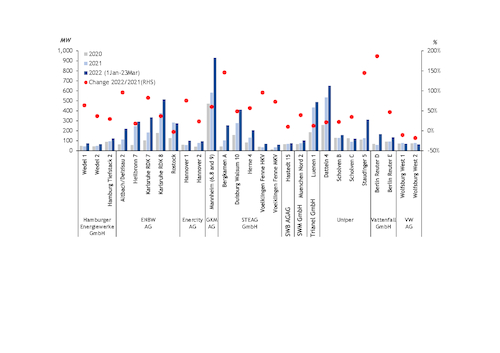
German coal power plant operators have partly secured their requirements of non-Russian coal this year but several question marks cloud the medium-term supply outlook, according to responses to an Argus survey.
EnBW AG, Enercity AG, GKM AG, Hamburger Energiewerke GmbH, STEAG GmbH, SWB AG, SWM GmbH, Trianel GmbH, Uniper SE, Vattenfall GmbH and Volkswagen AG were among the recipients of the survey but not all provided responses. Daily average coal output from 1 January-23 March 2022 from coal-fired units operated by these companies was 6.4GW, up by 43pc from the full year 2021 daily average, data from Fraunhofer ISE show.
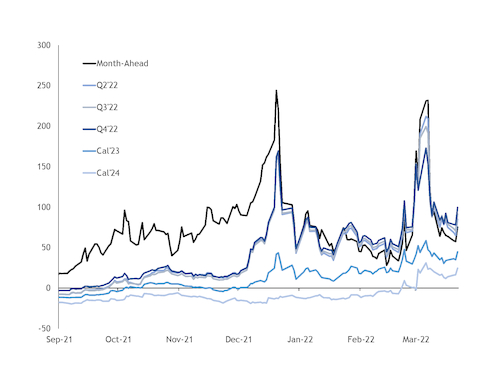
Total coal-fired generation in Germany could grow for a second consecutive year in 2022 should the current year-to-date growth rate prevail for the remainder of this year. The prevailing fuel-switching forward curve and the government's plan to bring back coal capacities for supply security reasons both point to firm coal burn expectations this year.
Short-term non-Russian alternatives partly secured
Some German utilities have already secured additional non-Russian coal supplies for prompt delivery, while some are still struggling to source replacements, survey participants said.
Utilities are understood to have paid high premiums to the API 2 index to secure replacement cargoes at short notice. Prompt-delivery cargoes of non-Russian coal for northwest European were recently heard to have dealt at premiums of $60-150/t, sources said.
While some German utilities already began lessening their dependency on Russian coal supplies last year following railing issues in Russia's northwest, Russia remains by far the country's biggest supplier. Australian, US, Colombian, South African and Indonesian coal are among the alternative sources, according to the survey. But technical specifications of some coal power plants, such as boiler setups, could limit which origins and blends of coal can be burnt in certain plants. Compositions of high-CV and low sulphur coal are the preferred blends, one participant said.
Several plant operators with multiple coal generation units included in the survey are not planning any technical adaptions and will keep the setup of their boilers. Overall, participants were reluctant to comment on additional costs pertaining to changing blends.
One operator said that its unit is designed to run on a blend of North American and Russian coal. Although the operator did not share the exact specifications of the preferred blend, German utilities commonly blend down high-sulphur US coal, such as product from the Illinois basin, with low-sulphur Russian coal. This would suggest that any Russian alternatives should ideally have similar characteristics to the Russian product. Typical specifications of high-CV Russian coal, such as producer SUEK's high-CV Kuzbass coal blended for export out of Baltic ports, have a net calorific value (NCV) of 5,900-6,000 Kcal/kg and sulphur content 0.3-0.35pc on an as received (AR) basis, according to the producer's website.
At least for one operator the technical setup seems to limit their sourcing flexibility, as they are currently looking at how they can replace Russian coal.
A combination of existing coal stocks and planned non-Russian arrivals should be sufficient to supply coal operations for one operator into October, the respondent said.
Longer-term diversification
German utilities did not share the same view about when supply will improve in a sustainable manner, but respondents to the survey were unified in their endeavours to diversify as part of their procurement strategies going forward.
Selecting new suppliers will not happen immediately for some companies owing to corporate procurement policies. One utility expects to evaluate potential new coal suppliers in the US, Australia, Colombia, South Africa and Asia while looking for further procurement options as part of its medium-term plan.
Scarce non-Russian availability and competition from other European countries could cap imports and pose a challenge to accommodate the bloc's firm demand and restocking requirements, especially with Amsterdam-Rotterdam-Antwerp stocks at historic lows of 2.4mn t.
Current power plant coal stocks can reportedly cover operations for between several weeks and three months, depending on the plant.