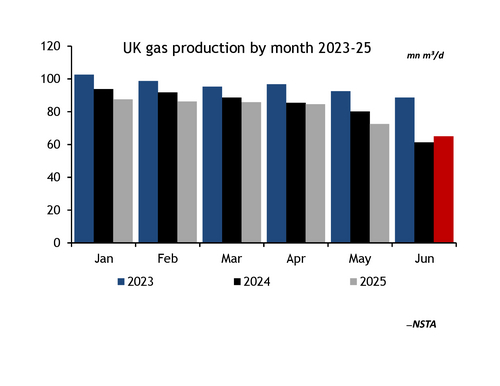
UK gas production has continued to decline in January-May this year but at a slower rate than a year earlier, and continued to meet a large portion of domestic demand.
Gas output on the UK continental shelf (UKCS) averaged 83.4mn m³/d in January-May this year, latest North Sea Transition Authority (NSTA) data show. This is down from 88mn m³/d during the same period a year earlier, equating to a 3.6pc decrease on the year. This is a much slower rate than the 9.5pc decrease on the year in January-May 2024.
Output in January was the highest for any month so far this year at 87.6mn m³/d, having fallen by 6.7pc on the year. The lowest output was in May at 72.5mn m³/d, falling by 9.6pc year on year.
Decline in UK demand in recent years has limited the increase in the country's import needs in response to declining UKCS output.
That said, this trend was interrupted in the first quarter, when domestic demand rose on the year on the back of colder and still weather boosting local distribution zone and power sector gas demand. UK demand was 240.3mn m³/d in January-March, up from 216.3mn m³/d a year earlier.
UKCS production in the first quarter met 37pc of aggregate demand, down slightly from 43pc in the first quarter of 2024.
UK demand declined on the year in April and May and in turn the share of demand met by domestic production increased. Domestic production met 67pc of domestic demand in April and 81pc in May, up on the year from 59pc and 80pc, respectively.
Production fell on the year in January-May at most large UKCS fields. Output at the Bruce and Cygnus fields declined the most during this period. Bruce production was 4mn m³/d in January-May, down on the year from 5.6mn m³/d, while Cygnus produced 4.5mn m³/d, down from 5.9mn m³/d.
But stronger output at some other fields dampened the overall decline. The Culzean field's output ticked up over the whole period, driven by strong output across January-March.
UKCS output decline may pick up over rest of 2025
Production data coupled with a forecast output decrease suggest that the rate of the annual decline may pick up over the coming months.
Offshore regulator North Transition Sea Authority (NSTA) expects net UK gas production of 24.5bn m³ this year, 10pc lower than in 2024, which would equal 67mn m³/d, according to data published in March.
There is a lag in the NSTA's reporting, with only offshore UKCS production data currently available for June.
That said, implied output, based on gas delivered to the national transmission system, averaged 72.1mn m³/d and 74.6mn m³/d in June and July, respectively, National Gas data show. This suggests an uptick on the year from realised output of 61.4mn m³/d and 71.6mn m³/d in June and July 2024, respectively.
Following the NSTA's forecasted annual rate of decline of 10pc, a total of 9.2bn m³ could be produced in August-December, which would translate to a 23.1pc decrease on the year in August-December. If a 10pc decline rate is applied to August-December, this is equal to an output of 10.8bn m³ during that period.
But Serica expects an increase in output from the Bruce hub thanks to optimisation work at the hub earlier this year. The work will "boost production in the second half of the year", said the firm in its half-year results published on Tuesday.
Similar recent developments may have not been taken into account by the NSTA and suggest that UK production may surpass the operator's current forecast in terms of either output or the rate of decline.
The NSTA is set to update its biannual production forecast in October.
Maintenance at the UKCS is set to be the heaviest this month, with minimal works later in the year, suggesting that production may decline more sharply on the year in August and resume a lighter on-the-year decline in September-December.
The Elgin-Franklin complex will be shut down on 28 July-25 August. And the ramp up to normal rates of production will take two days, a National Gas Remit message states.
Exports from the UK's second-largest gas field, Cygnus, stopped on 1 August and will restart at the end of the 16 August gas day. And fields in the Greater Britannia area will also shut down for five days, starting 15 August.