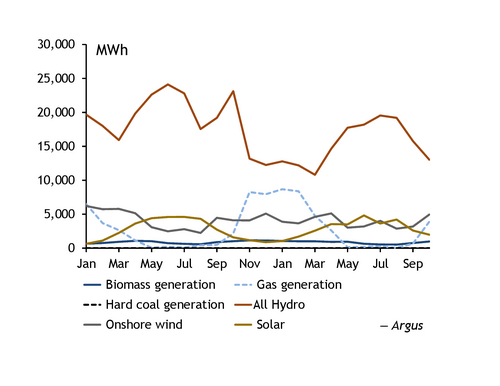
Austria has obtained most of its gas from the west in 2025 — a reversal of previous years' pattern — and looks likely to bring in even more from the west in the coming years.
The halt of Russian gas deliveries at the beginning of 2025 has been completely offset by German and Italian supplies, according to system operator Gas Connect Austria (GCA).
Flows now primarily come through the Oberkappel entry point on the German-Austrian border, instead of the Baumgarten point with Slovakia, GCA added.
Net imports from Germany at Oberkappel averaged 184 GWh/d in January-September, a jump from 10 GWh/d across all of 2024. And flows at the German-Austrian Uberackern point rose to 59 GWh/d from 3 GWh/d.
Firms have switched to net exports to Slovakia — through which Russian gas used to arrive. Austria net exported 11 GWh/d in January-September, against net imports of 292 GWh/d last year.
Similarly, Austria has become a net importer from Italy, albeit to a smaller extent. Net imports from Italy through the TAG pipeline at Arnoldstein averaged 33 GWh/d in January-September, switching from 154 GWh/d of net Austrian exports across 2024.
"Another trend that continues... is increasing exports to the east via the Mosonmagyarovar exit," the GCA press release said. Austria exported 79 GWh/d to Hungary in January-September, up from 1 GWh/d across all of last year.
Austrian gas demand up by 16pc in Jan-Aug
Changes in supply have not impacted Austria's ability to cover higher gas demand, which has been driven by lower temperatures and weak renewable generation at the beginning of 2025.
January-August consumption was 50.4TWh, up from 43.6TWh a year earlier, according to GCA. "The increase was particularly strong in the winter months of February (46pc) and March (26pc)" and significantly more gas was also consumed in April and May.
Minimum temperatures in February-March in Vienna were 0.2°C on average, down from the 1.2°C long-term norm and 5.2°C in February-March last year.
Gas-fired generation in January-May was well up on the year — 4.9GW, against 2.8GW. Gas-fired output was up on the year in each of these months (see graph).
But renewable generation fell to 21.2GW in January-May from 27.5GW a year earlier, and was also down for each of these months.
And gas supply was also strong enough to fill Austrian storage sites ahead of winter. Stocks had reached 84.92pc of capacity on 1 October, down from 92.69pc a year earlier, but above the 82.59pc EU average.
Receipts from west to keep rising
Austria is poised to receive more and more of its gas from the west as Russian gas is phased out of the EU in the coming years.
EU energy ministers agreed on Monday to back a full phase-out of Russian pipeline gas and LNG imports by 1 January 2028, as part of the REPowerEU strategy.
The final REPowerEU legal text now moves to the European Parliament, which has proposed an earlier 1 January 2027 deadline for ending long-term Russian gas and LNG contracts signed before 17 June 2025.
Irrespective of the version of the text agreed, a ban on Russian pipeline gas imports will increase eastern European countries' dependence on western supply.
The Oberkappel entry point with Germany is at capacity, but there is still spare capacity at the 269 GWh/d Arnoldstein point with Italy.
And to the east, there is capacity left at the 153 GWh/d Mosonmagyarovar point with Hungary and 247 GWh/d Baumgarten point with Slovakia.
Increased flows through these points could offset the loss of the remaining Russian gas that arrives in Bulgaria from the 587 GWh/d Turkish Stream pipeline.
Slovakia and Hungary are still threatening to veto the EU's 19th sanctions package against Russia, which includes a full ban on LNG imports from 2027. Their opposition will not affect separate legislation to phase out Russian gas and LNG by 2028, as this only needs to pass with a qualified majority.