The UN's Cop 30 climate summit in Belem, Brazil, last month pushed clean cooking in lower-income countries higher up the global agenda as part of a just energy transition. US-based non-profit the Clean Cooking Alliance (CCA), working alongside the likes of the IEA and the World Liquid Gas Association, has played a central role in bringing attention to the issue and helping to tackle the financing and policy barriers faced in shifting to cleaner fuels, particularly LPG. Argus' Waldemar Jaszczyk spoke with CCA chief of staff and chief external affairs officer Jillene Belopolsky about what the event delivered and what still needs to happen:
What were your overall impressions of Cop 30?
Cop 30 was a very exciting and exhilarating experience as always, especially because it made it clear that clean cooking has moved from the margins to the mainstream of climate conversations. We now see it explicitly linked to energy access, nature, food systems and gender equality and not treated as a niche issue. The big challenge remains turning that visibility into scale of finance and delivery capacity that countries actually need to implement their ambitious targets.
How has clean cooking become more visible at the summit?
Cop 25 had one session on clean cooking on the last day in a backroom. But in the past few years, we've seen high-level multi-stakeholder events and commitments. This momentum has been building owing to the advocacy and engagement of organisations as they, like CCA, are really driving awareness through global platforms. The G20 and G7 included an explicit commitment to clean cooking this year. The IEA summit on clean cooking in Africa last year mobilised $2bn worth of pledges. African governments have elevated clean cooking in their energy and climate plans. Regional bodies such as the Africa Energy Commission are driving a more co-ordinated approach. At Cop 30, we had governments, development finance institutions and firms debating not whether to act but how to scale faster, mobilise finance and integrate clean cooking into just energy transition strategies. We also saw the launch of the platform for clean cooking in schools (see p2).
Was clean cooking adequately included in climate planning in the past?
In the early years, clean cooking was definitely under-represented in climate planning, and there were many other larger-scale issues driving the agenda. But this has absolutely improved and we have seen steadily increasing recognition of cooking as a critical climate solution. As of July, 74pc of low and middle-income countries include household energy or explicit clean cooking measures in their nationally determined contributions (NDCs). That is up from about two-thirds of that number before Cop 26. But there's still a gap between what is written on paper and the level of targets for finance and implementation required to close that gap by 2030. And that's why the CCA-led clean cooking and climate consortium has been providing technical and practical guidance to governments intending to use clean cooking interventions to achieve climate goals as part of their NDC targets or to create tradeable assets under an Article 6 framework.
How is LPG's role as a clean cooking fuel in climate discussions evolving?
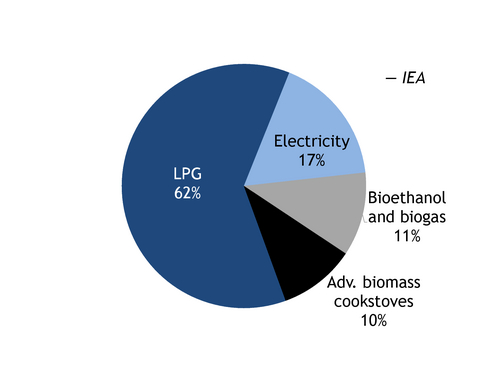
The conversation is more open and evidence-based. CCA-sponsored research helped shift the tone by showing that the benefits of transitioning to LPG are bigger and more immediate than assumed. That evidence is landing well with policy makers, donors and investors. We're also seeing a more nuanced discussion emerge. Countries are looking at LPG, electricity and biofuels as complementary pathways rather than competing narratives. Analysis such as the IEA's roadmap show that in the least costly pathway, LPG provides access for more than 60pc of people that require access. It does not mean that LPG is the answer everywhere or forever. But there is a growing acceptance that when used efficiently and paired with a long-term credible transition, it can play a vital near-term role.
Has the summit delivered in terms of funding for clean cooking?
The IEA roadmap estimates that universal clean cooking access in Africa will require roughly $37bn of total investment between now and 2040, equivalent to $2bn/yr. The IEA's summit in 2024 mobilised $2.2bn in commitments, of which about $470mn has already been dispersed, which is a really meaningful step but still only a fraction of what's required. It's important to highlight that there is very strong policy momentum. Since the IEA's summit, more than 70pc of the population without access to clean cooking live in countries that have strengthened clean cooking policy frameworks. Cop creates a lot of agreements and investment vehicles, and there is an opportunity to leverage this finance for clean cooking. Cop can help direct resources toward more integrated, holistic approaches.
What barriers are preventing this level of investment being reached?
Limited bankable project pipelines, gaps in government delivery capacity, policy and tariff uncertainty and inconsistent carbon market rules. Investors also cite currency risk affordability and fuel price volatility. Cop 30 helped advance some of these conversations, particularly around the high-integrity carbon markets, stronger clean cooking signals, NDCs and alignment with larger nature and food security agendas. But the progress does not hinge on Cop alone. CCA and our partners have been working to address some of these bottlenecks. We're supporting governments through national clean cooking delivery units. We're improving the data and planning tools, strengthening standards and carbon methodology and helping to structure real project pipelines that can attract capital. While Cop adds that visibility and momentum, this core work of derisking markets and building investable opportunities happens every day across countries.
How can the LPG sector tap into carbon credits to become more affordable?
Carbon finance is one of the most immediate and promising ways to overcome affordability barriers. It can help reduce upfront costs such as cylinders, connections and efficient LPG stoves and can provide targeted subsidies to help reach the poorest households — as long as credits are generated through high-integrity projects. Initiatives such as the CCA-led consortium and emerging tools such as the clear carbon methodology are designed to ensure that any LPG-related carbon projects are transparent, conservative in their claims and aligned with NDCs rather than being used as a licence to delay decarbonisation. We have worked hard to ensure this carbon methodology will be adopted by the UNFCCC and the voluntary standards bodies. It will be a game changer for the sector if done right.
If Cop 30 fails to leverage the necessary financing for clean cooking, what is the CCA's plan to maintain momentum into 2026?
We have never expected a single summit to close the finance gap. We definitely can't let the momentum fade. That's why our focus after Cop 30 is very practical. We are working to turn commitments into capital, turn pilots into portfolios of projects and help governments build the delivery systems that make investment viable. For us, that means expanding our clean cooking delivery units, supporting countries to sharpen clean cooking in their NDCs and investment plans and working closely with investors to structure high-integrity projects and affordable business models. Cop 30 is not the finish line, it's a launchpad.