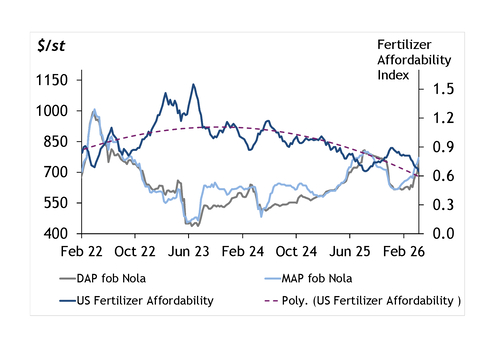
The US phosphate market is facing renewed scrutiny as US exports rise even as war in the Middle East disrupts global fertilizer trade flows, pushing prices to the highest levels since 2022 and compounding consumer affordability concerns.
The effective closure of the strait of Hormuz, through which a large portion of seaborne urea, ammonia, sulfur and phosphates transit, has severely tightened global supplies and drawn public attention to rising US fertilizer prices, most recently from US President Donald Trump.
Farmers, traders and US lawmakers have pointed out that disruptions at the strait have collided with already strained domestic farmer economics. Even before the Middle East conflict, US fertilizer buyers and sellers had raised concerns about farmer input costs, fertilizer market concentration, and the effects of trade policy. But the Iran war has amplified those pressures.
Phosphate exports tighten domestic supply
Elevated US phosphate exports in the first quarter have further tightened domestic supplies at a time of surging prices.
The US has seen a significant uptick in supplies leaving domestic ports, including domestically produced phosphates sold into the global market, as well as traders moving to re-export volumes originally brought to New Orleans, Louisiana, (Nola) because of concerns that their supply could exceed US spring demand.
Mosaic, the country's largest phosphate producer, has exported outside of North America roughly 201,000 metric tons of DAP and MAP from January through March, according to its reported sales. This is at least 85,700t higher than combined DAP and MAP exports from the US to destinations aside from Canada for the same period in 2025, according to US Census Bureau data.
On top of Mosaic's reported sales, domestic traders sold imported volumes at Nola for re-export in March, but the volume and load dates for the re-export tons have not been confirmed.
The producer seems to be prioritizing higher profits overseas and domestic contract holders over US spot buyers while also delaying the release of barges, which has tightened availability ahead of the spring planting season, multiple Mosaic customers said.
But following fertilizer industry criticism from Trump, Mosaic on Saturday said US phosphate prices are at a discount to the global market, reflecting "reduced farmer demand due to the overall difficult economic situation facing American farmers". The company added that its commitment is to "help feed a growing global population".
Thin availability and rising feedstock costs for sulfur and ammonia have caused producers in China, Morocco, South Africa and India to pull back phosphate output.
Most of Mosaic's export sales this year were to Latin American and India, where cfr values currently range from $865-900/t compared to a Nola DAP and MAP equivalent from last week of around $842/t cfr.
Antitrust scrutiny and monopoly accusations
The US Department of Agriculture (USDA) and the Department of Justice have been investigating competitiveness in the fertilizer, seed and feed markets since late last year. A memorandum of understanding signed in September 2025 directed the DOJ's antitrust division to examine market concentration in nitrogen, phosphate, and potash. Major producers — including Nutrien, Mosaic, CF Industries, Koch, and Yara — have been part of the inquiry.
On Saturday, Trump took to social media to warn fertilizer companies about excessively raising US prices, adding that the administration "will not accept PRICE GOUGING from the fertilizer monopoly".
USDA deputy secretary Stephen Vaden has also publicly described North American producers as a "duopoly", arguing in early March that limited competition allows producers to exert too much pricing power. Some US lawmakers have echoed these concerns, questioning whether price increases during the Middle East conflict reflect genuine supply constraints or market manipulation.
Over 60 US grower associations and groups called for the end of countervailing duties (CVDs) on phosphate fertilizers from Morocco and Russia in a recent letter to the Department of Commerce, arguing that CVDs have limited farmers' supply options.
A collection of Democratic lawmakers in a late March letter urged the USDA to take steps to reduce fertilizer costs that have increased as a direct result of the war with Iran.
Despite the scrutiny, the administration has taken no direct action against producers. Instead, regulatory attention has focused on an ongoing five-year sunset review of CVDs on phosphate imports from Morocco and Russia. Many farmers and traders have urged the government to lift these duties, arguing that they restrict supply and worsen affordability at a time when global disruptions are already severe.
US producers Mosaic and Simplot have told Commerce in filings that the CVDs should not be revoked.