
The first three months of Canada's Trans Mountain Expansion (TMX) have sent a surge of crude to refiners in California and China, shifting tanker demand in the Pacific basin.
The 590,000 b/d TMX project nearly tripled the capacity of Trans Mountain’s pipeline system to 890,000 b/d when it opened on 1 May, linking Alberta's oil sands to Canada's west coast for direct access to lucrative Pacific Rim markets, where buyers are eager for heavy sour crude.
Between 20 May, when the first TMX cargo began loading, and 20 August, about 165,000 b/d of Vancouver crude exports landed at ports on the US west coast, primarily in California, up from about 30,000 b/d in that same span last year, according to data from analytics firm Kpler.
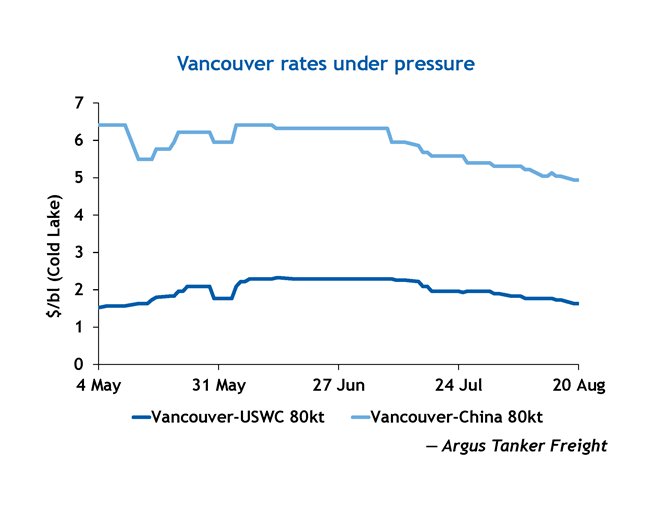
The freight rate for a Vancouver-US west coast Aframax shipment averaged $1.98/bl for Cold Lake between 1 May and 20 August. This ranged from a low of $1.50/bl from 1-3 May when shipowners repositioned to the region in anticipation of TMX to a high of $2.32/bl from 13-14 June, according to Argus data.
The new oil flow into the US west coast has displaced shipments from farther afield in Ecuador and Saudi Arabia. Crude exports from those countries into the US west coast averaged 110,000 b/d and 25,000 b/d, respectively, between 20 May and 20 August, down from 155,000 b/d and 135,000 b/d over the same stretch in 2023, according to Kpler.
The growth of the Vancouver market, which benefits from its proximity to California, has reduced tonne-miles, a proxy for tanker demand, into the US west coast. This has outpaced slightly lower crude demand, which fell in part due to Phillips 66 halting crude runs at its 115,000 b/d refinery in Rodeo, California, in February to produce renewable fuels, as well as weaker-than-expected road fuel demand this summer.
Tonne-miles for US west coast crude imports fell by 14pc to 106bn between 20 May and 20 August 2024 compared with the same period a year earlier, Vortexa data show, while overall crude imports declined just 8.6pc to 1.37mn b/d, according to Kpler.
PAL-ing around with VLCCs
Though much of Vancouver’s exports have been shipped to the US west coast, Canadian producers have found ready buyers in Asia-Pacific as well, where about 160,000 b/d of Vancouver exports went between 20 May and 20 August, compared with none a year prior, Kpler data show.Buyers and sellers have displayed a preference for using ship-to-ship transfers onto very large crude carriers (VLCCs) at the Pacific Area Lightering zone (PAL) off the coast of southern California, rather than sending Aframaxes directly to refineries in east Asia. Of the 30 Vancouver-origin Aframax cargoes that have landed in China, South Korea and India, 19 were transferred onto VLCCs at PAL, Kpler data show. Seven cargoes were sent directly to east Asia on time-chartered Aframaxes — the majority by Suncor — and just four were sent using spot tonnage, likely due to the expensive economics of trans-Pacific Aframax shipments.
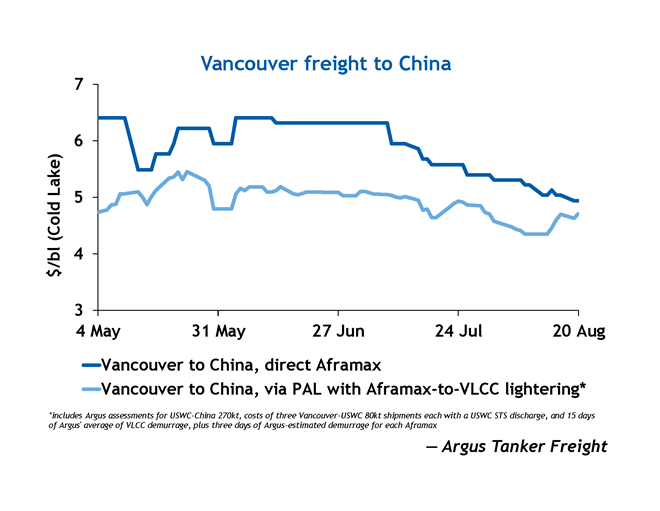
The Vancouver-China Aframax rate between 1 May and 20 August averaged $5.90/bl, with a low of $4.94/bl from 19-20 August and a high of $6.41/bl from 1-10 May and again from 4-12 June, according to Argus data.
Over the same time, the cost to reverse lighter, or transfer, three 550,000 bl shipments of Cold Lake crude from Vancouver onto a VLCC at PAL averaged about $8.055mn lumpsum, or $4.92/bl, with a low of $4.35/bl from 8-13 August and a high of $5.45/bl on 22 May, according to Argus data. This includes $150,000 ship-to-ship transfer costs at PAL, 15 days of VLCC demurrage and three days of Aframax demurrage for each reverse lightering.
VLCC costs could change preferences
Though it may have been cheaper to load TMX crude on VLCCs at PAL since May, volatility in the VLCC market — which often falls to yearly lows in summer before climbing to seasonal highs in the winter — could entice traders to opt for direct Aframax shipments if VLCCs hit their expected peak in the winter.
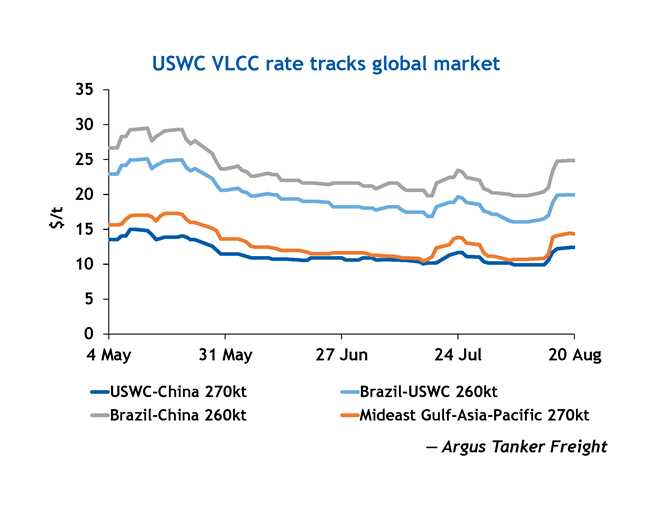
VLCC costs for shipments from the US west coast to China are influenced by the VLCC markets in the Mideast Gulf and Brazil, where ships look for their next voyage after discharging on the US west coast.
For now, Vancouver-loading Aframax rates are under pressure from the reemergence of VLCCs in what had become an Aframax trade in Thailand, boosting Aframax supply in the Pacific and pulling the class’s rate to ship crude from Vancouver to the US west coast to its lowest level in more than three months on 19 August.
In mid-July, VLCCs resumed discharging via single point mooring (SPM) at Thailand's port of Map Ta Phut for the first time since January 2022, ship-tracking data from Vortexa show. Prior to the SPM's return to service, VLCCs could discharge cargoes only by lightering onto smaller Aframaxes, which would then unload at a different berth in the port.
This created demand for about eight Aframax lighterings each month, but with VLCCs in Thailand again able to discharge directly, that demand is effectively halted, putting downward pressure in the broader southeast Asia Aframax market.
Since July, two Aframaxes have left the southeast Asia market for Vancouver, according to ship tracking data from Kpler: the Eagle Brisbane, which previously was used in lightering operations at Map Ta Phut, and the Blue Sea, which recently hauled fuel oil from nearby Singapore to China.
Spotlight content
Related news
Ithaca first to try new UK North Sea regime
London, 18 December (Argus) — UK-listed upstream producer Ithaca Energy has begun the approval process for a development in the North Sea, the first since the government softened its approach to the region. Ithaca has submitted a development summary and environmental statement for the Fotla field to the offshore regulator Opred. It outlines a two-well tie-back to the Britannia platform, which processes liquids from the Greater Britannia Area, including Ithaca's Alder field. Ithaca indicates that if the process is successful, drilling will begin in the first half of 2027, with first oil in the final quarter of that year. This is the first submission of an offshore proposal since the UK government published its 'North Sea Future Plan' alongside its budget in late November. That enables "limited oil and gas production in areas that are already part of an existing field, or in areas adjacent to already licensed fields, linked via a tieback, to help ensure they remain economically viable". Developers are not permitted to explore for oil and gas at these sites, and a ban remains on new oil and gas licensing. London's stance on North Sea development has delayed the Rosebank project, in which Ithaca holds a 20pc stake, and the company's west of Shetland Cambo project. Ithaca expects its production to average 119,000-125,000 b/d of oil equivalent (boe/d) this year. By Ben Winkley Send comments and request more information at feedback@argusmedia.com Copyright © 2025. Argus Media group . All rights reserved.
BP appoints Woodside’s O’Neill as next CEO
New York, 17 December (Argus) — BP appointed Woodside Energy chief executive officer Meg O'Neill as its next chief executive effective from next April. O'Neill will replace Murray Auchincloss, who has decided to step down on 18 December after more than three decades with the London-based oil major. O'Neill transformed Woodside into the biggest energy company listed on the Australian Securities Exchange after taking over as chief executive in 2021, according to BP. While at Woodside, she also oversaw the acquisition of BHP Petroleum International. O'Neill also spent more than two decades at ExxonMobil earlier in her career. "Her proven track record of driving transformation, growth, and disciplined capital allocation makes her the right leader for BP," said Albert Manifold, chairman of the company's board of directors. Carol Howle, executive vice president, supply, trading & shipping of BP, will serve as interim chief executive until O'Neill takes over. Auchincloss will also serve in an advisory role until December 2026 to ensure a smooth transition. BP scaled back ambitious low-carbon goals earlier this year with Auchincloss conceding that the company had been "optimistic for a fast [energy] transition but that optimism was misplaced." The company raised its 2030 target for oil and gas production as part of a "fundamental reset" of strategy that also entailed a cut in renewable energy investments. O'Neill's appointment follows a search process overseen by the board, with the help of an independent recruitment firm, as part of the company's long-term succession planning. By Stephen Cunningham Send comments and request more information at feedback@argusmedia.com Copyright © 2025. Argus Media group . All rights reserved.
Trump doubles down on Venezuela oil threat
Washington, 17 December (Argus) — President Donald Trump on Wednesday doubled down on his threat to blockade Venezuelan oil shipments unless Caracas offers compensation for oil assets expropriated years ago. Democratic lawmakers on the same day forced the House of Representatives to schedule a vote on resolutions that would prohibit Trump from using military force against Venezuela without explicit authorization from Congress. "They took all of our oil from not that long ago, and we want it back," Trump told reporters on Thursday. "They illegally took it." Trump's domestic policy adviser Stephen Miller on Wednesday said that "American sweat, ingenuity and toil created the oil industry in Venezuela". Venezuela nationalized its oil industry in 1976, only to partially reverse course in the 1990s by inviting US and other foreign oil companies to participate in joint ventures with state-owned PdV. Former Venezuelan president Hugo Chavez in 2007 ordered PdV to change the business terms of operations in joint ventures. Chevron and some European companies accepted these terms. ExxonMobil and ConocoPhillips did not, eventually winning awards in international tribunals and US courts for the expropriation of their assets in Venezuela. ConocoPhillips holds the largest claim for expropriated assets, at $12bn. That claim is about to be partially satisfied as a US court has ordered the auction of PdV-owned US refining company Citgo. It was not clear what prompted the change in the stated rationale of the US campaign of pressure against Venezuelan president Nicolas Maduro. Trump and US officials until this week described the campaign in terms of curbing the seaborne flow of drugs and putting an end to migration from Venezuela, even though Trump previously mentioned possibly pushing for regime change in Caracas. Trump in a social media post on Tuesday night declared a blockade of most Venezuelan seaborne oil shipments. "We're not gonna let anybody going through that shouldn't be going through," Trump said on Wednesday. The Maduro government denounced Trump's threat and appealed to the UN. It is not clear if Caracas can counteract the blockade. Venezuelan oil flows to Cuba already have stopped and cargoes to other destinations were grinding to a halt, following the 10 December seizure of a Cuba-bound Venezuelan oil tanker by the US Coast Guard. US House debate The House of Representatives later on Wednesday will vote on two separate resolutions to prohibit the use of US military force against Venezuela without congressional approval. Debate on the House floor Tuesday afternoon showed a division largely along partisan lines, indicating the resolutions are unlikely to pass. Republican lawmakers pushed back against the resolution, casting the US operation as an extension of the administration's domestic counter-narcotics efforts — a line the White House had advanced until Wednesday. "Congressional authorization is not required to carry out precise, limited strikes," House Foreign Affairs Committee chairman Brian Mast (R-FLorida) said. "My colleagues did not object when prior presidents conducted military operations in Yemen, in Libya, and Syria," Mast said. The US military operation near Venezuela "isn't about drugs — it's about regime change, and it's about oil," said congressman Gregory Meeks (D-New York), who sponsored one of the resolutions. "Trump is provoking a new war right in our backyard and threatening to destabilize an entire region", Meeks said. By Haik Gugarats Send comments and request more information at feedback@argusmedia.com Copyright © 2025. Argus Media group . All rights reserved.
Libyan oil firms bypass government to sell crude
London, 17 December (Argus) — Libyan upstream operators have used a special contractual clause to sell some crude directly to international oil firms in recent months, bypassing the central government to directly access oil revenues, sources told Argus . Mellitah Oil & Gas, Akakus Oil, Zueitina Oil and Agoco sold crude worth more than $380mn between March and October, under this "proxy-payment" scheme, to Italy's Eni, Spain's Repsol, Austria's OMV and Libya's Arkenu Oil respectively, according to sources. The mechanism is legal under a clause in production-sharing contracts dating back to the time of former leader Muammar Gaddafi, which allows operators to sell crude directly to cover special funding needs, sources said. But sources and analysts say the mechanism is opaque, lacks checks and balances and could be exploited for personal gain. It also diverts oil revenues away from the central bank, the custodian of Libya's oil wealth. "The proxy payments occur outside the framework of the ministry of finance and the central bank [and] are not recorded as official revenues or expenditures," said an official at the ministry of finance. "It is being used as an unlawful tool for controlling oil revenues." NOC, Eni, Repsol and Arkenu have been contacted for comment. OMV declined to comment. State-owned NOC, which has stakes in the upstream operators, normally sells its equity crude production to international buyers with proceeds flowing to a ministry of finance account at the central bank in Tripoli. International oil firms with stakes in the operators, including Eni, Repsol and OMV, are allocated equity crude and pay royalties and taxes to the Libyan state. The crude being sold under the proxy payment mechanism is from Libya's equity production, and is separate from the equity crude allocated to international oil firms. The operators are usually reliant on the state to fund their operations. But Libya's political division, with rival governments in the east and west, has for years prevented a unified state budget, leaving operators with irregular and insufficient funding from the central government in Tripoli. "The mechanism was never supposed to be used in this way," said a source with knowledge of the matter. "You can't confirm where this money is being spent." "It's been heavily exploited now in the absence of a budget," said another source at a private Libyan oil firm. Libya's fragmented political framework has allowed powerful groups varying levels of control over the economy, including in the upstream sector. Enter Arkenu The most high-profile example of this is services firm Arkenu Oil, which the UN has said is controlled by Saddam Haftar, a son of east-Libya militia leader Khalifa Haftar. Arkenu has a contract with NOC subsidiary Agoco , operator of the Sarir and Mesla oil fields, to boost output in return for payments in crude. Industry figures and analysts question the capacity of Arkenu to carry out such work and have said the company may be part of an illicit revenue generating scheme. Arkenu has received crude valued at $200mn under the proxy payment mechanism, a source said. Libya's Tripoli-based government ordered a review of contracts related to Arkenu earlier this year, although analysts question the sincerity of the move. Sources and analysts say the use of proxy payments mechanism could spiral and further drain state revenues. Libya produces about 1.4mn b/d of crude and makes most of its income from oil exports, which were worth $28.7bn in 2024, according to Opec's latest Annual Statistic Bulletin. The heads of NOC, the central bank, audit bureau and the attorney general met in late November to discuss, among other issues, the proxy payment mechanism "and its implications for the state's general budget." By Aydin Calik Send comments and request more information at feedback@argusmedia.com Copyright © 2025. Argus Media group . All rights reserved.

