Alaska's upstream oil and gas industry is undergoing a revival as producers look to capitalize on the region's steady, low-cost oil and gas supplies. But the US state still faces challenges in continuing to attract the investment needed to sustain output growth.
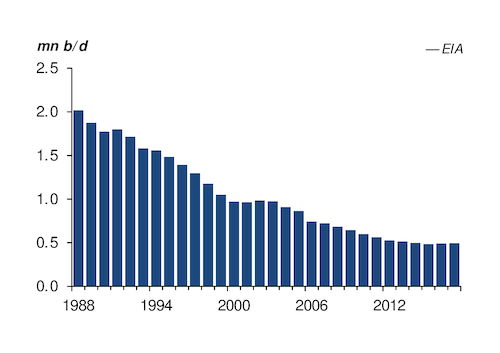
Alaskan production has declined steadily from its 2mn b/d peak in the late 1980s to nearer 500,000 b/d today, in part because of a lack of investment. The region has dropped to fifth among the US' top oil producing states, well behind first-placed Texas with 4.2mn b/d. But this trend is slowly changing, with production edging higher since 2016. A slew of new exploration and development projects, and upgrades to existing assets may mean that the reversal is sustained.
Italy's Eni is one of the latest to spot the region's potential. The firm last month acquired 124 exploration leases over about 350,000 acres (1,416km²) in the Eastern Exploration Area (EEA) in Alaska's North Slope from US independent Caelus Energy. The EEA is close to existing pipeline infrastructure and lies between two of the largest oil discoveries in North America — Prudhoe Bay and Point Thompson, Eni says. The company already owns the Nikaitchuq field and holds 30pc of the Oooguruk field on the North Slope, which have combined output of 20,000 b/d of oil equivalent (boe/d).
US upstream independent ConocoPhillips is renewing its efforts in Alaska. The US last month started environmental reviews of the firm's plans to build a central processing facility and five drilling sites for its Willow discovery in the National Petroleum Reserve-Alaska. The Willow prospect contains estimated recoverable oil resources in excess of 300mn bl. ConocoPhillips estimates it could produce up to 100,000 b/d and achieve initial commercial production as early as 2023.
The independent in July bought interests in the Kuparuk and satellite oil fields in Alaska from BP in return for a 16.5pc stake in the UK's Clair field. Overall, ConocoPhillips now holds about 2bn boe of resources at its Alaskan legacy assets at a supply cost of $40/bl, and a potential 500,000-1.1bn boe from an exploration program that it began in 2016. "These assets respond well to new technologies and approaches... [they are] big fields and they get even bigger and better with time," chief executive Ryan Lance says.
Pukka Pikka
BP has kept output steady at its giant 280,000 b/d Prudhoe Bay field since 2015, something the major says is unheard of for a 40-year old asset. The major plans to complete a 3D seismic survey of the area next year, to further prolong the life of the field. Spain's Repsol says it made the largest US onshore conventional discovery in 30 years at the Pikka field in Alaska's North Slope in 2017. Repsol's preliminary estimates for Pikka suggest first production in 2021 at up to 120,000 b/d. Other key Alaskan oil projects include the 60,000-70,000 b/d Liberty field operated by US independent Hilcorp.
ExxonMobil has agreed to sell gas to the 20mn t/yr Alaska LNG project, according to developer state-owned AGDC. ExxonMobil, BP and ConocoPhillips were originally equity partners in Alaska LNG, but pulled out in late 2016 after deeming the project too expensive. Start-up is scheduled for 2025.
Amid this upstream revival, consultancy IHS expects Alaska's North Slope to re-emerge as a major source of US supply, with crude output potentially increasing by as much as 40pc by 2025. But the state's ability to attract investment will be key to achieving this. Alaska needs at least $3.6bn/yr of capital to grow production, compared with the $1.9bn/yr it is attracting now — just 1.7pc of the US total, the Alaska Oil and Gas Association says. A stable tax and exploration and drilling regime is key to securing more funds, it says.