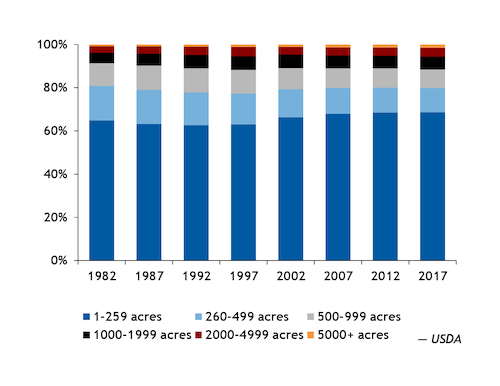
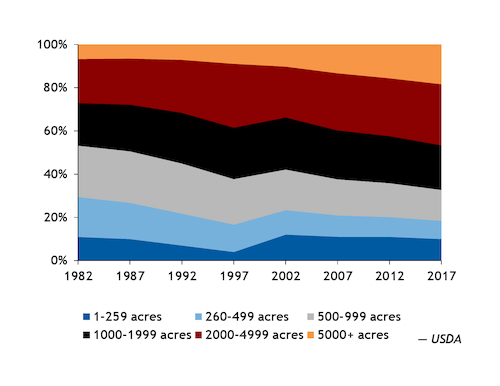
Farm consolidation is ongoing in the US and has been expedited by the growing use of high-expense technology during a period of low agriculture prices, and an aging workforce.
Major farming operations in the US are getting larger, while growers planting on fewer than 1,000 acres are diminishing in number and losing their share of annual domestic production.
The number of farms operating on more than 1,000 acres has progressively expanded during the last 35 years despite representing a small fraction of total farms. These large farms now command a majority of crop production in the US, according to the US Department of Agriculture's (USDA) 2017 census.
This trend has progressed during a period of persistently low grain prices, which squeezed revenues for all farmers. Major operators continue to expand under unfavorable economic conditions because more utilize precision agriculture technology.
Precision agriculture collects various data to optimize yield and production as well as digitize how farmers order seed and crop inputs.
James MacDonald, branch chief of the USDA's economic research service (ERS), said technology favors larger farms because the associated costs are more spread out.
"Bigger, faster and smarter equipment allows a single farmer, or farm family, to cover a given amount of acreage in less time, allowing them to manage a larger farm with the time available to them," he said.
Precision agriculture has been key in cutting expenses during periods of price downturn, especially when farmers are expected to plant more acres to meet growing demand.
US corn acres jumped substantially between 2006-2007 from 78.3mn acres to 93.5mn acres, respectively, according to the USDA. Domestic corn area has remained consistently above 85mn acres during the last decade, even while corn prices have simultaneously remained below $4/bushel since 2014.
And, still, large operations expanded thanks to the growing use of technology.
Those farming on 1,000 acres and more grew to comprise a larger share of harvested area during 2007-17, while smaller operations lost a share of acreage. The former expanded by 12pc to operate on about 67pc of total harvested acres during the 10-year period, while the latter's share shrank by 11pc during the same period.
Mathieu Ngouajio, national program leader at the USDA's national institute of food and agriculture, said he expects the trends for farm expansion and greater precision with seeding, fertilizer and pesticide applications to minimize operational expenses to continue.
"[The] margin of profit is getting smaller and smaller, meaning that you have to produce more acreage to be able to make a profit," he said. "So my feeling is that [farms are] going to continue to be larger and larger down the road. It will mean fewer farmers [and] fewer people producing for the rest of the population."
Aging farmers, too, have contributed to the pace of consolidation in the industry.
The average age of producers has steadily risen since 1982 from about age 50 to nearly 58 in 2017, according to the USDA. American Farm Bureau economist Veronica Nigh cited unfavorable economics for mid-tier operations as a primary detractor to young growers, which has raised the average age.
"There are not new farmers coming in who want to run an operation of 500 acres, and so the guys are retiring," and selling their land to larger, multi-generational operations or corporations, she said. "In order to have multi-generations on the same farm that requires a certain size of business to make that happen."