Japan's energy and climate priorities may suggest a lack of ambition to other developed countries, write Motoko Hasegawa and Yusuke Maekawa
The energy crisis provoked by Russia's invasion of Ukraine last year forced advanced economies to rebalance their energy priorities to put security ahead of sustainability in the shorter term, hindering ambitions to accelerate climate policy towards a net zero emissions goal by 2050. For resource-poor Japan, the crisis has reinforced the need to consider all options for meeting climate targets, taking advantage of the G7 leaders' recent consensus on the need for members to pursue "various pathways" towards net zero, depending on each country's situation.
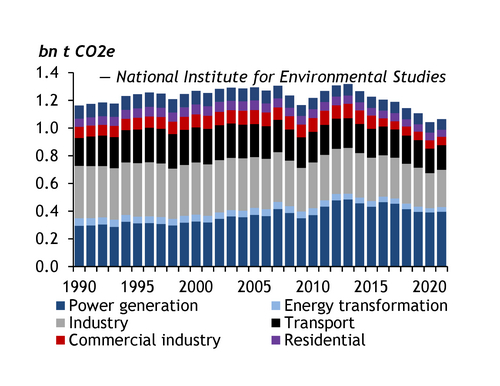
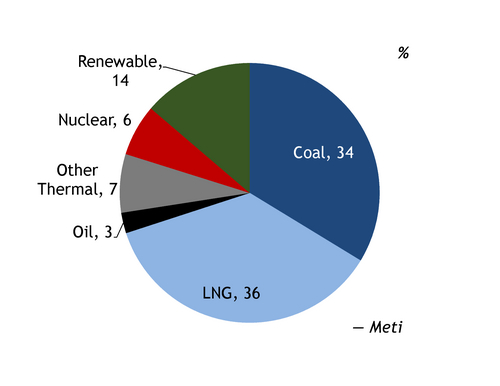
This language first appeared in the G7 leaders' communique issued in Germany in 2022, but was emphasised by Japan when it hosted the G7 summit this year. With its nuclear power capacity still far below pre-2011 Fukushima disaster levels, and constraints on its expansion of renewable energy, Tokyo has justified importing fossil fuels to support economic growth during the energy transition period. Thermal generation accounted for 80pc of Japan's power mix in the fiscal year ending 31 March, according to data from trade and industry ministry Meti. Tokyo aims to halve this to 41pc by 2030-31, but fossil fuels will still play a vital role in enhancing the country's energy security.
Tokyo says it will continue providing public finances to overseas — even unabated — fossil fuel projects, as long as it is necessary for its energy security and geopolitical interests, and is in line with the Paris goal of limiting global warming to 1.5°C. Meti also keeps funding the domestic use of refined oil products. This can be compared with stalled efforts to enhance international climate financing since 2021, when Japanese prime minister Fumio Kishida pledged an extra $10bn of overseas public-private climate funding over 2021-25, on top of the already committed $60bn.
Japan aims to find its winning formula by keeping all of its energy options open, and eventually prioritising some technologies and abandoning others, a commissioner of Meti's natural resource and energy agency told Argus. A Meti minister also stressed this month that Japan will push ahead with decarbonisation in a "realistic" way, not through a choice of either renewables or fossil fuels.
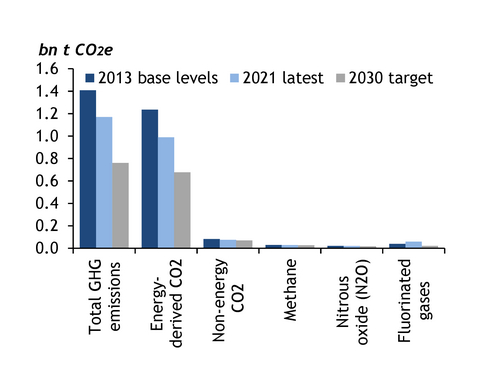
Tokyo is accelerating the roll-out of renewables, nuclear, cleaner fuels such as hydrogen and ammonia, and abatement technologies such as carbon capture and storage, along with energy-saving measures and enhanced diplomacy to secure natural and mineral resources, under its green transformation (GX) policy. But the country, which has been on board with leading mitigation policies, may face challenges to meet its greenhouse gas (GHG) emissions reduction target of 46pc by 2030-31 against 2013-14, given that it only achieved a 20.3pc cut in 2021-22.
Carbon trading lacking credit
As part of the GX strategy the Tokyo Stock Exchange began national carbon credit trading on 11 October, 18 years after the EU emissions trading system was set up. But initial trading is limited to J-credits — government-certified amounts of GHG emissions reduced or removed through energy savings, renewables and forest sinks — and domestic investors, which may hamper liquidity expansion. Japan's carbon pricing scheme is yet to come, with carbon levies on fossil fuels scheduled to start in 2028-29 and the auctioning of emissions quotas in 2033-34.
Japan's relatively slow progress on carbon pricing and its ‘all of the above' energy approach towards meeting net zero may be deemed internationally as a lack of ambition. This was obvious from the fact that Kishida was not invited as a speaker to this year's UN-convened Climate Ambition Summit in September. Former premier Yoshihide Suga, who advocated the 2030-31 emissions target and 2050 net zero goal, sent a video message to the previous summit in 2020.