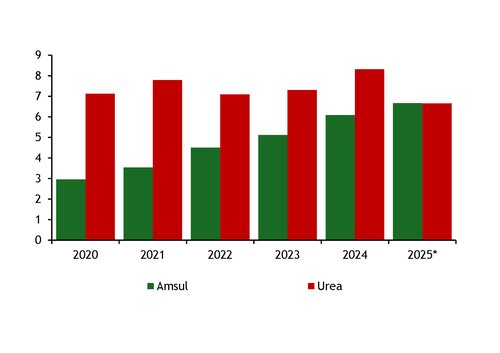
Ammonium sulphate imports will continue to match urea imports in Brazil next year, as high urea prices and increased availability of amsul have been steadily leading farmers away from the former and towards the latter.
Brazil's urea imports have historically been 2mn-3mn t/yr higher than its amsul imports, but urea's lead has eroded as amsul has become more affordable for farmers. Amsul is also more easily available and has less volatile pricing. Brazil's amsul imports almost tripled over 2018-24, rising to more than 6mn t/yr, while urea imports increased by almost 2mn t/yr to around 8mn t/yr over the same period.
Argus-assessed amsul prices averaged $178/t cfr over August-November, which is when Brazil does its lion's share of its amsul buying, in line with the same period last year. Amsul prices averaged $244/t cfr over August-November 2020-24. Brazil imported nearly equal volumes of urea and amsul in January-November this year, at around 6.7mn t of each product, trade data show.
Going into 2026, Brazil will maintain its position as the only market capable of absorbing leftover amsul in the market, but Chinese output will probably fall next year, which could compensate for some Chinese supplies being redirected to Brazil and away from other regions.
Mexico re-imposed an $181/t import duty on Chinese amsul on 25 November. The onset of the EU's carbon border adjustment mechanism from 1 January may keep European buyers away from Chinese imports, at least in the first quarter. Depending on the specifics of the regulation, some Chinese amsul producers may be rendered uncompetitive in the European market.
Meanwhile, the Chinese caprolactam-grade amsul industry is likely to adopt a more "self-disciplined" strategy next year, keeping operating rates below 80pc and being more cautious to commit to contracts of affreightment. Most compacted amsul shipments from China to Brazil are covered by contracts of affreightment, which can lead to a build-up of unsold amsul in Brazil during the peak season, which may pressure equivalent urea purchases or offers.
Buyers usually expect the price per nitrogen unit to be lower in amsul than urea, as amsul requires additional logistical and operational costs to bring the fertilizer to the fields and to apply. Twice the volume of amsul is required compared with urea for an equivalent amount of nitrogen.
Affordability has been a key concern globally this year, with record highs for urea prices. Brazil is no exception, with the Argus nitrogen affordability index for Brazil averaging 0.87 over January-November, compared with 1.05 in the past four years. The lower the index, the worse fertilizer affordability is for farmers against their crop sales, making lower-cost nitrogen sources such as amsul more attractive.
Weather conditions also affect urea-amsul substitution. Amsul is less volatile than urea, with the latter losing its nitrogen content easily during heatwaves or period of heavy rainfall, reducing the amount of nutrient available for the crop. Amsul can be stored more easily for long periods in warehouses compared with urea, which is more sensitive to heat.
Availability and pricing are important considerations but there are a few barriers to amsul increasing its market share against urea.
Corn is the main crop that can substitute urea with amsul. But falling corn prices are discouraging farmers from investing in the crop. Using more amsul over a long period can change the acid-to-alkaline balance of the soil, hampering yields, market participants said.
The extent to which amsul can be successfully substituted depends on the region, the soil specifications in each field and which other fertilizers are being combined with it in NPK blends. Brazil can successfully swap amsul for urea as a raw material for most blends, but not those with single super phosphate, as the combined sulphur content would be too high.
The availability of suitable trucks has also been a concern this year, preventing inland amsul transport. Record grain exports will continue to compete with fertilizer imports for trucks at Brazilian ports in 2026, meaning urea will be easier to transport as half as much is needed compared with amsul. Lastly, Brazil's fertilizer storage capacity is small and fertilizers compete with agricultural products for warehouse space, preventing large volumes being imported.