An enforceable federal-level ethanol mandate — based on an improved version of Queensland's current scheme — is key to supporting domestic ethanol production, according to the industry body Australian Sugar Manufacturers (ASM).
Ethanol is a feedstock for producing sustainable aviation fuel and renewable diesel, but the absence of a federal mandate — combined with "exemptions and loopholes" in Queensland's state-based policy — has reduced incentives to produce ethanol, said the ASM's chief executive Ash Salardini in a statement released last week.
Queensland's bio-based gasoline mandate requires 4pc of the total volume of regular unleaded gasoline sales and ethanol-blended fuel sales by liable fuel retailers to be ethanol. Retailers are only subject to the ethanol mandate if they operate 10 or more sites or sell more than 500,000 litres of all grades of petrol across any site in a calendar quarter.
But the mandate's effectiveness has been limited. Exemptions are routinely granted for reasons including the cost to upgrade infrastructure, the unavailability of compatible infrastructure and ethanol supply issues. This has eroded compliance and depressed domestic demand, said Salardini. The Queensland government has previously said that in any given quarter since the introduction of the mandate in January 2017, around half of liable fuel retailers have held an exemption, and this is currently still the case, according to market participants.
A "strong, enforceable" mandate and state and federal investment is required to provide the certainty needed by the sugar manufacturing and ethanol industries to expand production, Salardini said. Several existing sugar mills could be converted to produce ethanol, but without clear government policy to create demand, there is no commercial incentive to proceed, he added.
New South Wales (NSW) has a higher 6pc ethanol mandate, but like in Queensland, the mandate has never been reached. Fuel retailers may claim exemptions from blending ethanol when the price exceeds the NSW Independent Pricing and Regulatory Tribunal's (IPART's) "reasonable wholesale price" of ethanol. This price is based on a nine-month average of weekly price estimates from the lowest-cost origin for ethanol from either the US or Brazil plus freight, the current rate of fuel excise, customs duty and port costs. IPART's determinations set a ceiling price for domestic ethanol prices, as selling above that threshold allows retailers to avoid blending requirements.
Exports rise on slow domestic demand
Ethanol has increasingly been exported from Australia, primarily to markets with stronger ethanol blending requirements, such as the Philippines, which has a 10pc ethanol mandate.
Australia exported 112.2mn l of denatured and undenatured ethanol last year, with 71pc of those volumes heading to the Philippines, according to Global Trade Tracker (GTT) data. Most of those exports were from the port of Sydney in NSW, as producer Manildra has been able to capture a premium compared to selling domestically for gasoline blending. Australia imported 1.4mn l of imported denatured and undenatured ethanol in 2025, according to GTT data.
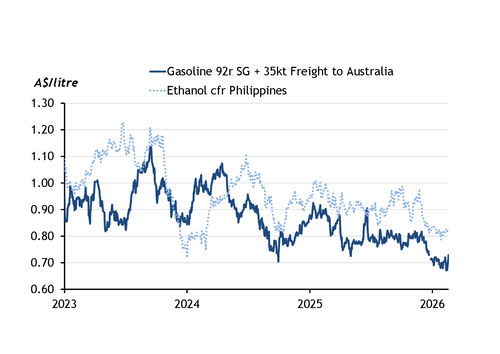
Since mid-2024, Argus price data (see graph) shows ethanol delivered to the Philippines maintained a strong premium compared to gasoline delivered to Australian east coast ports. Ethanol generally needs to be cheaper than gasoline to be commercially viable in fuel blending in the absence of a strong mandate, due to ethanol's lower energy content. Because of this, Australia's ethanol producers have been price takers, with the gasoline import price effectively setting the ceiling price. Premiums can be achieved for food-grade ethanol and ethanol's use in chemical manufacturing for items such as hand sanitiser.
Production has also been below capacity in recent years. Australia currently has two ethanol-producing plants — Wilmar's 60mn l/yr sugarcane-based plant in Sarina, Queensland, and Manildra's 300mn l/yr wheat-starch plant in Nowra, NSW. Both operated well below capacity in 2022, producing about 175mn litres combined, according to a 2025 Bioenergy Australia report. The plants are currently still operating below capacity, according to market participants.
The Australian Taxation Office (ATO) updated excise taxes on 2 February this year, setting the excise on ethanol at A$0.172/l ($0.12/l) compared to A$0.526/l for gasoline. The ATO considers blends of ethanol and gasoline with 10pc or less ethanol (E10) to be 100pc petrol and the excise is A$0.526/l.
There is no mandate for ethanol blending in other Australian states like Victoria, South Australia or Western Australia.
The Queensland government is conducting an inquiry into sugarcane bioenergy opportunities, with a report due on 31 March.