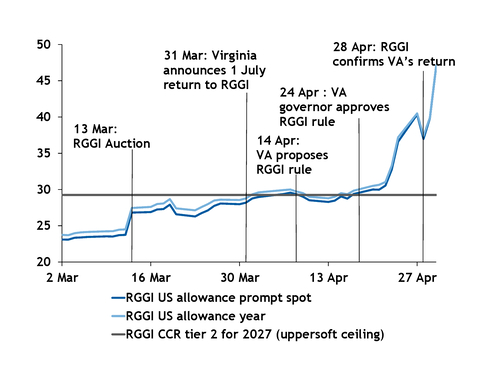
The Regional Greenhouse Gas Initiative (RGGI) CO2 allowance trading market catapulted to historic levels in recent days ahead of Virginia's earlier-than-expected return to the program in July, leaving market participants confounded over the cause behind the record rise in prices.
The northeast US power plant cap-and-trade program has set a series of record highs since 20 April, with prompt-month and December 2026 allowances soaring as much as 44pc week on week to $47/short ton (st) and $47.09/st, respectively, on Thursday.
That bull run was likely kickstarted, at least in part, by news that Virginia would rejoin RGGI as soon as 1 July, six months earlier than what most market participants had anticipated. Prices jumped further on Wednesday after the current 10 RGGI member states affirmed Virginia's mid-year reentry.
Participants expect the RGGI market to become short as a result of Virginia's return, given the vast power-hungry data center market continues to boost electricity demand. In addition, CO2 emissions from the state's power plants covered by RGGI have been on an upward trend since its exit in 2023.
Virginia's emissions are on track to reach 7.5mn st for the first quarter of this year, according to preliminary US Environmental Protection Agency data. The state's adjusted RGGI emissions cap for the latter half of this year is set at just under 11.5mn st.
"Virginia has absolutely been a factor and probably will be dominant in the near term," said Paola Tamayo, a senior policy and data analyst at the Acadia Center, a non-profit clean energy research group.
But Virginia's summertime return may only be part of the reason behind the dramatic rally.
The state's return had been expected by both RGGI officials and market participants since at least 2025. In addition, prices had jumped considerably after governor Abigail Spanberger (D) — who had promised to rejoin the program during her campaign — handily won the November 2025 election in Virginia. As a result, participants widely believed that the state's return to RGGI was already priced in the market at the time.
Even when accounting for Virginia's earlier-than-expected return, that six-month difference is unlikely to be enough to drive prices up drastically when accounting for "the size of the bank and the total number of RGGI allowances as the cap goes down to zero," according to Bill Shobe, a professor at the University of Virginia and a member of the state's Air Pollution Control Board.
In addition, there is uncertainty in the market over the terms of Virginia's return, which are currently being negotiated between state regulators and the current 10 member states. Those terms could include an initial allocation to account for allowances would have been accrued during the years Virginia was not a participant in RGGI, which could dampen the level of demand the state could bring into the market.
Still, Virginia's announcement that it would return in July, followed by state regulators' efforts to propose and finalize rules to rejoin RGGI made it "more real" said Justin Johnson, the RGGI representative for the International Emissions Trading Association (IETA).
"That's the big change, is it's real," he said.
Everything, everywhere all at once
While Virginia's return to RGGI has amplified bullish sentiments, additional factors are likely contributing to the record high allowance prices.
Speculative activity might have spiked as prices began to rise, with speculators attempting to capitalize on the gains in the secondary market. Their long positions jumped by 10.7pc to nearly 14,500 contracts, but their short positions tumbled by 14.1pc to over 5,300 contracts during the week ended 21 April, according to the latest US Commodities Futures Trading Commission data.
In addition, participants, including returning compliance entities in Virginia like Dominion Energy, could be buying allowances now in anticipation of potentially higher prices in the future, driving up demand.
"I absolutely think that there's some buying ahead [of Virginia's return] … so it's not all about people just looking at it and saying, oh, gee, the market's going to get tighter. It might be that, gee, we're going to have an obligation," said Johnson.
At the same time, potential sellers may be holding off if they expect the price to increase. As a result, these combined factors may also be creating a feedback loop as allowances increase, reinforcing participants' behavior and pushing prices ever higher, Johnson said.
Dominion, the largest utility in Virgina, did not respond to requests for comment on Virginia's return to RGGI or on the rising allowance prices.
Macro uncertainties around the PJM Interconnection market, which serves 13 eastern states including Virginia, could also be contributing to uncertainty in the RGGI market. PJM has had to reckon with a backlogged interconnection queue as well as record-high capacity auctions.
"Another thing I think that's playing into all of this, given the sort of hostility in some areas of government towards renewables, [is] we've seen a sort of slowdown in when renewables [are] coming online," which could be bolstering expectations for increased power plant emissions, Johnson said.
In addition, cyclical weather patterns, which affect electricity demand, remain a driver of compliance demand in the RGGI market. Temperatures in the northeastern US are expected rise to higher-than-normal levels this summer, according to the National Weather Service.
Still, there may yet still be other reasons behind soaring allowance prices. But the lack of a clear reason has left market participants, observers and experts alike baffled.
"Markets are strange in the way they respond to events in the sense that we can't really know what's going on in people's minds," Shobe said.
We're all in this together
The bullish run in the market, however, is unlikely to ruffle the feathers of the RGGI states for now, which are likely following developments in the secondary market closely and waiting to see whether such high prices will persist at the upcoming June auction.
RGGI did not respond to requests for comment.
Member states have had to contend with rising energy prices, which have become a contentious political issue in overall considerations over affordability.
Northeast US states have had to balance affordability with their climate goals, which are some of the most stringent in the nation and are increasingly being framed as an obstacle towards lowering costs.
Still, RGGI is a vehicle for member states to raise revenue for clean energy and energy efficiency investments and, more importantly, ratepayer rebates to compensate for rising costs.
"I still think policymakers still view RGGI as a very high value revenue source for those programs in the sense that it's an efficient way to raise revenue," said to Jamie Dickerson, senior director of climate and clean energy programs at the Acadia Center.
While it is difficult for all of the RGGI states to quickly agree on and implement measures to mitigate prices, the issue of high allowance prices could be considered during the 2028 program review. In addition, individual states could implement their own measures, such as front-loading allowances from future supply to be sold during current auctions. But such measures would likely only have temporary relief, Johnson said.
As a result, the market's rally is unlikely to disturb the agreement among RGGI states to implement the cap-and-trade program.
"Since 2009, these states have all been working together, even though they disagree on lots of other stuff", Shobe said. "Every time the program was under stress, they got together and worked to change it in ways that strengthened it again, and I think states still want to do that."