Strong downstream demand for electronic components and tantalum bearing alloys have supported the tantalum market at historically high levels through the second half of 2026, but market participants have questioned if current raw material prices are sustainable in the medium term.
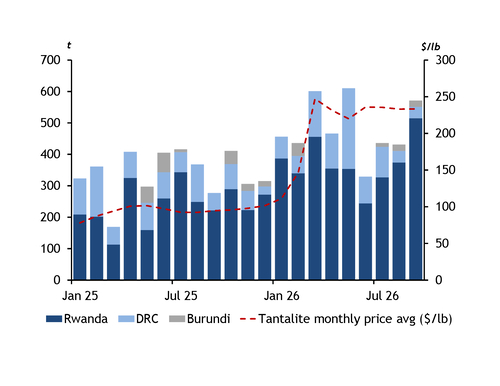
The Argus benchmark price assessment for tantalum concentrates (tantalite) rose to an all-time high of $285-295/lb cif main port in late March, up by 269pc from the start of the year. Prices have since settled slightly lower, averaging around $236/lb in the second half of the year, but remain at historically high levels that were last achieved in the early 2000s. Argus last assessed the international ore market at $240-245/lb cif main port on 20 October.
Likewise, the European tantalum metal assessment more than doubled in the three months through to the end of March, peaking at $850-875/kg duty unpaid Rotterdam, and settling at $810-870/kg in August-October.
Artificial intelligence (AI) buildout is the biggest factor driving the increased demand for tantalum products.
Major capacitor makers such as Taiwan's Yageo and Japan's Kyocera have reported significant boosts from AI demand, with Yageo describing the current demand cycle as a structural transformation for the electronics component industry. Yageo's consolidated sales for January-August were up by almost 35pc on the year at 115.1bn New Taiwan dollars ($3.62bn) while Kyocera's sales revenues for its electronic components segment increased by 11.5pc on the year in January-June.
The AI boom has also led to tighter supply and higher demand for advanced memory and logic chips used in data centres and consumer electronics. Chip fabricators are a significant downstream consumer of high purity tantalum and tantalum nitride sputtering targets, which are used to apply a thin film barrier layer over copper interconnects within some integrated circuits. US combined imports of memory chips under the HS code 854232 and logic chips under HS code 854231 rose by 42pc to $30.6bn in January-August of 2026, up from $21.6bn in the same period of 2025, trade data show.
Furthermore, the need to power data centres has driven demand for tantalum ingots and scrap needed to produce superalloys for industrial gas turbines (IGTs). Major IGT producer GE Vernova's order backlog grew to 53GW in the second quarter of 2026, up from 44GW in the first quarter, and the company expects to have up to 125GW under contract by the end of the year. At least 20pc of their contracted customers are now data centres, GE Vernova has said.
But AI is not the only factor driving demand. Defence demand for tantalum capacitors and tantalum bearing alloys is also rising, and the US Defence Logistics Aagency (DLA) has begun to stockpile metal.
Tantalum capacitors are less likely to fail in high stress environments than some other capacitor models, making them essential to military and aerospace electronics which often operate in extreme conditions inside missiles, satellites and radar systems. Tantalum metal is also added to some nickel-based superalloys required for jet engines and tantalum carbide is used as a coating in rocket nozzles, thermal protection systems and hypersonics.
The US Defense Logistic Agency (DLA) awarded a $100mn contract to US tantalum producer Global Advanced Metals (GAM) for tantalum ingots in 2025, which market participants expect to tie up a significant portion of GAM's production over the next five years and tighten the availability of US-produced tantalum for other consumers.
But despite the strong downstream demand signals, some market participants consider current tantalite price levels to be unsustainable in the medium term and expect the market to come under pressure if spot liquidity eases. Although capacitor demand has increased by double digits, this does not justify the price of tantalite doubling on the year, one trader said.
Additionally, current price levels for tantalite have prompted some smaller smelters in China to pull back from the spot market and draw down stocks instead of sourcing more material from Africa, market participants told Argus. The tantalite market often goes through cycles of peaks and troughs in response to surges in demand from end users and some buyers are hesitant to take on stock while prices are at historic highs in case prices move significantly lower again.
China's imports of tantalum and niobium concentrate from the key African origination markets Rwanda, DRC, and Burundi peaked at 610t in May, but dipped in June-August as buyers slowed purchases in response to higher prices and ample stocks. Imports increased again on the month in September, rising to 571t. This coincided with an uptick in enquiries from some larger smelters and led to firmer prices above $240/lb cif China in October.