Корпоративное управление и внутренний контроль
Внутренний контроль и этика
- Вступление
- Передовой опыт, используемый в отрасли
- Корпоративная структура и управление
- Этические стандарты
- Штат компании
- Данные и их защита
- Сбор ценовой информации
- Политика внесения исправлений
- Методология и внутренний контроль
- Внешний аудит
- Консультации и контакты с участниками рынка
- Порядок рассмотрения жалоб
- Контактная информация

Проверка соответствия стандартам
Все публикуемые Argus котировки товарно-сырьевых рынков ежегодно проходят независимую проверку на соответствие стандартам. Последний из таких аудитов был проведен в октябре 2025 г.
Скачать
Методология
Для расчета котировок Argus использует специализированные методики, учитывающие особенности конкретного рынка. Мы проводим консультации с различными участниками рынка и размещаем на нашем сайте методики, которые используем при подготовке каждого из отчетов.
Узнать большеКонсультации и пересмотр методик
Все методики регулярно пересматриваются с тем, чтобы они отвечали потребностям участников рынка и соответствовали стандартам отрасли. Argus стремится точно и объективно отражать особенности функционирования рынка, не навязывая участникам свое мнение.
В июне – июле 2021 г. компания Argus провела консультацию по изменению методики Argus O.M.R. Fuels:
Argus proposes to change the way outright E10 and 98 Ron gasoline prices are calculated to incorporate the regional variation in differentials to the price of E5 gasoline.
Under this proposal, Argus would calculate E10 and 98 Ron outright prices using regional differentials to the relevant regional E5 price. Currently, outright prices are calculated using national consensus E10 and 98 Ron differentials and regional E5 price assessments. As part of this change, assessed E10 and 98 Ron differentials will be published as a single value for each product and region, rather than as a low-high range for each.
Argus would also like feedback on the timing of this proposed change, specifically whether 1 October 2021 or 1 January 2022 is preferable.
At the same time, Argus would like to more clearly define a general approach to legislation that affects fca truck prices. As the implementation date of a relevant law approaches — for example, legislation setting out gradually increasing CO2 levies or greenhouse gas savings requirements — Argus may exclude transactions that are expected to load after the date the law comes into effect, or which are priced in a way that indicates the inclusion of the new levy.
This would effectively reduce the typical 28-day loading window for transactions considered for inclusion in Argus assessments. Argus will discuss any new legislation with market participants in advance, to determine whether this approach should be taken.
To discuss comments on this proposal, please contact Kevin Schaefer or Hagen Reiners at kevin.schaefer@argusmedia.com or hagen.reiners@argusmedia.com. Formal comments should be marked as such and may be submitted via e-mail to Germanfuels@argusmedia.com and received by 31 July 2021. Please note, formal comments will be published after the consultation period unless confidentiality is specifically requested.
По итогам консультации поступило три ответа от заинтересованных лиц, которые дали согласие на публикацию своих комментариев.
Результат консультации по котировкам бензина E10 и бензина с октановым числом 98
Following consultation, from 1 January 2022 Argus will calculate daily E10 and 98 Ron outright prices using a daily assessment of the prevailing regional differential to the corresponding regional E5 price assessment. As part of this change, assessed E10 and 98 Ron differentials will be published as a single value for each product and region, rather than as a low-high range for each, and the existing national differentials will be discontinued.
Argus will soon begin daily publication of regional E10 and 98 Ron differentials in the Argus O.M.R Fuels report. Regional E10 and 98 Ron differentials for 17 August 2021 are included here as a guide.
| Regional E10 and 98 Ron differentials to E5 on 17 August 2021 | ||
|---|---|---|
| E10 | 98 Ron | |
| North | -1.60 €/100l | 6.70 €/100l |
| Seefeld | -1.60 €/100l | 6.70 €/100l |
| Emsland | -5.00 €/100l | 5.90 €/100l |
| East | -1.60 €/100l | 6.70 €/100l |
| Magdeburg | -1.60 €/100l | 6.70 €/100l |
| West | -1.60 €/100l | 6.70 €/100l |
| Southeast | -1.60 €/100l | 6.70 €/100l |
| Cologne Lowland | -1.60 €/100l | 6.70 €/100l |
| Rhine-Main | -1.60 €/100l | 6.70 €/100l |
| South | -1.60 €/100l | 6.70 €/100l |
| Southwest | -1.60 €/100l | 6.70 €/100l |
В апреле – мае 2020 г. Argus провел консультацию по внесению изменений в методику сервиса Argus German Fuels.
Во время данной консультации поступило шесть ответов от заинтересованных лиц, которые дали согласие на публикацию своих комментариев.
Ответ Argus
В ответ на отзывы, полученные от участников рынка в ходе официальных консультаций, в соответствии с принципами деятельности ценовых агентств, установленными Международной организацией комиссий по ценным бумагам (IOSCO), Argus опубликовал следующее объявление:
Outcome of the consultation on methodology changes related to the integration of Argus and O.M.R. services
London/Kellinghusen, 15 May 2020 (Argus O.M.R.) — Following consultation, Argus and O.M.R. will merge Argus German Fuels (Argus Handel) and O.M.R.’s Inland Price Assessments into a single report and online service publishing prices produced according to both methodologies at the start of 2021. Further integration of Argus and O.M.R. will occur as we combine the activities of our journalists into one team. That group will continue to produce low, high and volume-weighted average price assessments, offering the market a choice of pricing methodology to use in term contracts. A comprehensive list of price assessments that will be included in the Argus OMR service from the start of January 2021 is available here.
Timing
Following consultation, that overarching integration of Argus O.M.R. will occur at the start of January 2021. The alignment of regions will occur to a different timeline than initially proposed, and with a revision to the West pricing region.
The location Gustavsburg will be added to the vDIP Argus O.M.R. price for the Rhein-Main region from 1 January 2021 instead of 1 June 2020 as initially proposed.
From 1 January 2021 price region West will also include locations Neuss and Düsseldorf with a freight differential to Duisburg, like the current vDIP Argus price region Niederrhein-Ruhr.
From 1 June 2020 Argus will add vDIP prices for the East and Emsland regions.
Transactions in the low/high assessment process
O.M.R. low/high price assessments are currently based on reported offer prices and list prices received by email. From the start of January 2021, Argus O.M.R. will primarily base its low/high price assessments on reported transactions, using reported offers only when liquidity is low.
Argus has been collecting transaction data from the German downstream market for heating oil, diesel and gasoline since 2014 and now receives several hundred transactions from a growing number of market participants every day. Argus editors and reporters test the data to identify and remove outliers or other anomalous trades, after which the resulting set of data is used in the production of the Argus volume-weighted average price assessments published in Argus German Fuels.
From the start of January 2021, that cleaned trade data will also form the basis of the low/high Argus O.M.R. assessments. The high price will be the highest price at which 90m³ of heating oil and diesel and 30m³ of E5 gasoline traded in the relevant location, and the low price will be the lowest price at which 90m³ of heating oil and diesel and 30m³ of E5 gasoline traded in the relevant location. If either the high or low traded price did not trade in at least 90m³ or 30m³, Argus O.M.R. will publish a volume-weighted average of the highest-priced or lowest-priced trades whose total aggregate volume meets the 90m³ or 30m³ threshold.
If less than 500m³ of total volume is reported for a given assessment or fewer than six parties report transactions, Argus O.M.R. reporters may also take offers into account in the published low/high assessment.
Argus O.M.R. will continue to publish the midpoint price for each region as the mean of the low/high assessment.
Argus O.M.R. will cease publication of the existing Argus low and high prices, which are simply the lowest and highest reported trade for a region.
Sample data
Sample price data produced using the new methodologies described in this announcement will be made available on request. Click here to register.
Transactions and the Intraday Price Prisma
To preserve the relevance and utility of the Prisma indications, Argus O.M.R. will incorporate trade information in their creation. From the start of January 2021, the Prisma indications will incorporate trade information in a similar way to the new end-of-day low/high methodology.
Although increasingly common, not all market participants can report trades to us throughout the day. Accordingly, Argus O.M.R. editors will continue to survey market participants for both order and trade prices to inform the Prisma indications.
Assessment and Intraday Price Prisma timing
From the start of January 2021, Argus O.M.R. will advance the end times of those three survey periods, which would serve as cut-off times for information to be considered in the Prisma or end-of-day price assessments. Accordingly, information received until 11:15 will be included in the first Prisma assessment, information received until 14:15 will be included in the second Prisma assessment, and information received up to 17:00 will be included in the end-of-day assessment. Argus O.M.R. editors and reporters will continue to contact market participants by telephone and electronically throughout the day. Information about trades completed after 17:00 Central European Time and/or reported to Argus after 17:00 London time may not be considered for inclusion in the assessment.
Regional alignment
Argus and O.M.R have historically produced prices according to slightly different regional definitions. From the start of January 2021, pricing regions will fully align, and low/high and volume-weighted average price assessments will be produced for:
- North - Hamburg
- West - Duisburg, Gelsenkirchen, Essen base with Neuss and Düsseldorf
- Cologne Bay - Cologne, Cologne-Godorf, Wesseling
- Rhein-Main - Frankfurt base with Flörsheim, Raunheim, Gustavsburg, Hanau, Aschaffenburg
- Southeast - Cunnersdorf, Gera, Hartmannsdorf, Leuna, Rhäsa, Thüringen (Lederhose)
- Southwest - Karlsruhe
- South - Ingolstadt, Vohburg, Neustadt
- Magdeburg - Magdeburg
- Seefeld-Schwedt - Seefeld, PCK Schwedt
- East - Berlin including Kablow
- Emsland - Lingen, Osnabrück, Münster
From the start of June 2020, Argus O.M.R. will cease the Argus assessments for Munich.
Volume-weighted averages become vDIP
To more clearly differentiate the various types of assessments published by Argus O.M.R., the current set of Argus volume-weighted average price assessments will be renamed “vDIP Argus O.M.R.”. The methodology governing those prices will not change.
Standardising 98 Ron and E10 assessments
Both Argus and O.M.R. publish price assessments in the less liquid 98 Ron and E10 markets based on differentials to the more active trade in E5 gasoline. From the start of January 2021, both low/high and vDIP assessments will use a single assessment of a national consensus differential to E5, as currently reported in Argus German Fuels for 98 Ron and E10 gasoline, which will then be applied to regional E5 low/high and vDIP assessments to produce outright regional 98 Ron and E10 gasoline prices.
Conclusion
Thank you very much for your response to this consultation. We look forward to working with you on bringing more transparency to the German downstream market.
Best regards,
Kevin Schaefer, Hagen Reiners
Geschäftsführer Editor - German Fuels

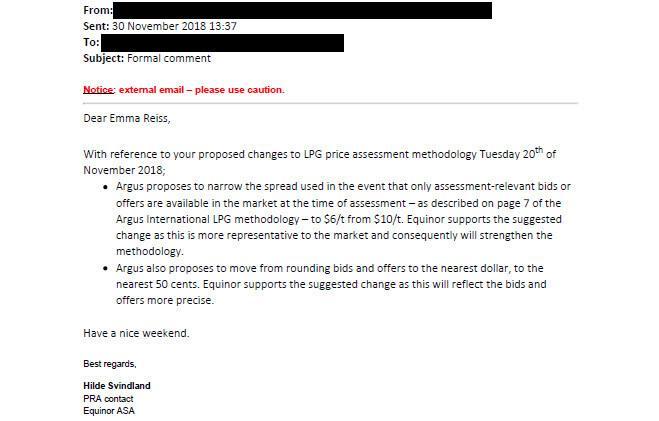
В октябре – ноябре 2018 г. компания Argus провела консультацию по внесению изменений в методику определения котировок СУГ:
Лондон, 19 октября (Argus) — В ответ на запросы участников рынка Argus предлагает уменьшить разницу, используемую в том случае, если на момент определения котировки на рынке доступны только предложения покупки или продажи, актуальные для данной котировки (в порядке, изложенном на стр. 7 методики сервиса Argus International LPG), с $10/т до $6/т
Argus также предлагает перейти от округления цен спроса и предложения до ближайшего доллара к округлению до ближайших 50 центов.
На данное дискуссионное предложение поступил один ответ заинтересованного лица, которое дало согласие на публикацию своих комментариев.
Ответ Argus
В ответ на отзывы, полученные от участников рынка в ходе официальных консультаций, в соответствии с принципами деятельности ценовых агентств, установленными Международной организацией комиссий по ценным бумагам (IOSCO), Argus опубликовал следующее объявление:
Argus уменьшит дифференциалы цен на пропан и бутан в Северо-Западной Европе и Средиземноморье с $10/т до $6/т.
После консультаций Argus уменьшит ценовую разницу, публикуемую в том случае, если на момент определения котировки на рынке доступны только предложения покупки или продажи, актуальные для данной котировки, с $10/т до $6/т. Изменение вступит в силу в среду 2 января 2019 г.
После консультаций, в начале 2019 г. Argus также начнет округлять цены спроса и предложения до ближайших 50 центов вместо ближайшего доллара. Точная дата вступления этого изменения не может быть объявлена в настоящее время по техническим причинам, но будет объявлена в ближайшее время.
В декабре 2017 г. компания Argus провела консультацию о внесении изменений в методику определения котировок энергетического угля. Argus предлагал расширить спецификации котировок Argus cif ARA и fob Richards Bay 6000, уменьшив значение низшей калорийности угля до 5 700 ккал/кг.
В ходе консультации также предлагалось начиная с 26 февраля 2018 г. сократить минимальный объем партий, учитываемых при расчете котировки Argus cif ARA (5 850 ккал/кг), до 25 тыс. т.
Консультация продолжалась пять недель, и в ходе дискуссии был поднят ряд вопросов, в том числе:
- Что произойдет с текущим индексом для долгосрочных сделок?
- Не должна ли эта спецификация соответствовать спецификации контракта COAL DES ARA 5700, используемого на мировом рынке?
- Зачем нужно сокращать объем партии до 25 тыс. т на базисе поставки DES ARA?
- Почему нельзя параллельно публиковать разные индексы? Несколько участников рынка запрашивали дополнительные данные об объеме рынка угля калорийностью 5700 ккал/кг и о количестве сделок.
- Зачем повышать предельное значение зольности в контракте fob Richards Bay 5700 до 18%?
Во время данной консультации поступило 26 ответов, но только четверо из ответивших заинтересованных лиц дали согласие на публикацию своих комментариев:
Ответ Argus:
В ответ на комментарии, полученные от участников рынка в ходе формального обсуждения методологии в соответствии с принципами деятельности ценовых агентств, установленных Международной организацией комиссий по ценным бумагам (IOSCO), Argus приступает к публикации двух новых котировок физических партий энергетического угля с учетом сделок по реализации угля низшей теплотворной способностью до 5 700 ккал/кг на базисах поставки CIF ARA и FOB Richards Bay.
Публикация этих котировок не нанесет ущерба качеству действующих индексов API 2 и API 4. Argus совместно с заинтересованными лицами начнет надлежащую процедуру пересмотра котировок с целью определить, являются ли котировки CIF ARA и FOB Richards Bay 5 700 ккал/кг достаточно надежными и прозрачными для формирования на их основе новых эталонных индексов.
За дополнительной информацией обращайтесь к Дэну Хейзу.
В апреле – мае 2023 г. компания Argus провела консультацию о внесении изменений в методику определения котировок биотоплива..
Clarifying name of Malaysia/Indonesia POME assessment
London, 17 April (Argus) — Argus proposes to change the name of its RED palm oil mill effluent (POME) fob Malaysia/Indonesia price assessments on Argus Direct and other digital distribution channels — including spot assessments, month-to-date and monthly averages — to exclude the word "biodiesel".
Argus will accept comments on this proposal until 24 April. To discuss this proposal, please contact John Houghton-Brown at john.hbrown@argusmedia.com or +44 20 7780 4281. Formal comments should be marked as such and may be submitted by email to biofuels@argusmedia.com and received by 24 April. Please note, formal comments will be published after the consultation period unless confidentiality is specifically requested.
The formal consultation was expanded and the comment deadline extended.
Proposal to clarify the name of POME assessments
London, 2 May (Argus) — Following consultation, Argus seeks further feedback related to proposals to change the name of its RED palm oil mill effluent (POME) fob Malaysia/Indonesia price assessments on Argus Direct and other digital distribution channels — including spot assessments, month-to-date and monthly averages — to exclude the word "biodiesel".
Argus further proposes to change the name of all POME assessments, including cif ARA and fob Malaysia/Indonesia prices, to "POME oil", to more accurately describe the physical product being assessed.
Argus will accept comments on this proposal until 12 May. To discuss this proposal, please contact John Houghton-Brown at john.hbrown@argusmedia.com or +44 20 7780 4281. Formal comments should be marked as such and may be submitted by email to biofuels@argusmedia.com and received by 12 May. Please note, formal comments will be published after the consultation period unless confidentiality is specifically requested.
The consultation received one response from a stakeholder that agreed that their response could be published.
Ответ Argus
В ответ на отзывы, полученные от участников рынка в ходе официальных консультаций, в соответствии с принципами деятельности ценовых агентств, установленными Международной организацией комиссий по ценным бумагам (IOSCO), Argus опубликовал следующее объявление:
Change to names of POME assessments
Following consultation, Argus will change the name of its RED palm oil mill effluent (POME) fob Malaysia/Indonesia price assessments on Argus Direct and other digital distribution channels — including spot assessments, month-to-date and monthly averages — to exclude the word "biodiesel".
Argus will also change the name of all POME assessments, including cif ARA and fob Malaysia/Indonesia prices, to "POME oil", to describe the physical product being assessed more accurately.
These changes will be implemented on 22 May.
Ответы регулирующим органам
Argus ведет активную политику по связям с общественностью и отслеживает все изменения в законодательстве, затрагивающие сферу его деятельности. Мы регулярно контактируем с законодательными и регулирующими органами, правительствами стран и различными отраслевыми организациями, стараясь обеспечить прозрачность и эффективность функционирования товарно-сырьевых рынков.
ПодробнееКомментарии и жалобы
В Argus установлен порядок рассмотрения официальных жалоб, который изложен на стр. 6 Политики внутреннего контроля. За дополнительной информацией о данной политике и по любым вопросам, связанным с внутренним контролем, обращайтесь к нам.
Заявление в отношении современного рабства
Argus серьезно относится к своим юридическим обязательствам в соответствии с законом «О современном рабстве» 2015 г. Ознакомьтесь с нашим заявлением о мерах, принятых нами для предотвращения современного рабства и торговли людьми в нашем бизнесе и среди наших поставщиков.

Запросить примеры отчетов
Напишите нам на markets@argusmedia.com или заполните форму, и мы
подберем для вас решение, которое будет соответствовать вашим потребностям.