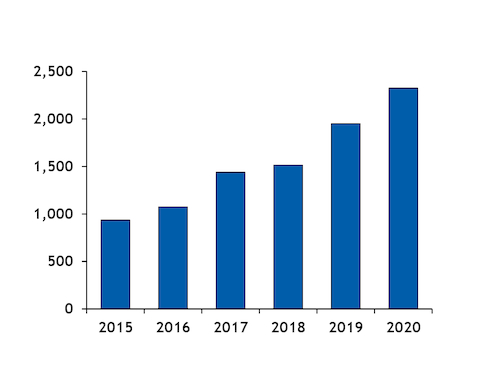
Russian wood pellet exports rose by 19pc on the year to a new record in 2020, as deliveries to northwest Europe climbed and shipments to South Korea more than doubled on the year.
Russia exported 2.32mn t of wood pellets in 2020, an increase of 19pc from 1.95mn t in 2019. And pellet exports in the fourth quarter rose by 11.1pc on the year to 652,000t, but were down by 6.3pc on the third quarter. Russian wood pellet shipments rose both on the year and month to 237,000t in December.
Russian pellet exports set numerous records throughout 2020, boosted by growing demand from European and South Korean industrial users. Despite South Korean pellet demand holding flat on the year in 2020, Russian producers made in-roads to the market. Russia exported 184,000t of wood pellets to South Korea in 2020, more than double the 2019 figure. Russian wood pellets secured a higher share of South Korean demand in 2020, offering more competitive prices compared to 2019 and a higher-CV than southeast Asian pellets. Russian pellets tend to compete with Canadian supply for deliveries into South Korea, given the similarities in quality.
Excluding South Korea, Russian wood pellet exports to Asia reached 22,000t in 2020, the majority of which went to Japan. Comparatively, Russia sent under 1,000t of wood pellets to Asia — excluding South Korea — in 2019.
In Europe, biomass-fired industrial capacity increased in 2020, predominantly in the Netherlands, as co-firing there ramped up. Despite this rise, Russian exports dipped on the year, as Dutch buyers sought North American volumes to cover the demand growth. Russia sent 114,000t of wood pellets to the Netherlands last year, compared to 150,000t in 2019.
But Danish demand for Russian supply rose again in 2020. Russian wood pellet exports to Denmark grew by 22.1pc on the year to 988,000t in 2020, making Denmark by far the largest recipient of Russian pellets.
Overall heat demand was largely flat on the year at 2,432 heating degree days in 2020, compared with 2,399 in 2019, data from Danish utility Orsted show.
The Danish voluntary energy agreement states that utilities must ensure that 90pc of their wood pellet supply is Sustainable Biomass Programme (SBP) compliant in 2020. Orsted hit its 100pc certified sustainable woody biomass target in 2020, up from 96pc in 2019.
To match the requirements, Russian wood pellet producers have ramped up their efforts to obtain SBP certification. There were 26 operational SBP-certified biomass production facilities in Russia at the start of 2020, and by the end of the year there were 50.
Russia's wood pellet exports to Belgium and the UK also grew in 2020. Russian exports to Belgium reached 264,000t last year, up from 85,000t in 2019. Deliveries rose despite the permanent closure of French utility Engie's 80MW Les Awirs power plant at the end of August. Engie still operates the biomass-fired 205MW Rodenhuize 4 (Max Green) facility in Belgium. The rise could be attributed to a growth in shipments taken into the port of Antwerp to then be distributed to other markets, and also increased price competition from Russian wood pellet producers.
Russian shipments to the UK rose by 63.8pc on the year to 213,000t in 2020. Biomass-fired power production increased by 8.3pc to 19.45TWh from 17.96TWh in 2020, data from UK generator Drax and Imperial College London show.
And Czech-Slovak utility EPH's Lynemouth plant in northeast England continued to ramp up available capacity to 75.06pc average in 2020, up from 67.38pc in 2019.
Conversely, Russian exports to Sweden sank to 54,000t in 2020, down sharply from 281,000t in 2019. Forest fires in the summer of 2018 restricted Swedish raw material supply, resulting in a spike in pellet import demand in 2019.
Pellet throughput at the Russian port of St Petersburg climbed to a record high in 2020, with exporters able to significantly increase shiploads as a result of infrastructure upgrades and the streamlining of intra-port logistics, the St Petersburg port authority said.
St Petersburg handled just over 660,000t of wood pellets last year, a rise of almost 50pc from 444,000t in 2019, the port authority said.