More than 2.1mn Houston-area homes and businesses were without power Monday evening following Hurricane Beryl's visit to the region, bringing 90mph winds and up to 2 feet of rain in some locations.
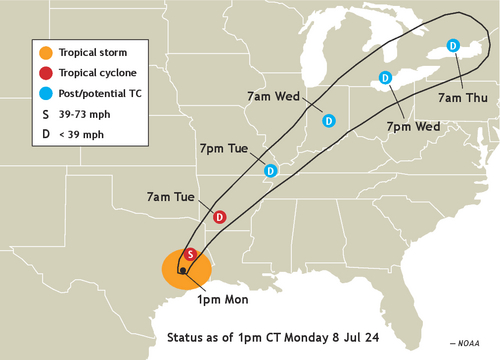
Beryl, which came ashore near Matagorda Bay, Texas, early Monday as a Category 1 hurricane, was downgraded to a tropical storm and is heading into the lower Mississippi and Ohio valleys Tuesday and Wednesday.
Several petrochemical plants pre-emptively shut down or experienced power surges over the weekend before Beryl hit the Texas coast today. Refineries in the region so far are reporting limited operational issues from the storm, but assessments are likely to continue for several days.
The Port of Houston, which was shut to all traffic early Sunday, will remain closed on Tuesday as officials continue to assess damage. The Port of Corpus Christi, which was closed earlier in the weekend, reopened Monday afternoon.
The storm appeared to be heading for the refining and crude export hub of Corpus Christi early in the weekend, but its path shifted to the east, exposing the western side of Houston to some of the strongest winds and rains.
A weather station in Freeport, Texas, directly south of Houston on the Gulf of Mexico, reported a wind gust of 94mph early Monday while a station at the entrance to Galveston Bay and the Houston Ship Channel recorded a gust of 82mph.
More than 2.1mn Houston customers were without power as of 6pm ET according to outages tracked by CenterPoint Energy, as tree limbs and winds brought down power lines.
Water levels at the Interstate 610 bridge on the Houston Ship Channel -- home to several refineries and petrochemical plants –- were observed at 10 feet above mean low water levels at 11am ET, well into the "major flooding" range, according to data from the National Oceanic and Atmospheric Administration (NOAA).
The storm had minimal impact on Gulf of Mexico oil and natural gas production given its path far to the west of most offshore platforms. Companies began to send workers who had been evacuated from some offshore sites late last week back to their sites on Sunday.
Beryl is the second named storm of the 2024 Atlantic hurricane season, following tropical storm Alberto, which came ashore in northeastern Mexico late last month. This year's Atlantic hurricane season is expected to be more active than normal, according to the US National Oceanic and Atmospheric Administration, with 4-7 major hurricanes that pack sustained winds of 111mph or higher possible.