A core group of eight Opec+ producers meet on 3 May to decide whether to repeat last month's surprise move to add extra oil to an increasingly weak market.
The main motivation for the group of eight's decision to triple the size of their output increase for May remains, suggesting that a repeat could be on the cards for June. As the dust began to settle on last month's decision, it became clear that raising their combined output target by 411,000 b/d in one month, rather than the scheduled 137,000 b/d, was rooted not only in stronger fundamentals, as the official communique suggests, but also in a desire to send a message to those countries that have persistently breached their production targets.
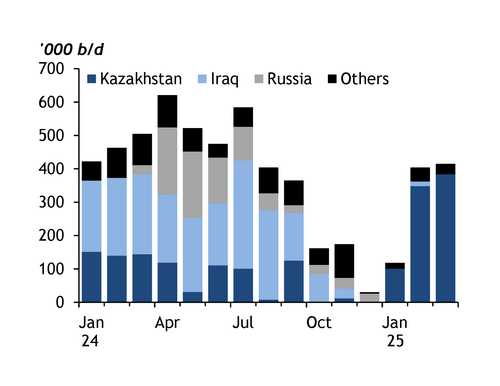
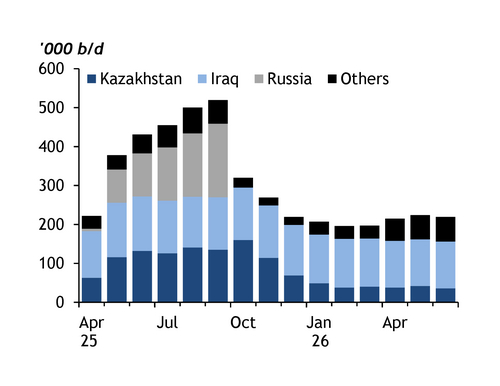
The main culprits are Iraq and Kazakhstan, which have consistently failed to keep their production in check since the start of last year (see graph). The two are left with a lot to do by way of compensating for those excess barrels between now and the middle of next year (see graph). Russia, too, has overproduced during that period, but to a much lesser degree relative to its overall output.
That persistent overproduction has been a source of deep frustration among other countries in the group of eight — principally the core of Opec's Mideast Gulf members — that have "sacrificed", in the words of one delegate, to adhere to their targets. April's decision was a nod to those that have sacrificed and a sharp warning to Kazakhstan and Iraq to do better and to do so quickly. Two delegates stressed to Argus at the time that the coming weeks would be critical for Baghdad and Astana to show that they were serious about abiding by their quotas. Failure to do so could trigger another "surprise" move for June, they said, possibly even another three-in-one hike.
It was little surprise, then, that some ill-timed comments by Kazakh energy minister Yerlan Akkenzhenov on 23 April — in which he explicitly said Astana's national interests take priority over its Opec+ commitments, and that the country simply "cannot" reduce output — triggered serious speculation about whether the eight may repeat last month's decision. March data from Iraq, too, were not ideal, in that while they showed that Iraq did produce below quota, its efforts to compensate fell well short.
Timing is everything
Some in the group of eight may well be tempted to go down that route, thinking a second consecutive "shock" could deliver the desired wake-up call that the first did not. Two delegate sources confirmed to Argus that another 411,000 b/d target increase for June remains a distinct possibility. But such a course of action would be risky. Crude is already trading $12/bl below where it was when the group last met, and demand-side concerns are again on the rise because of the potential impact of US trade tariffs.
The Opec secretariat and the IEA downgraded 2025 oil demand growth forecasts in their latest oil market outlooks. Opec revised its forecast down to 1.3mn b/d from 1.45mn b/d in its previous report. The IEA revised down its forecast by a sizeable 310,000 b/d to 730,000 b/d for 2025, despite "robust" consumption in the first quarter. It downgraded its forecast for April-December by 400,000 b/d. Another three-in-one hike for June would be "difficult" to imagine in this market, one delegate says.
With that said, the eight's options include a "standard" 137,000 b/d rise to the group's collective target for June, in line with the original schedule, or, at a push, a two-in-one hike. That would not only send that internal message to the least compliant of the group, but also act as a show of good faith towards US president Donald Trump ahead of his visit to Riyadh, Abu Dhabi and Doha on 13-16 May.