Power consumption from oil and gas production on Norway's continental shelf (NCS) is expected to increase sharply by 2030 as operators electrify fields and processing sites to reduce emissions, industry body Offshore Norway told Argus, but doing so with power from shore is attracting significant political interest.
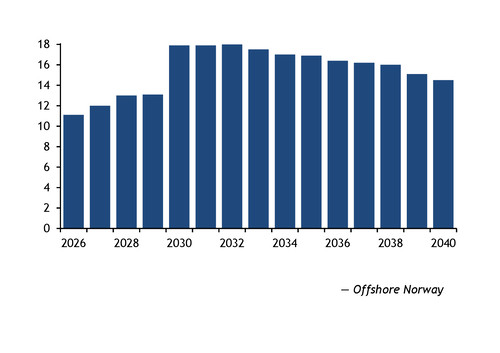
Operational consumption from fully or partially electrified production reached about 10TWh in 2025, according to Offshore Norway data. Consumption is expected to grow slowly to 2029, averaging 670 GWh/yr in new operational capacity.
But from 2030, NCS electrification is forecast to take a substantial leap forward, as significant projects such as the 350MW Hammerfest LNG plant come on line (see power demand graph).
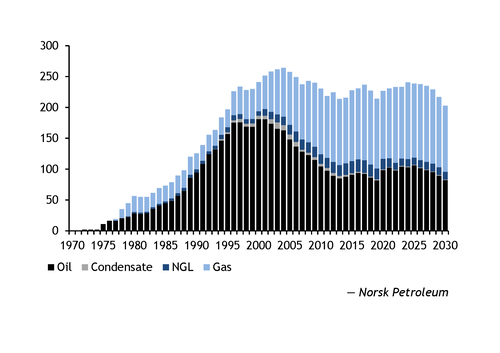
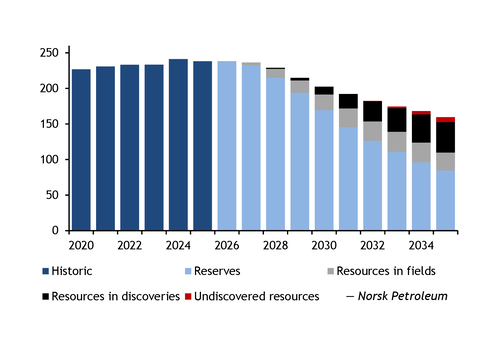
Consumption will reach as much as 17.9 TWh/yr, with 17.2 TWh/yr operational or holding a grid reservation, according to Offshore Norway data, before tapering as oil and gas production declines towards the end of the next decade (see hydrocarbon output graphs).
But the 2030 rise is likely to be less dramatic than forecast, with Equinor having decided to cancel electrification works on the Halten Bank and Tampen fields — which were included in Offshore Norway's 2025 modelling — citing project economics late last year.
That leaves several electrification projects under construction, but just one in the planning phase, according to the Norwegian Offshore Directorate (NOD) — Equinor's Grane-Balder project. The major is targeting a 120MW grid connection for the two offshore oil and gas fields.
Electrifying away emissions
Electrifying oil and gas installations with power from shore is the measure operators consider most important for reducing emissions, Offshore Norway told Argus, and helps the industry meet its legislated 50pc Scope 1 emissions reduction by 2030 from 1990 levels.
Norway now has 39 fields partly or wholly operated with power from shore or with final investment decisions (FIDs) to electrify, according to the NOD, up from 16 in 2020.
That has reduced the industry's greenhouse gas emissions to about 11mn t of CO2 equivalent (CO2e) in 2024 from 13.6mn t/CO2e in 2005, Offshore Norway said. And if all operator measures are realised, the industry expects emissions to fall by 47pc by 2030 compared with 2005. Shore power is expected to reduce emissions by 3mn t/CO2e by 2030, according to data from Norwegian petroleum industry association KonKraft.
Electrifying the entire NCS has never been a goal per se, Offshore Norway said. Instead, "the objective is to eliminate emissions from key hubs on the shelf", to "maintain the competitiveness of the NCS", which faces significant pressure from EU emissions trading system and other carbon costs, the group said.
The government agreed, with state secretary Snorre Skjevrak telling Argus "broad electrification…has never been a priority". Instead, the "aim is to reduce emissions from the production of oil and gas". This lowers the "high price on carbon" operators face, which is "much higher than in other oil and gas-producing countries".
But given that high price, operators have broadly "assessed which installations" are best suited for "conversion to power to shore", Skjevrak said, which means the "best projects are already in operation or in the execution phase", explaining why there is no new wave of conversion projects coming despite electrification already proving useful in "enabling tie-ins of new discoveries" and "extending the operational lifetime of existing fields", Svjevrak added.
Offshore Norway acknowledged that the "remaining electrification projects are dependent on cost efficiency", in line with the government's assessment, but also pointed to the "ongoing debate" about NCS electrification and "who should have access to power".
Power politics
The Norwegian government approved Equinor's plans to electrify gas processing at the Hammerfest LNG terminal in 2023, marking "Norway's largest climate initiative", KonKraft said.
But late last year the parliamentary energy committee brought forward several motions to halt or delay the plan.
Parliamentarians questioned whether a tightening power situation, which is "completely different" from when Norway approved the first projects, is appropriate for further electrification, noting that Offshore Norway's forecast of 18TWh consumption by 2032 is equivalent to 11pc of national output.
The initiatives would have ended the electrification process at Hammerfest, blocked further NCS electrification with mainland power and required oil and gas producers to power their assets using offshore wind and gas with carbon capture.
The plans, which the government and industry opposed, risked the "stable framework conditions" required to deliver a "balanced energy transition", Equinor chief executive Anders Opedal said.
Demanding supply
Parliament's focus on offshore electrification and the power balance comes despite project cancellations and complex economics hampering the growth outlook, and more pressing demand sources elsewhere.
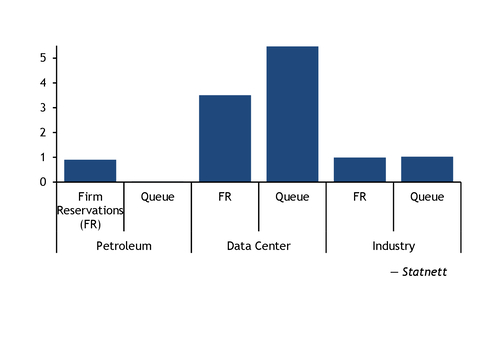
Norwegian petroleum projects with a grid reservation totalled about 901MW across four bidding areas. Last year, KonKraft forecast an additional 2 TWh/yr in incremental demand from power-from-shore projects approaching an FID, but two of those three projects have since been cancelled.
Petroleum industry enquiries for grid connections are small relative to other sectors, Offshore Norway told Argus, with grid operator Statnett data suggesting that the sector is well behind data centres and heavy industry in terms of both firm reservations and projects in the queue (see grid queue graph).
And Statnett's future scenarios forecast that the sector's power consumption will fall to the fourth largest by 2040, and be overtaken by data centres and hydrogen production by 2050.