Electricity demand in Spain's car manufacturing sector is unlikely to rebound in the near term, as falling production volumes owing to the shift from internal combustion engines (Ice) to electric vehicles (EVs) continue to outweigh higher electrification and a growing EV supply chain.
Although EV manufacturing has grown since 2023, a much sharper decline in output of Ice units means EV growth has been unable to offset the overall decline in production.
The automotive industry's raw output continues to fall from its 2017-19 peak. In 2025, passenger car output fell by 12pc on the year, according to the latest data from Spain's tourism and industry ministry Mintur. And so far in 2026, Mintur data show that manufacturing output for the sector is down by 7.2pc on the year compared with the equivalent period of 2025.
Spain's automotive industry association Anfac president, Jose Lopez-Tafall, attributes the country's falling production from the pre-pandemic peak to two factors. "One of these factors is negative and one is positive," Lopez-Tafall said at Anfac's 2026 forum. "The negative is that 90pc of our exports continue to go to the European market." The Anfac president added that "if Europe gets the flu, Spain does too", referring to weakening demand in Europe impacting Spain's manufacturing output.
Europe's declining demand in recent years reflects the bottleneck as manufacturers have been slow in their transition to majority EV manufacturing over Ice. Spain's transition to produce EVs at an increasing scale has hurt output, as factories are forced to adopt new and complicated processes, according to Lopez-Tafall. But he pointed to major progress in this area which he believes will help the industry in the long term, as Spain will transition from producing 22 EV models in 2025 to 32 this year, likely supporting EV output going forward.
This decline has outweighed higher electrification, with the industry moving more of its energy consumption towards electricity over the past 10 years.
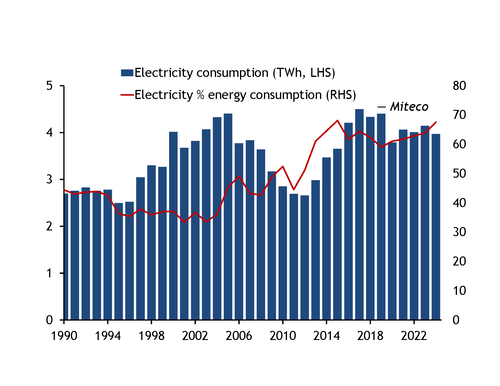
So far this decade, 63.4pc of the industry's final energy consumption has come from electricity, according to data from the ecological transition ministry Miteco (see demand graph). This is up from about 58.9pc in 2010-19 and just 40.6pc in 2000-09.
The increasing share of electricity has displaced oil products and, to a lesser extent, natural gas. The former has fallen from a share of about 11pc in final energy demand over 2010-19 to less than 3pc so far this decade.
Despite progress in electrification, outright power demand in the automotive sector has receded since its peak in the late 2010s. Excluding the outlier of 2020, which was heavily impacted by Covid-19, power demand in the sector was below 4TWh for the first time since 2015 in 2024, and down by about 12pc from the 2017 peak.
EV manufacturing picking up, but not quickly enough
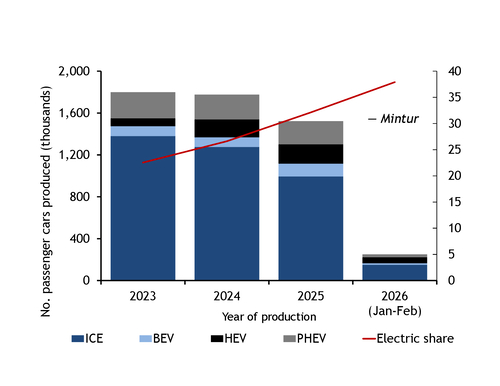
Production of Ice passenger car models reached about 2.2mn in 2019, before a steady decline to reach a year-end figure of about 1mn in 2025, according to Mintur.
EVs are yet to make up the Ice deficit, but the sector has registered growth across the past four years. Mintur records production data for battery EVs (BEVs), hybrid EVs (HEVs) and plug-in HEVs (PHEVs). Since Mintur began recording the full breakdown of EV passenger car production in 2023, these three categories have risen to 176,000 units produced in 2025 from 139,000 units in 2023 (see car production graph). Most of the growth in EV production across this period has largely come as a result of HEV output, rather than from BEVs or PHEVs.
Spain's government launched the Spain Auto 2030 plan in December to address the country's slow progress in EV production and purchasing. Under the new scheme, Spain is targeting total vehicle production across all types of 2.7mn by 2035 — an increase of about 10pc from 2023 levels.
And the government intends for 95pc of these units to be EVs, meaning production of about 2.55mn/yr by the end of the decade. This would mean an increase in EV production of at least three times in the next four years. The plan also notes that the average BEV vehicle requires 10MWh of electricity consumption per unit, double the average for an Ice model.
EV supply chain to support sector growth
The Spanish government has earmarked major financial support to build up the country's EV industry along the entire supply chain.
The Perte Vec scheme has awarded €837mn to EV battery production projects across Spain.
One of the largest recipients from the scheme was Dutch firm Stellantis, the largest car manufacturer in Spain by total output. The firm received €114mn from the scheme for its Figueruelas EV battery gigafactory near Zaragoza in northern Spain. Stellantis is building the factory as part of a joint venture with Chinese battery firm CATL, with construction starting in November 2025. The venture will have capacity of up to 50GWh with production likely to start at the end of 2026, according to Stellantis.
The Perte Vec scheme also allocated €167mn to Volkswagen's Sagunto gigafactory near Valencia in 2022. The site has a planned capacity of 40GWh with the option to expand to 60GWh, with first production starting this year, according to Volkswagen.