Drought conditions are worsening across much of the US southeast as of the week ended 23 April, which threatens to delay organic corn planting in a tight market.
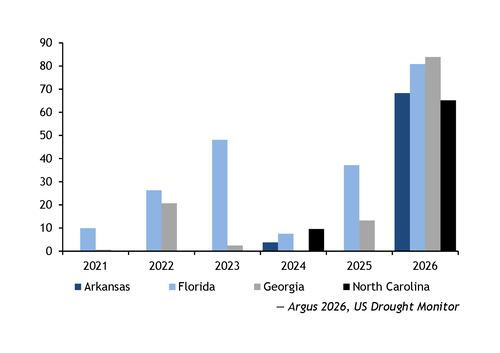
The organic corn Argus Organic Drought Index (AODI) worsened by 44 points or more from a year earlier for Georgia, Florida, and Arkansas, which combined for over 73pc of US southeast organic corn acreage in 2025, Argus data show.
The decline extended up the east coast, with the AODI for North Carolina reaching 69 in the latest week, up 51 points from a year earlier.
The organic corn AODI weights drought data from the US Drought Monitor by organic corn operations in each county. It ranges from zero to 100, with 0 representing no drought and 100 representing catastrophic drought affecting all organic corn farms in the state.
Conventional corn planting has already begun in the southeast and many organic farmers have prepared their corn fields for planting but are facing potential delays from the dry conditions in the soil.
Delays in organic corn planting into late May or June could reduce yields and delay harvest in the fall. The southeast is not a significant producer of organic corn compared with the Corn Belt or High Plains, but the southeast's earlier harvest makes the region's harvest important for delivery in August through the first half of October.
Despite the marketing year beginning in September, new crop supplies from the key production regions in and around the Corn Belt are normally not available until the second half of October because of the time needed to harvest and transport the grain to mills. Organic feed operations, especially poultry operations in the southeast, rely on the southeast harvest to bridge that gap.
The US will carry over little, if any, organic corn into the 2026-27 marketing year, with few unsold stocks currently available east of the Mississippi river, market contacts said. Many end-users are still uncovered for the third quarter and a delayed or smaller harvest in the southeast will further increase organic corn demand in September. Few buyers have bought significant new crop organic corn supplies, market contacts said.
Organic broiler production is continuing to grow on the east coast and southeast, driven by strong consumer demand for organic chicken, which could further increase feed demand in the region, market contacts said.
There is still time for moisture to improve across the southeast ahead of planting, with the National Oceanic and Atmospheric Administration expecting at or above average rain in Georgia and Florida in the coming week. Farmers will look for strong rain followed by a drier period for an opportunity to plant.
Moisture conditions improved across much of the Corn Belt, with Missouri being the only Corn Belt state to get worse from the prior year. The solid moisture conditions in the Corn Belt are supportive of the overall fall harvest. Current East Coast and Corn Belt new crop organic corn bids are several dollars below current spot prices, but any risks to supply would support new crop values.