Storage facilities have closed at pace, as falling domestic demand and increased competition force a switch to industry consolidation, writes Reina Maeda
Japan has closed LPG storage facilities with a combined capacity of more than 628,000t over the past two years as a result of declining demand, the latest Global LPG Storage Survey finds. Many of the units are being converted to store ammonia as the country looks to establish supply chains for renewable forms of the fuel.
Japan's total LPG storage capacity is down by 15pc to about 3.5mn t in the latest quarterly update of the survey, which updates Asia-Pacific, from 4.2mn t in 2024, owing to changing market conditions. Importers and distributors are increasingly looking towards consolidating with other companies and rationalising their operations to reduce costs, in particular those associated with maintaining ageing infrastructure. At the same time, petrochemical producers are shutting down their facilities as they are faced with declining domestic demand for olefins and intensifying international competition.
Japanese refiner Idemitsu in late 2024 announced plans to convert storage space at two of the country's largest LPG import terminals operated by its jointly owned subsidiary Astomos to ammonia by 2030. The Tokuyama facility in the Yamaguchi prefecture had capacity to store nearly 120,000t of LPG, while the Namikata terminal in Ehime prefecture could accommodate 182,000t. The former terminal regularly received more than 200,000 t/yr of LPG before 2018, while the latter achieved this level at its peak during 2018-19, data from analytics firm Kpler show. Astomos said at the time that it chose not to renew its contracts as part of cost-cutting measures because of flagging demand. The Tokuyama terminal shut down in March 2024 while Namikata was closed in March last year.
Astomos has partnered with fellow importer Gyxis to distribute LPG in the central Chukyo area since 2025 after closing one of two storage facilities in Hekinan, Aichi prefecture — owned by Idemitsu — in June 2025. The Hekinan terminal that closed could hold 52,500t of propane and the other 26,900t of butane. The terminal received more than 500,000t of LPG in 2014, and then took about 290,000 t/yr over 2015-24 as imports declined, Kpler data show.
Astomos has also collaborated with Japan Gas Energy for LPG sales in the Toyama prefecture since April 2024, but it has not shut down any storage facilities yet.
Refiner Eneos has also shut down several LPG storage facilities, including its Kawasaki, Wakayama and Kagoshima facilities. It permanently closed the 120,000 b/d Wakayama refinery in October 2023, including about 22,500t of LPG storage. The company also plans to shut down one of its integrated ethylene steam crackers at its 249,100 b/d Kawasaki refinery in March 2028, owing to falling domestic demand for ethylene and growing competition from overseas producers, the firm said in May.
Aichi fleet
Astomos and Toho Gas' LPG sales arm, Toho Liquefied Gas, partnered in May 2025 to streamline their operations in the central Chukyo area. They have recently discussed the possibility of reducing their tank storage capacity but have yet to disclose anything concrete. Toho Liquefied Gas owns a storage facility in Nagoya, Aichi prefecture, which can store about 2,800t of propane and 2,400t of butane.
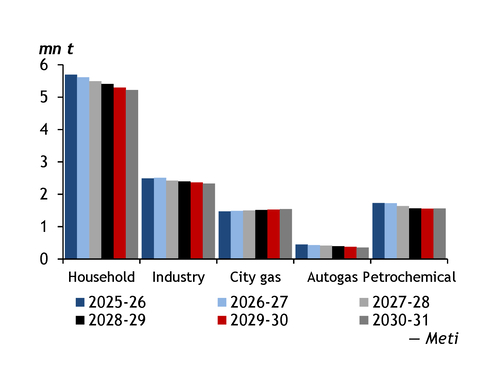
Japan's LPG demand is expected to fall to about 11mn t in 2030-31, pressured by lower requirements from the household sector due to an increase in energy efficiency and a drop in population in rural parts of the country, according to the latest outlook by economy, trade and industry ministry Meti.