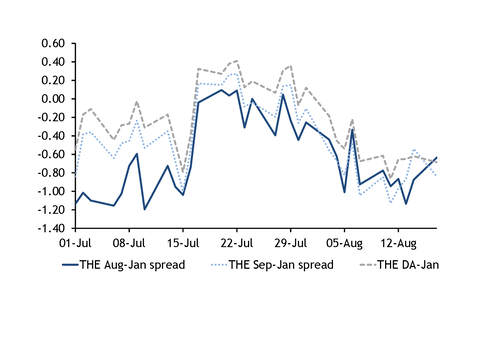
Stronger LNG and pipeline gas deliveries coupled with growing financial incentives to inject and a potentially mild autumn could offer some hope for an accelerated late stockbuild in Europe.
Higher European gas prices and weaker buying interest from Asia have shut the inter-basin arbitrage for US LNG exports in recent weeks. This supported a rise in LNG deliveries to Europe last week to 1.7mn t, the highest since the week starting 8 June and up from 1.4mn t a week earlier.
Forward prices suggest Europe could remain the preferred destination for US fob LNG cargoes well into the fourth quarter, because northeast Asian demand is limited in the shoulder season and high global prices have muted buying interest from price-sensitive Asian buyers. An LNG influx could provide European markets with critical supply to adequately fill underground storage ahead of the start of the heating season.
LNG sendout could be 322mn m³/d in September and 413mn m³/d in October, Argus analytics data show. If realised, that would be a significant increase from sendout of 238.7mn m³/d so far this month, although it would be lower than 378.8mn m³/d and 450.9mn m³/d, respectively, in September and October last year.
One of the drivers bringing more cargoes into Europe is the emergence of stronger injection incentives.
Earlier this summer, a lack of firm economic incentives to inject left many firms uninterested in competing for LNG cargoes against Asian buyers, which were eager to replace lost Qatari volumes during periods of peak summer demand. But with the Mideast Gulf conflict far from reaching a resolution, traders in Europe have started pricing winter demand risk into the fourth-quarter and January contracts, resulting in them strengthening relative to prompt prices.
The German THE September contract held €0.84/MWh below the January price at the latest close, moving out from a -€0.55/MWh spread at the beginning of this month and an average -€0.26/MWh throughout July (see graph). Injections into German sites — where the government has not intervened yet to promote injections despite low fill levels — will largely determine the health of the EU's start-of-winter inventories.
Additionally, lighter seasonal maintenance across Norway's offshore production in September could make more gas available for injection next month. Capacity cuts at Norwegian fields and processing plants were scheduled as of Tuesday to be 23.1mn m³/d and 79.16mn m³/d in September, lower than a year earlier. If the works are not revised, this could lift Norwegian production to 281mn m³/d, according to Argus analytics data, from output of 257.3mn m³/d a year earlier. But some maintenance could be extended and unplanned works are also possible.
In any event, there is still a large stock gap to bridge in a short period of time. Aggregate EU inventories on Monday morning were 212TWh below the five-year average and 146TWh lower than a year earlier.
Injections would have to be 3.3 TWh/d from 17 August-31 October to bring inventories in line with last year's level by 1 November. This is more than double the 1.4 TWh/d injected over the same period last year, but not much higher than actual injections of 2.9 TWh/d in 2022, when the bloc rushed to fill its inventories to make up for the loss of Russian gas supply.
To reach a 70pc fill level across Europe by 1 November, aggregate injections would also have to be a still strong 2.2 TWh/d.
Weather could support Europe's stockbuild
The El Nino weather phenomenon is poised to intensify from August and raise global temperatures above long-term averages.
The European Centre for Medium-Range Weather Forecasts (ECMWF) on 11 August pointed to higher-than-normal temperatures across most of Europe in September and October, which could dampen gas demand for heating and leave spare supply available to inject.
Long-term weather forecasts on Tuesday projected minimum temperatures in Amsterdam and Paris holding 0.8-1.2°C above average in September, although they were forecast to be 0.8°C below average in Essen during the same period.
But higher-than-normal temperatures in September could also extend the use of air conditioning, especially in southern Europe. The ECMWF projected significantly higher-than-average temperatures in September in central and eastern Europe and southeastern Europe, where extreme heat and disruption to nuclear generation have already lifted power-sector gas demand.