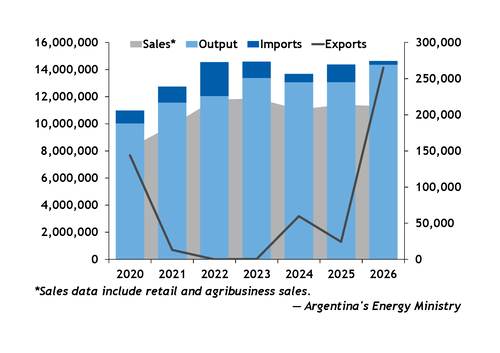
Argentina is edging closer to balancing its gasoline and diesel trade as stronger refinery output and weaker domestic demand narrow the fuel trade deficit and increase exports.
Combined gasoline and diesel exports reached 264,955m³ (7,860 b/d) in January-July, up by nearly elevenfold from the same period last year. At the same time, imports fell by 78pc to 283,405m³, the lowest for the first seven months of a year since at least the pandemic-hit 2020.
While Argentina remains a net importer of transportation fuels, it is closer to being in balance than it has been in recent years. For much of the past decade, Argentina relied on imported gasoline and, particularly, diesel to supplement domestic refinery production and satisfy domestic demand. The latest trade data indicate that dependence on imports is declining.
Part of the shift reflects the recovery from Argentina's biggest refineries maintenance programs that increased import requirements in 2025. Refineries that underwent work last year are now operating at high utilization rates, some even above nameplate capacity, generating additional volumes at a time when domestic fuel consumption remains weak.
YPF's La Plata refinery, Argentina's largest, operated at an average utilization rate of 101pc this year, processing 204,042 b/d.
Instead of securing barrels to meet demand, refiners are increasingly seeking outlets for excess production, supplying adjacent markets such as Uruguay, Paraguay and Bolivia.
The shift is visible across both major transportation fuels. Gasoline exports rose to 90,730m³ in January-July from just 132m³ a year earlier, supported largely by shipments from state-controlled YPF. Diesel exports climbed to 174,225m³ from 24,130m³.
Import requirements moved in the opposite direction. Diesel imports fell to 121,995m³ year-to-date July from 786,183m³ a year earlier, while gasoline imports fell to 161,409m³ from 506,666m³ over the same period.
Demand hit
But stronger refinery output tells only part of the story. Lower domestic consumption has also contributed to the change in Argentina's fuel balance.
Fuel demand is at its lowest level since 2021, when economic activity and mobility were still recovering from the effects of the Covid-19 pandemic. The decline extends a trend that has emerged since President Javier Milei took office in late 2023 and began dismantling fuel subsidies that had kept domestic prices below international levels.
As retail prices moved closer to international parity, fuel consumption growth slowed and some of the factors that had supported demand began to fade. For years, artificially low fuel prices encouraged higher consumption and helped sustain cross-border fuel purchases and smuggling into neighboring countries where retail values were often higher. Higher prices have reduced those incentives, bringing domestic demand closer to underlying market conditions.
The shift also reflects broader changes in Argentina's energy system. Greater use of natural gas from the Vaca Muerta shale formation has reduced gasoil consumption in the power sector, lowering the need for imported middle distillates.
More recently, pump prices received an additional boost from higher international values after the US-Iran war started in late February. State-controlled YPF sought to cushion consumers from part of that increase through a temporary pricing buffer, absorbing a portion of higher crude costs before ending the mechanism in July.
The cumulative effect has been an increase in fuel costs. Regular gasoline averaged Ps2,047 ($1.35)/liter in July, up by 64pc from a year earlier, while diesel rose by 68pc to Ps2,106/l. Premium gasoline and diesel recorded similar increases. Even in US dollar terms, regular gasoline climbed to about $5.13/USG from $3.40/USG a year earlier, while diesel rose to $5.28/USG from $3.42/USG. Premium gasoline increased to $5.62/USG from $4.03/USG and diesel to $5.81/USG from $3.95/USG.
Argentina has not yet crossed the threshold into net exporter status, and its ability to sustain export growth will depend in part on whether domestic demand will pick up.