

Carbon - In focus: Tech CDR market contracts in Jan-Aug
Discover why CDR credit deals fell in 2026, how Beccs demand collapsed, and why biochar procurement is gaining ground in a shifting carbon market.
Author
TLDR - Technology-based carbon removal (CDR) credit offtake volumes fell sharply to 6mn credits in January-August, down from 24mn a year earlier, largely due to a steep drop in Beccs demand and slower disclosed purchasing by Microsoft. While regulatory uncertainty and fewer public deal announcements weighed on the market, emerging policy support from the EU ETS and SBTi could boost future demand. Meanwhile, biochar continued to gain momentum, with procurement nearly doubling, a broader buyer base emerging, and retirements and issuances increasing across major carbon registries.
The volume of technology-based CO2 removal (CDR) credits signed through long-term offtake agreements fell to about 6mn in January-August, down sharply from 24mn a year earlier, as demand for bioenergy with carbon capture and storage (Beccs) projects fell, data collected by Argus show.
Beccs credits saw the steepest decline — to 2mn from 17mn.
The slowdown is likely to reflect reduced buying by major customers after an exceptional 2025, when several record deals were signed. This year's drop may not necessarily mean fewer transactions, but rather fewer publicly disclosed deals, a market source told Argus.
"This is still a very young market, where a small number of transactions move the numbers and public announcements do not capture all of the activity," direct air capture (DAC) company DeepSky's vice-president for carbon markets, Charlie Renzoni, told Argus.
Reports earlier this year about Microsoft pausing CDR credit purchases may have also curbed demand, even though Microsoft later clarified that it was pacing such operations, not pausing.
Microsoft's disclosed buying slowed sharply to just over 2mn in January-August, down from 16.5mn a year earlier. Of these, some 1.2mn are to be secured from Beccs projects. Earlier this year, the firm said it would review the pace of its CDR procurement. Given its heavy focus on Beccs, Microsoft's retreat probably weighed disproportionately on that share of the market.
Microsoft dominated CDR purchases in 2025, accounting for some 16.5mn Beccs purchases in a handful of large deals. It bought 6.75mn credits from AtmosClear under a 15-year agreement, 5mn credits from Stockholm Exergi over 10 years and around 3.6mn credits from Co280 on a 12-year term. It also closed sizeable deals last year in waste management, biochar and nature-based removals.
Other buyers may also be delaying commitments while awaiting regulatory frameworks offering incentives for Beccs or other technologies.
The most significant of these is the EU's carbon removal and carbon farming (CRCF) framework, a voluntary programme that could enable CDR credits to count under the bloc's emissions trading system (ETS).
"Greater regulatory clarity will help accelerate market development and give buyers and developers the confidence to make the long-term investments required to build carbon removal infrastructure at scale," DeepSky's Renzoni said.
But the CRCF has drawn criticism for failing to create strong demand signals, as participation in its buyers' club scheme is optional and mainly limited to companies already active in the CDR space. As of the end of August, the European Commission said the following companies had expressed interest in the buyers club — NextGen, Carbonfuture, ClimeFi, Climeworks, CUR8, Milkywire, Klimate, Pinwheel, SEB, SE Advisroy Services, South Pole. In addition to these, the Frontier Climate platform — whose members comprise Stripe, Google, Shopify, Antrhopic, Salesforce, H&M, JPMorganChase, McKinsey, Workday and Autodesk — had also expressed interest.
Integration of removals in the ETS could boost demand sharply, supporting investment in long-term projects. Frontier Climate has said it will prioritise funding in jurisdictions developing clear demand-creation policies. Frontier typically backs early-stage engineered CDR solutions. Other platforms and companies are following a similar strategy.
The commission proposed in July — as part of a wider EU ETS review — integrating biogenic CO2 with carbon capture and storage (BioCCS) and DAC with carbon capture and storage (DACCS) into the ETS. CDRs would be purchased by a central EU authority. The bloc has ring-fenced some 250mn allowances for auctioning in 2031-40 to fund these purchases, with another 10mn reserved if revenue gaps emerge.
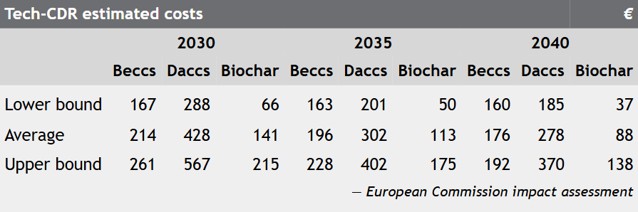
Notably, biochar was left out of the commission's proposal, drawing criticism from market stakeholders and EU lawmakers. Some have also questioned whether the EU's projected CDR costs are realistic (see table). Even so, CDRs' inclusion in the ETS could strengthen confidence and attract public and private investment.
Medium-term support could also come from the Science Based Targets initiative's (SBTi's) renewed Corporate Net-Zero Standard, which mandates certain companies to offset a share of their "remaining" emissions — Scopes 1-3 — with carbon removals starting in 2035. The requirement starts at 1pc of ongoing emissions in 2035 — of which at least 10pc should be permanent removals — and rises progressively until reaching 100pc coverage at the firm's net-zero year. SBTi does not treat removals as a substitute for emissions reductions.
The renewed standard also recognises leaders of voluntary use of removals and climate contributions from the present to 2035.
Biochar resilient
Biochar credits strengthened their position in January-August, with procurement rising to nearly 3mn from 1.5mn a year earlier, driven by larger contracts and a wider buyer base, although technology companies remained at the forefront.
Microsoft remained the largest repeat buyer, but cut its disclosed biochar credit portfolio to 1mn from 1.24mn. Google doubled its purchases to 400,000 credits across multiple deals.
Swiss financier Altitude has emerged as the most active buyer this year, having signed four agreements totalling over 900,000 credits, compared with a single 50,000-credit transaction in 2025.
On the supply side, the market grew more fragmented. This year, buyers have been sourcing from a broader pool of companies — including Liferaft, AMP, Carbonfuture, Equilibrium and Engrow Carbon Energy, alongside Exomad and Varaha. In 2025, sales were concentrated among a few developers, namely Bolivia's Exomad Green, US-based Carba and Charm Industrial, and India's Varaha.
Long-term commitments remained the norm in both years, with many contracts running beyond five years and some stretching to a decade.
Biochar retirements up
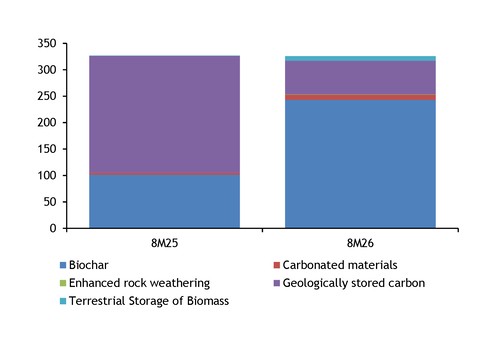
The shift from Beccs to biochar has been reflected in fundamentals data across carbon registries as well. Issuances on Puro.earth and Isometric rose for biochar credits this year. Puro.earth's overall volumes fell on a drop in geologically stored carbon issuances, while Isometric's output jumped sixfold, led by biomass geological storage, enhanced weathering in agriculture and reforestation.
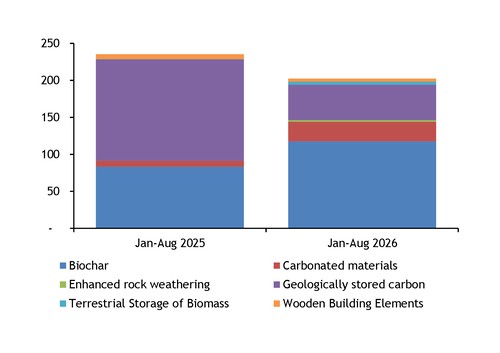
In terms of retirements, Puro.earth saw volumes slip on the year, with geologic credit retirements down by two-thirds, even as biochar retirements climbed by about 25pc. Retirements on Isometric rose fivefold — mostly due to the registry's smaller size — driven by biomass storage and subsurface biomass removal credits.
Biochar retirements on Puro.earth up '000t CO2e
Biochar issuances on Puro.earth up '000t CO2e
TLDR - Technology-based carbon removal (CDR) credit offtake volumes fell sharply to 6mn credits in January-August, down from 24mn a year earlier, largely due to a steep drop in Beccs demand and slower disclosed purchasing by Microsoft. While regulatory uncertainty and fewer public deal announcements weighed on the market, emerging policy support from the EU ETS and SBTi could boost future demand. Meanwhile, biochar continued to gain momentum, with procurement nearly doubling, a broader buyer base emerging, and retirements and issuances increasing across major carbon registries.


