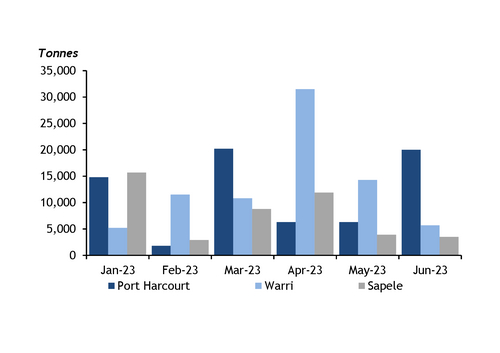
Nigeria's bitumen imports have jumped this year after a boost to road project activity in the wake of the country's elections in February. Market participants expect demand to continue growing under the government of Nigeria's new president Bola Tinubu.
Cargo deliveries to terminals at Warri, Port Harcourt and Sapele in southern Nigeria surpassed 200,000t in the first half of this year, 39pc higher than the same period last year when Vortexa vessel tracking data indicated just 144,000t was imported. Nigerian market participants noted a slowdown in construction work and demand for bitumen imports in the final year of former president Muhammadu Buhari's second term, but they expect Tinubu's more "business-oriented" policy approach to encourage infrastructure investment.
This year's rise in bitumen imports have been driven by deliveries to Warri, which rose by 23,700t on the year to 79,000t in January-June, according to Vortexa, the bulk of which went to Gradient Bitumen's 30,000t capacity terminal. Imports to Port Harcourt and Sapele — largely to Ringardas (Asca) terminals — increased to a respective 69,500t and 47,000t in the first six months of the year, up by 17,200t and 14,900t from the same period of 2022. The largest year-on-year increase was recorded for Warri in April, when imports reached 31,500t, compared with just 7,300t in the same month last year.
Rising spot tanker freight rates for standard 5,000t bitumen tankers have resulted in few, if any, cargoes of this size being shipped to Nigeria from outside the west African region over the past 12 months. But major trading firms such as Vitol and Gunvor have delivered cargoes to Nigeria using their own large tankers, mainly into Warri but also Port Harcourt.
These have added to the regular flow of large cargoes delivered by the fleet of Rubis Asphalt, traditionally the biggest single supplier of bitumen to Nigeria. Meanwhile, smaller tankers operating in west Africa have been regularly used to take cargoes to Nigeria via ship-to-ship transfer from larger incoming vessels from the Mediterranean and the US Gulf coast.
West Africa's only refinery with significant bitumen production — SMB's Abidjan facility in Ivory Coast with its 300,000 t/yr of bitumen capacity — has been increasingly busy since last year meeting a surge in domestic demand in the run-up to Ivory Coast's presidential elections in 2025. This, in turn, has limited the number of bitumen cargoes in the 4,000-5,000t range being exported from Abidjan to Nigeria, Ghana and other regional destinations.
Nigerian construction activity and bitumen consumption have started to fall back in recent weeks due to the onset of the country's main rainy season, which usually lasts through to October. Some local suppliers expect total annual bitumen demand to steadily rise to 400,000-450,000 t/yr in the next few years from around 300,000t on 2022.