Rising steel demand and upcoming furnace expansions within Italy's highly electrified steel sector could increase the country's industrial power consumption. But high energy prices in the wake of the US-Iran conflict may limit sector growth.
Italy is the second-largest steel producer in Europe, after Germany. It has the most electrified steel industry in the region, with 90pc of production coming from secondary steel made from scrap processed in electric arc furnaces in 2024, compared with an EU average of 45pc, according to steel association Federacciai.
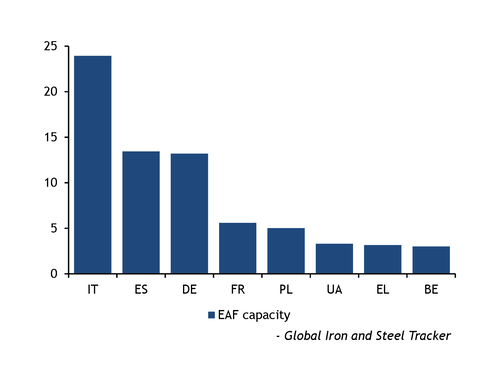
The country had 26 electric arc furnaces with a combined capacity of 23.9mn t/yr at the end of 2025, according to independent research body Global Iron and Steel Tracker (see capacity graph).
Italy's wholesale power prices are consistently among the highest in Europe and prices have risen further since the onset of the US-Iran conflict, owing to Italy's strong gas marginality. Italy's second and third quarter power contracts were up by 39pc at the end of March compared with the end of February.
Italian firms are constructing new electric furnaces that are expected to start operating in the next few years, which could increase steel sector electricity demand.
Producer Acciaierie Venete announced a new 100t electric arc furnace in Padova, expected to be operational by this summer and projected to produce 750,000 t/yr of steel. This furnace alone would consume about 500 GWh/yr of power, assuming energy consumption of modern electric arc furnaces is around 670 kWh/t, based on steel output and power demand recorded in 2025.
Fellow Italian steel producer Metinvest aims to break ground at a site in Piombino in central Italy by mid-2026. The new mill will have two electric arc furnaces and 2.7mn t/yr of hot-rolling capacity for low-emissions hot-rolled products, with production targeted for 2029. These furnaces would add a further 1.8 TWh/yr of power demand.
And steelmaker Acciaierie d'Italia plans to phase out Italy's only coal-fired blast furnaces at its Taranto plant and replace them with electric furnaces. The firm's Taranto facility has operated below full capacity for more than 10 years and was placed under extraordinary administration in February 2024. The Italian government has put the Taranto assets up for tender, requiring any buyer to commit to replacing the furnaces with electric ones, with authorisation for 6mn t/yr. Private equity firm Flacks Group has been selected as the preferred bidder, proposing a plan for 4mn t/yr. The switch to electric furnaces was scheduled for 2027, but doubt has been case over the future of the Taranto site owing to production issues and a court order mandating a shutdown because of health concerns.
State of play
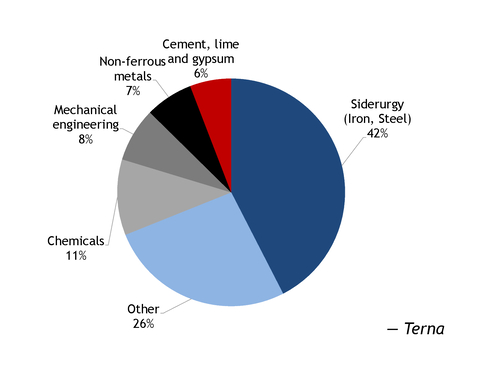
Italy's steel sector accounted for 42.4pc of total power demand from energy-intensive sectors in 2025, at 13.8TWh. This marks a 3.7pc increase from the previous year, according to transmission system operator Terna (see sectoral graph).
Italy's crude steel output rose by 3.6pc to 20.7mn t in 2025, Federacciai data show.
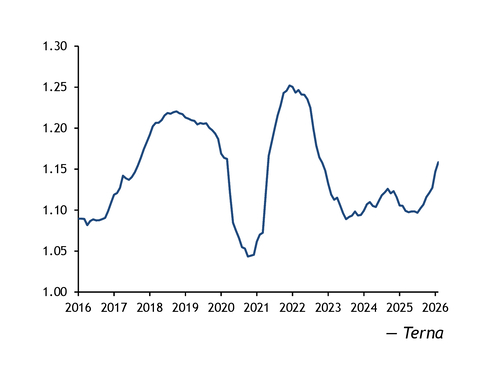
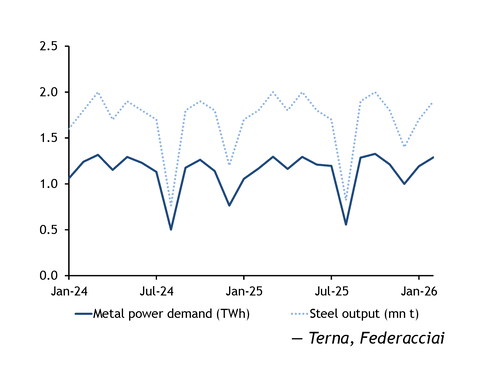
Steel power demand fell by 10pc on the year in 2022 and was stagnant over 2023-24 but turned to growth in 2025 (see long-term demand graph). Monthly power demand has consistently increased year on year since July 2025, driven by increased production in anticipation of higher steel demand in 2026 (see monthly graph). Steel sector power demand reached 1.3TWh in February, up by 3.7pc on the year, mirroring a 2.6pc increase in crude steel output to 1.9mn t.
EU steel demand is forecast to rise by 1.3pc to around 134mn t in 2026, according to European sector association Eurofer. And the EU plans to cut import quotas for flat steel from 1 July. Italy is a major importer of flat steel so the lower quota could boost domestic production.
Energy efficiency in the sector increased over 2015-21, with consumption falling from roughly 800 kWh/t to below 700 kWh/t, data from Federacciai show. But power demand per ton of output has been slowly edging up since 2021.
Geopolitical worries
The Italian government has taken steps to insulate industry from power price increases, but geopolitical risks continue to influence prices.
Italy launched its Energy Release Scheme late last year, offering electricity to energy-intensive users at a fixed price of €65/MWh in exchange for commitments to develop renewable capacity and return equivalent power over 20 years.
But high energy costs will continue to weigh on steelmakers this year, Eurofer director-general Axel Eggert said, pointing to the impact of the Middle East war on gas markets after the Dutch TTF benchmark moved above €50/MWh in early March.
Italian steel and scrap association Assofermet flagged the conflict as a source of potential additional cost pressures in an already volatile market. "Operating complexity and growing concerns related to the Carbon Border Adjustment Mechanism (CBAM) and the upcoming entry into force of the new safeguard measure are significantly weighing on the market," it said.
The rollout of the CBAM — which raises import costs — will be accompanied by a gradual reduction of free allowances under the Emissions Trading System, from which energy intensive industries have long benefited. As free allocations decline, steelmakers will need to buy more allowances, adding further cost burdens.