

$800/t bunker fuel is rewriting shipping's energy playbook
Bunker fuel prices have jumped from ~$462/t to $800+/t this year — and it's reshaping how shipowners think about fuel.
At a glance:
- Rising bunker prices accelerate green shipping
- Wind sails can cut fuel use by up to 10%
- Hydrogen is entering commercial use
- Methanol and biofuels face supply challenges
- Fuel availability remains the biggest barrier
Argus Freight reporting from Clean Maritime Regatta held in Portsmouth
The world changes gradually, then suddenly, as Ernest Hemingway wrote , and nowhere is this more true than in the shipping industry in 2026. The steady growth of green regulations and clean energy targets is creating a gradual metamorphosis in the shipping market, but the US-Iran war has led to soaring prices for traditional fuels — a voyage’s single greatest cost — and led to a sudden rush by shipowners towards energy-saving measures.
Deep-sea vessels traditionally use fuel oil-based bunker fuels and prices have jumped sharply. The price at the port of Singapore, a key bunkering hub, for 0.5pc sulphur 380cst material averaged more than $700/t each month following the start of the Iran war and over $800/t in September, Argus prices show.
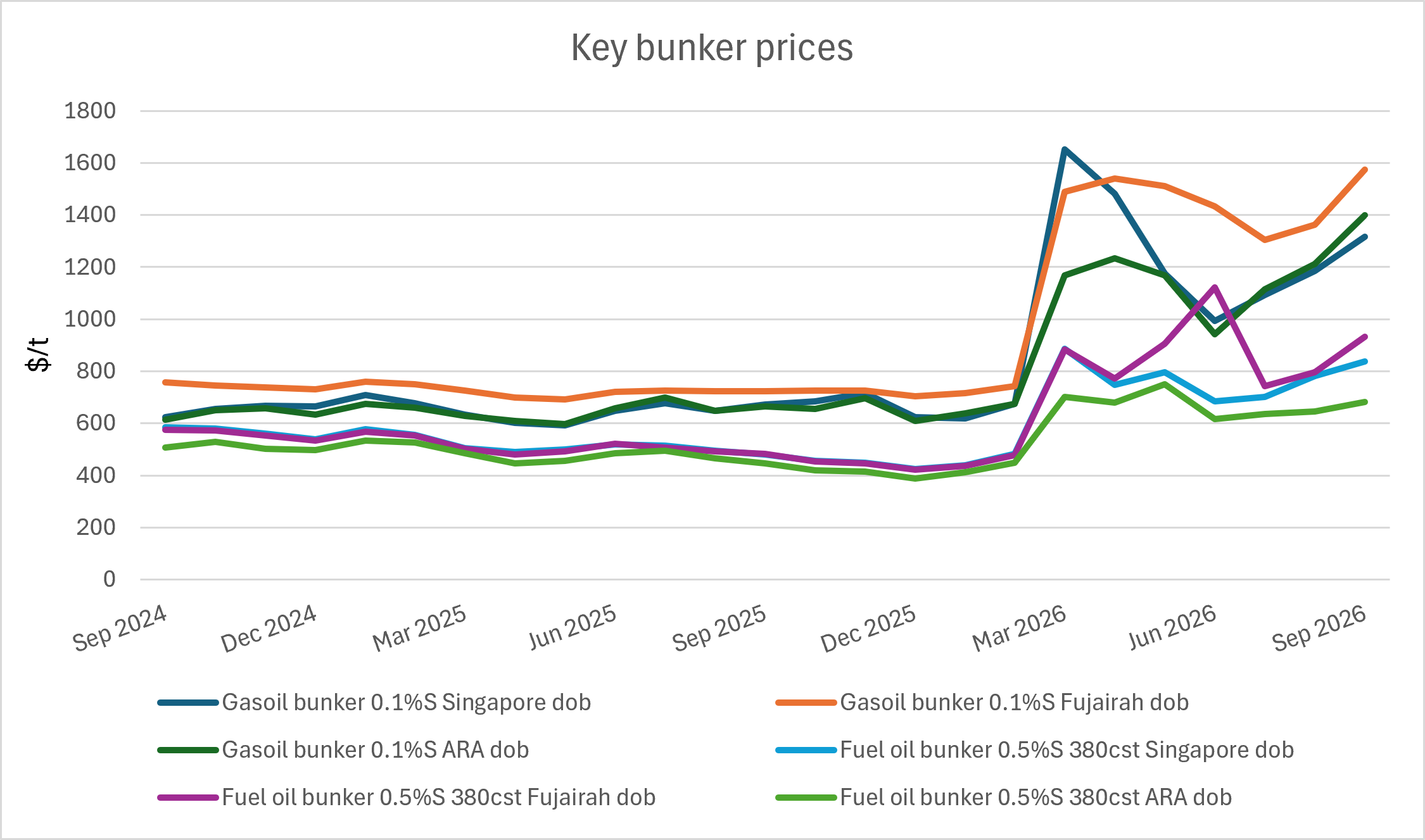
This excludes a brief period in June under the memorandum of understanding, when a reopened strait of Hormuz pushed prices down to a monthly average of $684.26/t.
The January-February 2026 price for the same grade, before the war broke out, averaged $461.95/t, according to Argus.
A very large crude carrier (VLCC) can burn 65 t/d of fuel when laden, so a $350/t increase in bunker prices means that a ship will incur nearly $23,000/d of extra costs, or over $1mn during the course of a standard 45-day voyage.
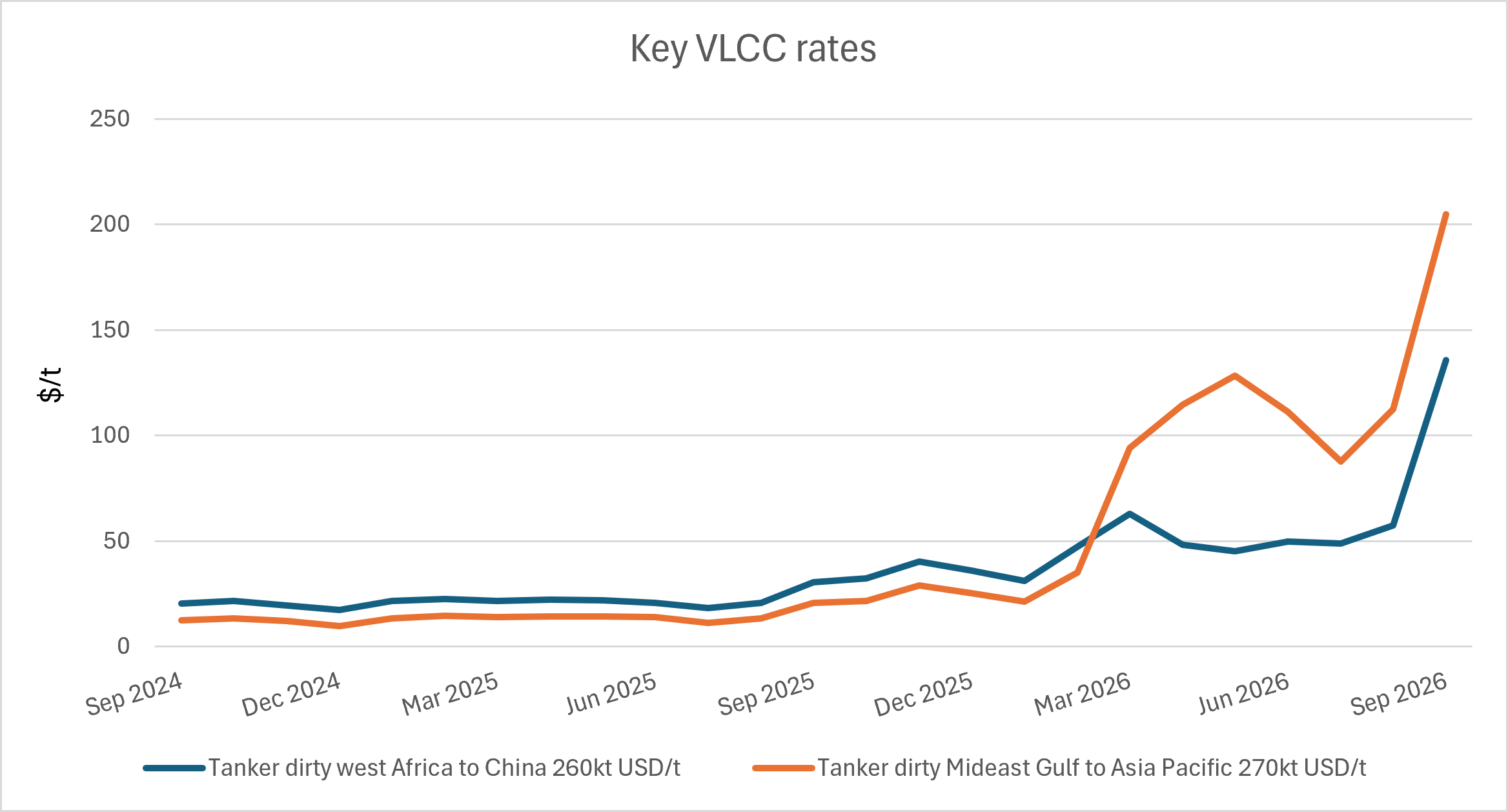
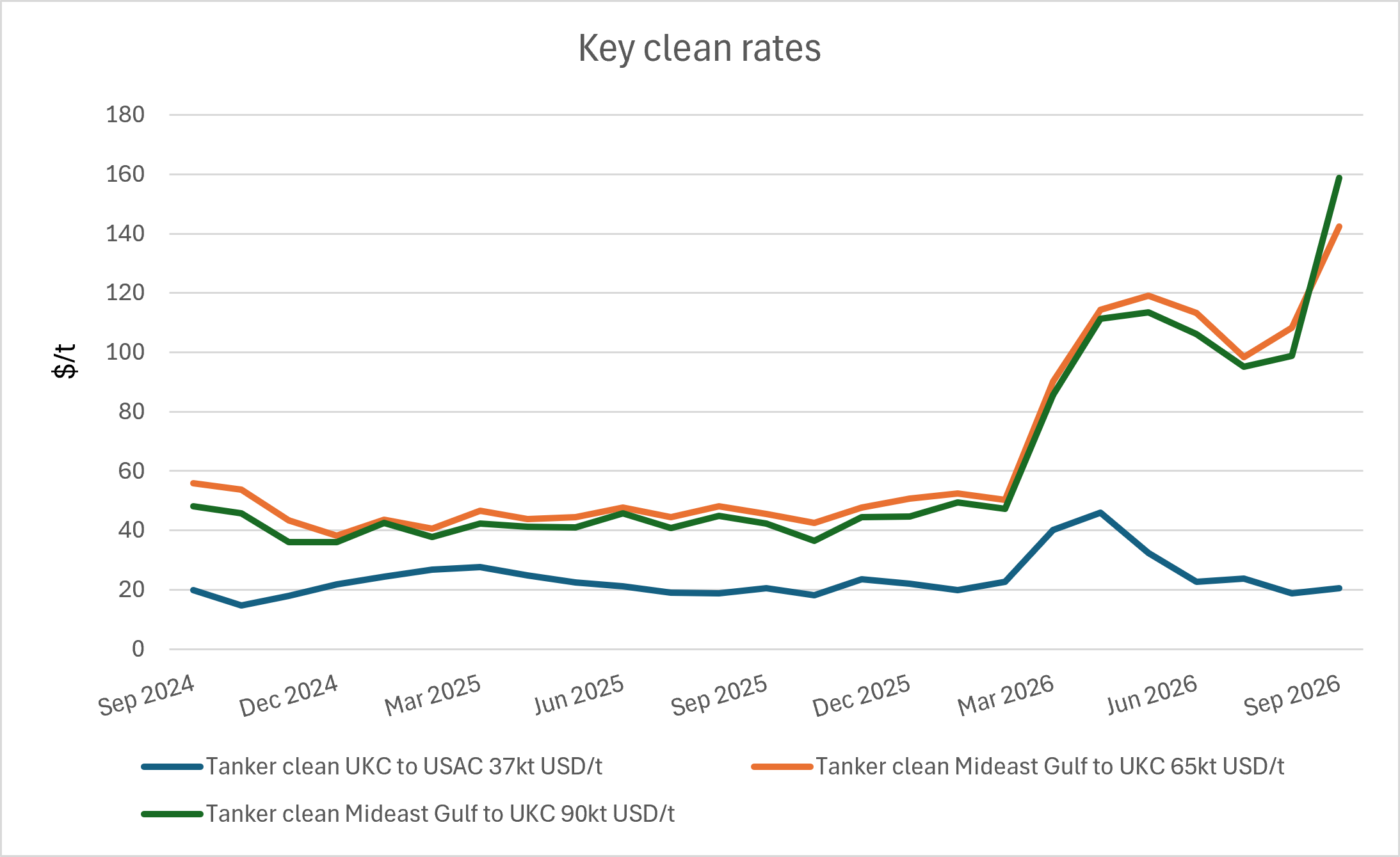
This sharp jump in fuel costs has demonstrated to shipowners the importance of moving towards clean energy technologies that can help offset this, some of which were explored at the recent Clean Maritime Regatta held in Portsmouth.
Rigid wing sails are one area that shipowners are looking at that can make small changes to the fuel bill. Shipowner Carisbrooke has installed one aboard the multi-purpose (MPP) carrier Vectis Progress, which typically operates on a transatlantic route, leading to a fuel saving of up to 10pc.
Shipowner Grieg Maritime is also in the process of installing two rigid wing sails on its MPP ship the Star Kirkenes and has retained the option to do the same on three more.
GT Wings, which manufactures the sails, emphasised that the technology is already commercially available and that rigid wing sails can be installed today and begin reducing fuel consumption immediately.
“Wind propulsion can be deployed reliably across modern commercial fleets, delivering not only emissions reductions but also reducing exposure to volatile fuel prices, an increasingly important priority for shipowners,” GT Wings chief executive George Thompson said.
A technology such as a rigid wing sail, a cousin of the rotor sail, reduces a ship’s fuel consumption by only a small amount. But the significant upswing in bunker fuel prices — which is forecast to take a significant period of time to unwind — and tightening green regulations could push more shipowners towards a quick and proven technology.
Wind propulsion is not the only technology beginning to move into commercial service. Ecap Marine has also installed hydrogen fuel cells aboard a number of ships, including the Coastal Liberty, an offshore supply vessel that runs entirely on hydrogen fuel cells.
Moreover, Norwegian shipping company Møre Sjø has signed an order for the construction of two emissions-free, hydrogen-powered bulk carriers at the Gelibolu Shipyard in Turkey. The 85m-long, 4,000 deadweight tonne carriers will primarily operate in Norwegian coastal waters and are scheduled for delivery in 2027.
Ecap is also installing fuel cell systems on two short-sea container vessels for global logistics provider Samskip. The vessels are being built at the Cochin Shipyard in India and will enter service in 2027.
Fuel cell technology requires hydrogen as a fuel source, which currently is not widely available so the technology is best focused on ships with consistent trade routes that will have fixed bunkering points, pushing Ecap towards the short-sea market or offshore supply markets as a result.
As shipowners explore green fuel technologies in response to rising bunker costs, a key challenge remains the gap between technical and operational viability. While owners may be willing to invest in vessels fitted for alternative fuels, the availability of bunkering infrastructure often determines whether a fuel can be used in practice.
Methanol is a case in point. The use of methanol as a marine fuel is receiving significant attention as a possible solution to the net-zero conundrum. In particular, green methanol — made from biomass or captured CO2 and green hydrogen — has the smallest carbon footprint among all different methanol types.
But the use of methanol-fuelled vessels carries several challenges. While the fuel may offer significant long-term compliance and environmental benefits, economics remain a key factor for shipowners. Methanol contains half the energy per unit volume of diesel, which means that ships will need to be fitted with larger fuel tanks to achieve a comparable fuel performance and shipowners might need to sacrifice cargo space for fuel storage.
At the same time, global supply remains constrained and bunkering options are still limited, with only a handful of established supply hubs globally.
For this reason, the main challenge facing the industry is not only how to store methanol onboard efficiently to minimise lost cargo space, but also how to ensure reliable fuel availability along trading routes. Shipowners would hence need to balance vessel design considerations with bunkering intervals and voyage patterns around a still-developing supply network.
For shipowners, deciding which technologies are worth pursuing can be as challenging as adopting them. Carisbrooke Shipping points to regular testing of new technologies and the accumulation of small incremental savings as the key. Carisbrooke regularly tests new technologies on board its vessels and has been an early adopter of ballast water treatment plants, biofuels and rigid wing sails. The company often liaises with early-stage green technology firms and gives some the chance to test out these technologies in a proper maritime environment. Carisbrooke will be trialling a hydrogen-powered engine on one of its ships in the coming months.
The owner has also focused on burning biofuels such as B30 and B100 where it can. The key to this is having the piping, valves, tanks and other related technologies already in place, enabling easier switching after the pipework is thoroughly cleaned.
But Carisbrooke pointed out that fuel availability remains one of the biggest hurdles for many of these fuel transitions. B100 can be difficult to secure in Europe and green methanol, hydrogen or liquid hydrogen are even more difficult.
Larger shipowners such as Maersk have gone so far as to secure long-term green methanol supply agreements in an effort to guarantee fuel availability while production remains limited. One example is its 2023 agreement with Chinese developer Goldwind to purchase 500,000 t/yr of green methanol from a new production facility. Goldwind shipped its first green methanol cargoes this month, showing the lengthy timelines required to bring new low-carbon fuel projects to commercial operation. This creates a new challenge for shipowners, whose expertise traditionally lies in operating vessels rather than securing fuel production. Increasingly, however, they are having to engage with both.
This is particularly true for hydrogen, which some point to as a key commercial fuel for net zero. Hydrogen is already widely used in Europe, particularly by refineries, where it is used to remove sulphur from fuel products. However, this is typically grey hydrogen produced from fossil fuels, rather than the green hydrogen required to meet net-zero goals. In addition, some projects use liquid hydrogen, which requires substantial cooling and has limited availability in commercial volumes.
Supply infrastructure to support liquid hydrogen (LH2) is developing. Norwegian Hydrogen, the LH2 supplier for Samskip, operates a 25MW electrolysis plant in Rjukan, southern Norway, and has confirmed demand for output from 2028 onwards. Firms are targeting short-sea shipping as the sweet spot for LH2. The company has taken a final investment decision on the electrolyser and aims to reach financial close “sometime later this year”, while discussing potential customers beyond Samskip.
Hemingway wrote that change happens gradually, then suddenly. For years, shipping's energy transition fell firmly into the former category, but the soaring bunker prices are pushing it into the latter. Rigid wings, wind power and fuel cells were once the edge of commercial reality but are now being installed on ships and delivering small but meaningful reductions in fuel consumption.
But further down the line, the technology is functioning. Fuel supply remains the key question that the industry will need to answer in the year ahead. Another gradual change, perhaps, waiting for a sudden shock.
At a glance:
- Rising bunker prices accelerate green shipping
- Wind sails can cut fuel use by up to 10%
- Hydrogen is entering commercial use
- Methanol and biofuels face supply challenges
- Fuel availability remains the biggest barrier


