

Weight of Freight: Size Matters – owners and charterers adjust to a changing tanker market
From 1967 until the oil crisis of 1973 there were orders for about 80 very large crude carriers (VLCC) and 40 ultra large crude carriers (ULCC), according to engine manufacturer Wartsila. This boom was followed by the total collapse of the newbuild market for these tankers until the middle of the 1980s. Since then, over 400 VLCC have been ordered, but it took more than 20 years before the next ULCC contract was signed.
The new TI class of ULCCs were delivered in the early 2000s, but within a decade most had been converted to floating production, storage and offloading (FPSO) vessels (FSOs) for use in the Mideast Gulf and southeast Asia. Prizing quantity over flexibility, these ships were wider than the new Panama Canal locks (begun in 2007 and completed in 2016), and could not travel through the Suez Canal unless on a ballast voyage.
Their massive capacity of more than 3mn barrels of crude oil reflected climbing global oil demand – almost double what it was in 1973 – and China’s arrival as the world's largest importer of crude oil. Some forecasters now predict oil demand will peak in 2030, reducing the need for supertankers, but other forces have seen shipowners and others return to newbuilding markets for VLCCs in recent months.
Pandemics, infrastructure projects, price wars and actual wars have moved and lengthened trade flows in the last four years, making larger vessels more attractive because of their economies of scale. These have impacted the make-up of the global tanker fleet in other ways as well, such as prompting a small recovery in interest in small Panamax tankers, which have long been sliding out of existence.
The role of vessel size in tanker freight markets is sometimes underappreciated. In the wake of the G7+ ban on imports of Russian crude and oil and products, and attacks on merchant shipping in the Red Sea and Gulf of Aden by Yemen’s Houthi militants, flows of crude oil have had to make massive diversions. Russian crude oil is flowing now to India and China rather than to Europe, while Europe’s imports of oil, diesel and jet fuel from the Mideast Gulf are taking two weeks longer, going around the Cape of Good Hope to avoid Houthi attacks. This has pushed up tonne-miles – a measure of shipping demand – to record levels. Global clean Long Range 2 (LR2) tanker tonne-miles rose to a record high in May this year, data from analytics firm Kpler show, while tonne-miles for dirty Aframax tankers rose to a record high in May last year. It has also supported freight rates.
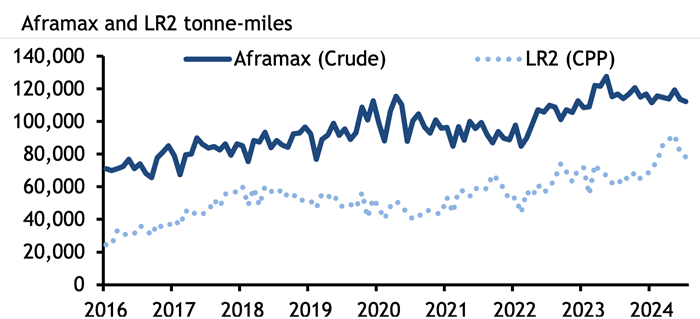
High freight rates have brought smaller vessels into competition with larger tankers, at the same time as long routes have increased the appeal of larger ships. The Atlantic basin appears to be key site for increases in production (from the US, Brazil, Guyana and even Namibia), and an eastward shift in refining capacity globally will further entrench these long routes and demand for economies of scale.
Aframax and LR2 tankers are the same sized ships carrying around 80,000-120,000t of crude oil or products. LR2 tankers have coated tanks, which allows them to carry both dirty and clean cargoes, and shipowners may switch their
LR2/Aframax vessels between the clean and dirty markets, with expensive cleaning, depending on which offers them the best returns. But an unusually high number of VLCCs – at least six – have also switched from dirty to clean recently. Shipowner Okeanis, which now has three of its VLCCs transporting clean products, said it had cleaned up another one in the third quarter.
A VLCC switching from crude to products is very rare. Switching to clean products from crude is estimated to cost around $1mn for a VLCC. It takes several days to clean the vessel's tanks, during which time the tanker is not generating revenue. But a seasonal slide in VLCC rates in the northern hemisphere this summer has made cleaning an attractive option for shipowners, while their economies of scale make the larger tankers more attractive to clean charterers as product voyages lengthen.
Argus assessed the cost of shipping a 280,000t VLCC of crude from the Mideast Gulf to northwest Europe or the Mediterranean averaged $10.52/t in June, much lower than the average cost of $67.94/t for shipping a 90,000t LR2 clean oil cargo on the same route in the same period. It is likely these vessels will stay in the products market, as cleaning a ship is a costly undertaking for a single voyage.
Typically, a VLCC will only carry a clean cargo when it is new and on its inaugural voyage, but just one new VLCC has joined the fleet this year, further incentivising traders to clean up vessels as demand for larger ones increases. This year has seen a jump in demand for new VLCCs, with 29 ordered so far. There were 20 ordered in 2023, just six in 2023 and 32 in the whole of 2021, Kpler data show. But the vast majority of these new VLCCs will not hit the water until 2026, 2027 or later because of a shortage of shipyard capacity.
Last year and 2024 also saw the first substantial newbuilding orders for Panamax tankers, also called LR1s, since 2017. Product tanker owner Hafnia and trader Mercuria recently partnered to launch a Panamax pool. The rationale may be that Panamax vessels can pass through the older locks at the Panama Canal, and so are not subject to the same draft restrictions imposed because of drought that has throttled transits and led to shipowners paying exorbitant auction fees to transit.
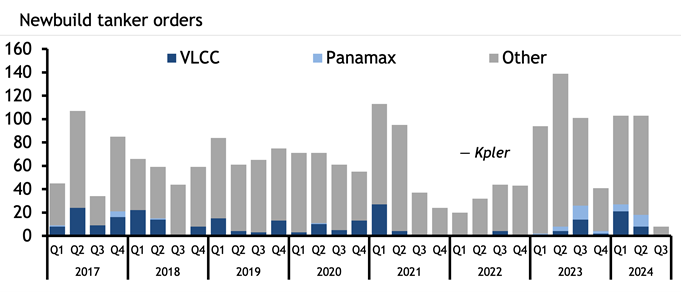
Aframaxes and MRs will remain the workhorses of crude and product tanker markets respectively, but the stretching and discombobulation of trade routes (which appear likely to stay) has already driven changes in which vessels are used and which are ordered. When these ships hit the water, they will join a tanker market very different to the one owners and charterers were operating in just four years ago.


Spotlight content


Related news
Ships abort Hormuz transit attempts
Ships abort Hormuz transit attempts
Singapore, 18 April (Argus) — At least 21 vessels that attempted to leave the Mideast Gulf following a brief reopening of the strait of Hormuz were forced to turn back, vessel tracking data show, after Tehran reimposed transit restrictions in response to the continued US naval blockade of Iranian ports. Tracking data indicate that at least 15 of the vessels were tankers across all size classes. Most of the ships had been trapped in the region since the US-Iran war began on 28 February. They appear to have moved after a short-lived opening was signalled on Friday, when Iranian foreign minister Seyed Araghchi announced that the strait would be open. US president Donald Trump said shortly afterwards that the waterway was completely open. But Iran has since reversed course , saying Hormuz would not remain open while the US naval blockade of Iranian ports remains in place and that transit had returned to strict military control. The rapid change in the status of Hormuz transits has raised questions about US president Donald Trump's comment on Friday that Washington was "very close" to a full deal with Tehran. By Sea Lui Send comments and request more information at feedback@argusmedia.com Copyright © 2026. Argus Media group . All rights reserved.
Product tankers exit Hormuz amid Iran U‑turn
Product tankers exit Hormuz amid Iran U‑turn
London, 18 April (Argus) — Three clean oil product tankers sailed out of the Mideast Gulf through the strait of Hormuz earlier on Saturday despite a rapid reversal in Iran's stance on shipping access, while two other vessels approached the strait but appeared to turn back. The movements highlight the lack of clarity facing shipowners and traders. Iran's foreign minister Seyed Araghchi said on Friday that the strait would be open during the current US-Iran ceasefire. US president Donald Trump said shortly afterwards that the waterway was completely open. But Iran's position has since shifted. Parliamentary speaker Mohammed Bagher Ghalibaf said the strait would not remain open while the US naval blockade on Iranian ports stayed in place. And later, Iranian military spokesperson Ebrahim Zolfaqari said that while Iran had initially agreed to the managed passage of a limited number of vessels, it has now returned the strait to strict military control. All three product tankers that exited the strait on 18 April are rated high sanctions-risk by marine consultancy Windward, though none appeared to be carrying Iranian products. It is not clear if they transited before or after the Iranian change of stance. Tracking data from Vortexa and Kpler show the largest vessel, the LR1 Navig8 Macallister , loaded 60,000t of naphtha at the UAE port of Ruwais in the first week of the war and remained in the Gulf for six weeks. The vessel is now signalling a voyage to east Asia. The MR tanker Akti A loaded 30,000t of gasoil from Bahrain's Sitra in the final week before the war began and waited in the Gulf for seven weeks. It is now signalling a voyage to east Africa. The MR Torin loaded 30,000t of naphtha from an unidentified Gulf port in the second week of April and waited for one week. The vessel transited Hormuz after receiving "special permission in co-ordination with Iranian authorities", a shipping broker said. Two other product tankers headed towards the strait on Saturday but did not complete a transit. The LR1 Khairpur appeared to turn back, according to Vortexa data. The firm estimates it is carrying 70,000t of gasoline from an unidentified Gulf port. The vessel had entered the Gulf empty a week ago, becoming the first low-sanctions-risk clean product tanker to do so since early March. The LR2 Sea Condor made a similar approach, carrying 90,000t of Kuwaiti naphtha loaded in the same week the war began, before also turning back. A further 18 clean products tankers have remained in the Gulf since before the war started , around seven weeks, with no sign of attempting an exit yet. Severely restricted traffic through the strait since the US-Iran conflict started at the end of February has tightened oil product supply. Only around 25,000 t/d of clean oil products have exited Hormuz so far in April, according to Vortexa data, compared with about 300,000 t/d across the full month last April. Clean product outright prices and premiums against crude have surged in Europe and Asia, setting multi-decade highs and delaying demand as buyers wait for firmer clarity on shipping access. By Rithika Krishna and Benedict George Send comments and request more information at feedback@argusmedia.com Copyright © 2026. Argus Media group . All rights reserved.
Iran closes Hormuz again in response to US blockade
Iran closes Hormuz again in response to US blockade
London, 18 April (Argus) — Tehran has reimposed restrictions over shipping passing through the strait of Hormuz in response to the continued US naval blockade of Iranian ports, Iran's military leadership announced on Saturday. "Following previous agreements reached in negotiations, the Islamic Republic of Iran, in good faith, agreed to the managed passage of a limited number of oil tankers and commercial vessels through the strait of Hormuz," Lieutenant Colonel Ebrahim Zolfaqari, spokesperson for the Khatam al-Anbiya Central Military Headquarters – the country's highest operational military command – said, according to Iran's Fars news agency, which is affiliated with the Islamic Revolutionary Guard Corps. "But unfortunately, the Americans, with their history of repeated breaches of promise, continue to engage in banditry and maritime piracy under the guise of a so-called blockade. For this reason, the strategic strait of Hormuz is under the strict management and control of Iran's Armed Forces." Zolfaqari added that "as long as the US does not agree to the complete freedom of navigation for vessels from their origin in Iran to their destination and from the destination back to their origin in Iran, the situation in the strait of Hormuz will remain tightly controlled and in its previous state." Tehran had announced on Friday that it was reopening the strait to shipping, until the 22 April expiry of its ceasefire deal with the US, in response to the ceasefire agreement reached between Israel and Lebanon. But the speaker of the Iranian parliament had warned later Friday that Tehran would reimpose the previous restrictions on passage if the US continued with the naval blockade of Iranian ports it began on 13 April. Some tankers have been able to move through the strait during the brief period of reopening – two crude tankers, a VLCC and an Aframax, were able to transit earlier Saturday, according to data from trade analytics platform Vortexa, after two products tankers carrying naphtha were able to pass through the strait overnight, according to data from Vortexa and Kpler. By Jim Washer Send comments and request more information at feedback@argusmedia.com Copyright © 2026. Argus Media group . All rights reserved.
Tankers transit Hormuz despite Iran blockade warning
Tankers transit Hormuz despite Iran blockade warning
London, 18 April (Argus) — Two tankers were transiting the strait of Hormuz eastbound on Saturday, according to data from trade analytics platform Vortexa, potentially marking the first crude shipments to exit the Mideast Gulf since Iran said on Friday that it was reopening the waterway to shipping. The transits also come despite Iran's parliamentary speaker warning later on Friday that the strait would not remain open if the US continued with the naval blockade of Iranian ports which it began on 11 Apr. A laden VLCC, the 301,861 dwt FPMC C Lord , which partially loaded on 23 February in Halul, Qatar, and partially on 28 February in Juaymah, Saudi Arabia, was passing Hormuz using the northern corridor close to the Iranian coast, according to Vortexa data. Vortexa lists the vessel's destination as Fujairah, although the cargo may be bound for Taiwan, where a local company reportedly fixed the ship in early February for a voyage to Mailiao, according to Reshamwala shipbrokers. In addition, the 114,790 dwt Aframax Desh Garima was also transiting Hormuz eastbound, carrying crude from Das Island, UAE, to India, Vortexa data show. Meanwhile, some VLCCs previously bound for Yanbu on Saudi Arabia's Red Sea coast may be redirecting back into the Mideast Gulf. The 299,472 dwt V. Advance , which had been ballasting westbound in the Arabian Sea, recently altered course and now appears to be heading towards the Mideast Gulf or Fujairah, according to Vortexa. Several Suezmax tankers are also idling inside the Mideast Gulf near the entrance to the strait of Hormuz, Vortexa indicate, which may reflect ongoing uncertainty over the status of Iranian and US blockades. Iran announced on Friday that it was reopening the strait of Hormuz until the end of its current ceasefire with the US next week, in response to the agreement of a ceasefire between Israel and Lebanon. But Iranian parliamentary speaker Mohammad Bhager Ghalibaf said later on Friday that the strait would not remain open while the US continued its blockade of Iranian ports. By Andrey Telegin Send comments and request more information at feedback@argusmedia.com Copyright © 2026. Argus Media group . All rights reserved.