

From 1967 until the oil crisis of 1973 there were orders for about 80 very large crude carriers (VLCC) and 40 ultra large crude carriers (ULCC), according to engine manufacturer Wartsila. This boom was followed by the total collapse of the newbuild market for these tankers until the middle of the 1980s. Since then, over 400 VLCC have been ordered, but it took more than 20 years before the next ULCC contract was signed.
The new TI class of ULCCs were delivered in the early 2000s, but within a decade most had been converted to floating production, storage and offloading (FPSO) vessels (FSOs) for use in the Mideast Gulf and southeast Asia. Prizing quantity over flexibility, these ships were wider than the new Panama Canal locks (begun in 2007 and completed in 2016), and could not travel through the Suez Canal unless on a ballast voyage.
Their massive capacity of more than 3mn barrels of crude oil reflected climbing global oil demand – almost double what it was in 1973 – and China’s arrival as the world's largest importer of crude oil. Some forecasters now predict oil demand will peak in 2030, reducing the need for supertankers, but other forces have seen shipowners and others return to newbuilding markets for VLCCs in recent months.
Pandemics, infrastructure projects, price wars and actual wars have moved and lengthened trade flows in the last four years, making larger vessels more attractive because of their economies of scale. These have impacted the make-up of the global tanker fleet in other ways as well, such as prompting a small recovery in interest in small Panamax tankers, which have long been sliding out of existence.
The role of vessel size in tanker freight markets is sometimes underappreciated. In the wake of the G7+ ban on imports of Russian crude and oil and products, and attacks on merchant shipping in the Red Sea and Gulf of Aden by Yemen’s Houthi militants, flows of crude oil have had to make massive diversions. Russian crude oil is flowing now to India and China rather than to Europe, while Europe’s imports of oil, diesel and jet fuel from the Mideast Gulf are taking two weeks longer, going around the Cape of Good Hope to avoid Houthi attacks. This has pushed up tonne-miles – a measure of shipping demand – to record levels. Global clean Long Range 2 (LR2) tanker tonne-miles rose to a record high in May this year, data from analytics firm Kpler show, while tonne-miles for dirty Aframax tankers rose to a record high in May last year. It has also supported freight rates.
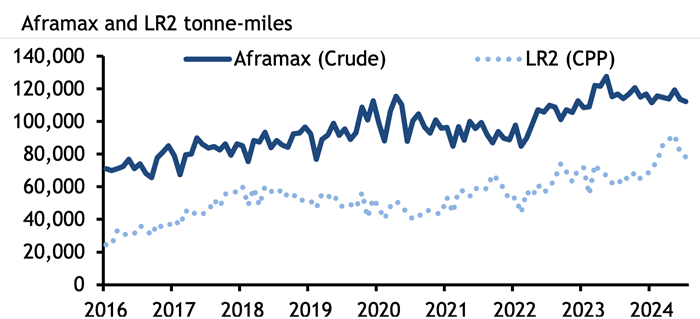
High freight rates have brought smaller vessels into competition with larger tankers, at the same time as long routes have increased the appeal of larger ships. The Atlantic basin appears to be key site for increases in production (from the US, Brazil, Guyana and even Namibia), and an eastward shift in refining capacity globally will further entrench these long routes and demand for economies of scale.
Aframax and LR2 tankers are the same sized ships carrying around 80,000-120,000t of crude oil or products. LR2 tankers have coated tanks, which allows them to carry both dirty and clean cargoes, and shipowners may switch their
LR2/Aframax vessels between the clean and dirty markets, with expensive cleaning, depending on which offers them the best returns. But an unusually high number of VLCCs – at least six – have also switched from dirty to clean recently. Shipowner Okeanis, which now has three of its VLCCs transporting clean products, said it had cleaned up another one in the third quarter.
A VLCC switching from crude to products is very rare. Switching to clean products from crude is estimated to cost around $1mn for a VLCC. It takes several days to clean the vessel's tanks, during which time the tanker is not generating revenue. But a seasonal slide in VLCC rates in the northern hemisphere this summer has made cleaning an attractive option for shipowners, while their economies of scale make the larger tankers more attractive to clean charterers as product voyages lengthen.
Argus assessed the cost of shipping a 280,000t VLCC of crude from the Mideast Gulf to northwest Europe or the Mediterranean averaged $10.52/t in June, much lower than the average cost of $67.94/t for shipping a 90,000t LR2 clean oil cargo on the same route in the same period. It is likely these vessels will stay in the products market, as cleaning a ship is a costly undertaking for a single voyage.
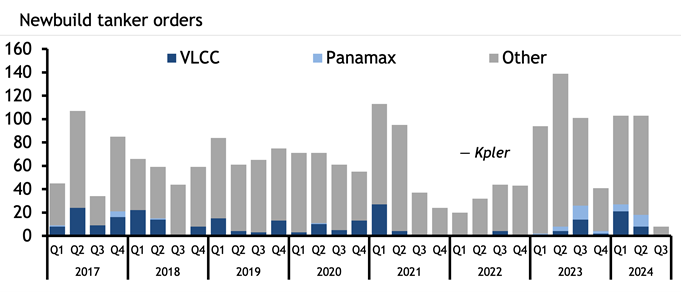
Typically, a VLCC will only carry a clean cargo when it is new and on its inaugural voyage, but just one new VLCC has joined the fleet this year, further incentivising traders to clean up vessels as demand for larger ones increases. This year has seen a jump in demand for new VLCCs, with 29 ordered so far. There were 20 ordered in 2023, just six in 2023 and 32 in the whole of 2021, Kpler data show. But the vast majority of these new VLCCs will not hit the water until 2026, 2027 or later because of a shortage of shipyard capacity.
Last year and 2024 also saw the first substantial newbuilding orders for Panamax tankers, also called LR1s, since 2017. Product tanker owner Hafnia and trader Mercuria recently partnered to launch a Panamax pool. The rationale may be that Panamax vessels can pass through the older locks at the Panama Canal, and so are not subject to the same draft restrictions imposed because of drought that has throttled transits and led to shipowners paying exorbitant auction fees to transit.
Aframaxes and MRs will remain the workhorses of crude and product tanker markets respectively, but the stretching and discombobulation of trade routes (which appear likely to stay) has already driven changes in which vessels are used and which are ordered. When these ships hit the water, they will join a tanker market very different to the one owners and charterers were operating in just four years ago.
Spotlight content
Related news
N Zealand proposes ETS governance penalties
London, 18 December (Argus) — New Zealand's environment ministry is eyeing fines for failure to comply with new reporting requirements under the NZ Emissions Trading Scheme (NZ ETS), briefing papers published by the ministry this week show. Under the penalty regime, failure to report price and volume information to the government or market monitoring entities would result in fines of NZ$8,000 ($4,621) on the first instance, doubling to NZ$16,000 in the case of a second breach. Each additional breach would carry a NZ$24,000 fine. Those that fail to store trading information data would face first-time fines of NZ$12,000, which would double to NZ$24,000 in case of repetition. Additional infractions would be penalised NZ$32,000 per breach. The ministry's proposal, which was put to the climate change minister in October, follows the decision to implement stronger NZ ETS platform reporting requirements , agreed by the country's cabinet earlier this year. Additional proposals for NZ emissions units (NZUs) transacted on the secondary market would require trading platforms to keep records of trading information for seven years, and submit daily reports to the ministry with the price and volume of NZUs transacted on that day. Under the proposals, confirmed instances of NZU price manipulation could face criminal charges, potentially resulting in imprisonment not exceeding five years, or a fine lower than NZ$2.5mn. Misleading conduct without confirmed evidence would face fines proportional to the gain made or loss avoided. But they would not exceed NZ$1mn if an individual were facing the fine, or NZ$5mn in any other case. In addition to fines, the ministry would also publish the details of the entity committing the infraction and the status of the penalty, the briefing paper said. The penalty regime will be incorporated into a bill amending the country's Climate Change Response Act, alongside other market governance changes. The introduction of the bill to parliament was initially scheduled for late 2025 but has now been postponed, with a first reading expected in early 2026. By Kiara Campagne Nieva Send comments and request more information at feedback@argusmedia.com Copyright © 2025. Argus Media group . All rights reserved.
Viewpoint: Japan's hybrid EV use keeps gasoline in mix
Tokyo, 18 December (Argus) — Japan's gasoline consumption will continue falling because of its decarbonisation drive, but the country's gasoline consumption is unlikely to reach zero as gasoline-powered cars and hybrid gasoline-electric vehicles (HEVs) account for a vast majority of newly registered passenger cars. Japan's gasoline sales declined at least over 2016-24, with the exception of a slight year-on-year increase of 0.03pc in 2022, data from the Petroleum Association of Japan (PAJ) show. The country's gasoline sales totalled 330mn bl (904,100 b/d) in 2016, falling to below 280mn bl (767,100 b/d) in 2024. The country's transport sector accounted for 19.2pc of total CO2 emissions in the April 2023-March 2024 fiscal year, according to Japan's environment ministry. Half of the transport sector's CO2 emissions came from gasoline in the 2023-24 fiscal year. Tokyo renewed its global warming countermeasures plan in February 2025, which reiterated its target of having all new car sales be "electrified vehicles" by 2035 and to achieve net-zero CO2 emissions through the vehicle lifecycle by 2050, in efforts to abate emissions. But these "electrified vehicles" do not only refer to fully electric-powered EVs nor fuel cell vehicles (FCVs) but also include gasoline-consuming HEVs and plug-in hybrid electric vehicles (PHEVs). This means that Japanese passenger car owners will likely remain dependent on gasoline, even as gasoline consumption declines, given that Japan's preference for hybrids is likely to sustain its momentum for the foreseeable future. The country's gasoline requirement will fall by 2.4pc to 260mn bl (712,300 b/d) in the April 2026-March 2027 fiscal year, compared with the 2025-26 level, based on Japan's trade and industry ministry Meti's outlook. This downtrend is expected to continue by declines of 2.1-2.5 pc/yr at least until 2029-30, largely because of higher fuel efficiency and wider use of HEVs, Meti said. The number of newly registered passenger cars, including imported cars, totalled slightly below 2.4mn units over January-November 2025, data from the Japan Automobile Dealers Association (JADA) show. Out of this total, gasoline-consuming HEVs accounted for 60pc, and gasoline cars hold a 32pc share. Gasoline-powered cars and HEVs have jointly accounted for around 90pc at least since 2020. The share of HEVs in newly registered cars has also grown consistently every year, from 37.1pc in 2020 to 61.1pc in 2024, mostly replacing the share of gasoline cars, while the share of EVs has stalled at 0.6-1.7pc of the total of registered units every year over the same period, data from the JADA show. "The hybrid trend is likely to remain strong going forward. Compared with the time when it seemed the global shift to EVs would happen decisively and rapidly, the momentum now appears to have slowed somewhat," Japan's trade and industry minister Ryosei Akazawa said at an interview with reporters, including Argus , in October. The shift towards EVs has not been as strong as expected, which could have benefited gasoline car makers. But US tariffs on Japanese automobiles likely eroded the profitability of Japanese automakers, with 15pc of their domestic car output exported to the US in 2024, according to Meti. The US tariff rate was lowered to 15pc from 27.5pc in September, but is still far higher than 2.5pc, the rate before US president Donald Trump's additional 25pc automobile tariff took effect in April. To support Japanese automakers given the challenging tariff environment, Tokyo could freeze its environmental performance tax — a levy of 0-3pc — imposed on car owners at the point of acquisition depending on automobile features, such as fuel efficiency. This move could pave the way for gasoline-powered vehicles to regain momentum or pose obstacles to the expansion of EV cars' market share in the coming years. By Kohei Yamamoto Send comments and request more information at feedback@argusmedia.com Copyright © 2025. Argus Media group . All rights reserved.
BP appoints Woodside’s O’Neill as next CEO
New York, 17 December (Argus) — BP appointed Woodside Energy chief executive officer Meg O'Neill as its next chief executive effective from next April. O'Neill will replace Murray Auchincloss, who has decided to step down on 18 December after more than three decades with the London-based oil major. O'Neill transformed Woodside into the biggest energy company listed on the Australian Securities Exchange after taking over as chief executive in 2021, according to BP. While at Woodside, she also oversaw the acquisition of BHP Petroleum International. O'Neill also spent more than two decades at ExxonMobil earlier in her career. "Her proven track record of driving transformation, growth, and disciplined capital allocation makes her the right leader for BP," said Albert Manifold, chairman of the company's board of directors. Carol Howle, executive vice president, supply, trading & shipping of BP, will serve as interim chief executive until O'Neill takes over. Auchincloss will also serve in an advisory role until December 2026 to ensure a smooth transition. BP scaled back ambitious low-carbon goals earlier this year with Auchincloss conceding that the company had been "optimistic for a fast [energy] transition but that optimism was misplaced." The company raised its 2030 target for oil and gas production as part of a "fundamental reset" of strategy that also entailed a cut in renewable energy investments. O'Neill's appointment follows a search process overseen by the board, with the help of an independent recruitment firm, as part of the company's long-term succession planning. By Stephen Cunningham Send comments and request more information at feedback@argusmedia.com Copyright © 2025. Argus Media group . All rights reserved.
Trump doubles down on Venezuela oil threat
Washington, 17 December (Argus) — President Donald Trump on Wednesday doubled down on his threat to blockade Venezuelan oil shipments unless Caracas offers compensation for oil assets expropriated years ago. Democratic lawmakers on the same day forced the House of Representatives to schedule a vote on resolutions that would prohibit Trump from using military force against Venezuela without explicit authorization from Congress. "They took all of our oil from not that long ago, and we want it back," Trump told reporters on Thursday. "They illegally took it." Trump's domestic policy adviser Stephen Miller on Wednesday said that "American sweat, ingenuity and toil created the oil industry in Venezuela". Venezuela nationalized its oil industry in 1976, only to partially reverse course in the 1990s by inviting US and other foreign oil companies to participate in joint ventures with state-owned PdV. Former Venezuelan president Hugo Chavez in 2007 ordered PdV to change the business terms of operations in joint ventures. Chevron and some European companies accepted these terms. ExxonMobil and ConocoPhillips did not, eventually winning awards in international tribunals and US courts for the expropriation of their assets in Venezuela. ConocoPhillips holds the largest claim for expropriated assets, at $12bn. That claim is about to be partially satisfied as a US court has ordered the auction of PdV-owned US refining company Citgo. It was not clear what prompted the change in the stated rationale of the US campaign of pressure against Venezuelan president Nicolas Maduro. Trump and US officials until this week described the campaign in terms of curbing the seaborne flow of drugs and putting an end to migration from Venezuela, even though Trump previously mentioned possibly pushing for regime change in Caracas. Trump in a social media post on Tuesday night declared a blockade of most Venezuelan seaborne oil shipments. "We're not gonna let anybody going through that shouldn't be going through," Trump said on Wednesday. The Maduro government denounced Trump's threat and appealed to the UN. It is not clear if Caracas can counteract the blockade. Venezuelan oil flows to Cuba already have stopped and cargoes to other destinations were grinding to a halt, following the 10 December seizure of a Cuba-bound Venezuelan oil tanker by the US Coast Guard. US House debate The House of Representatives later on Wednesday will vote on two separate resolutions to prohibit the use of US military force against Venezuela without congressional approval. Debate on the House floor Tuesday afternoon showed a division largely along partisan lines, indicating the resolutions are unlikely to pass. Republican lawmakers pushed back against the resolution, casting the US operation as an extension of the administration's domestic counter-narcotics efforts — a line the White House had advanced until Wednesday. "Congressional authorization is not required to carry out precise, limited strikes," House Foreign Affairs Committee chairman Brian Mast (R-FLorida) said. "My colleagues did not object when prior presidents conducted military operations in Yemen, in Libya, and Syria," Mast said. The US military operation near Venezuela "isn't about drugs — it's about regime change, and it's about oil," said congressman Gregory Meeks (D-New York), who sponsored one of the resolutions. "Trump is provoking a new war right in our backyard and threatening to destabilize an entire region", Meeks said. By Haik Gugarats Send comments and request more information at feedback@argusmedia.com Copyright © 2025. Argus Media group . All rights reserved.


