Higher outright bitumen prices are deterring buying across northwest and central Europe and the Mediterranean, limiting the usual recovery in demand after the August holiday period.
Infrastructure funding constraints have hit demand in Romania and Spain, while import restrictions are limiting Algerian buying. The approaching end of the Nordic paving season, including in Sweden, is adding to the softer demand outlook.
Limited export opportunities have added to the pressure. The Americas remain well supplied, while west African demand, led by Nigeria, is subdued during the rainy season. This has left European suppliers with few outlets for surplus volumes and ample refinery supply to meet regional requirements.
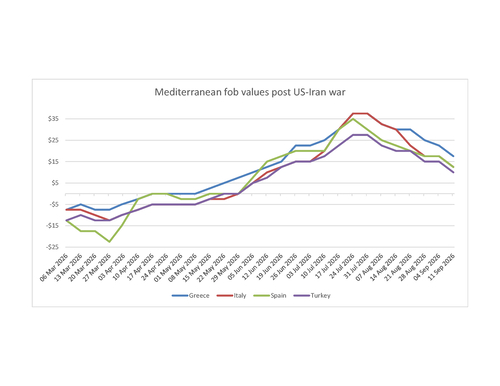
Mediterranean cargo suppliers have consequently been forced to reduce their premiums to fob Mediterranean high-sulphur fuel oil (HSFO) cargoes to secure sales. Rotterdam cargo premiums to fob Rotterdam HSFO barges have also come under pressure.
Spanish cargo premiums rose to $35/t above fob Mediterranean HSFO in late July, supported by rising Spanish bitumen consumption and busy seasonal work across much of Europe and north Africa. Refinery production was also constrained at the time by reduced availability of bitumen-yielding Middle Eastern crude following the effective closure of the strait of Hormuz.
But Argus-assessed Spanish cargo premiums have since fallen to $10-15/t as construction activity has weakened. The Spanish government's provisional suspension of six road maintenance contract packages worth a combined €1.01bn ($1.17bn) has contributed to the downturn, while traders have reported greater spot cargo availability from Spanish export terminals.
Delivered cargo costs rise as premiums fall
Despite falling premiums, sharp gains in regional HSFO prices, together with higher cross-Mediterranean bitumen tanker freight rates caused by a spike in bunker fuel values since the renewed US-Iran escalation, have driven up outright prices for cargo deliveries into north African and Black Sea markets, prompting importers to retreat from spot purchases.
Trading firms say fob cargo premiums at Mediterranean loading points have fallen to $10-15/t, with some indications in single digits, as suppliers seek to encourage buying. Delivered premiums into Algeria and Morocco have dropped to $70-80/t cfr from $110-120/t in July, while Libyan imports have been indicated at premiums as low as $60/t cfr.
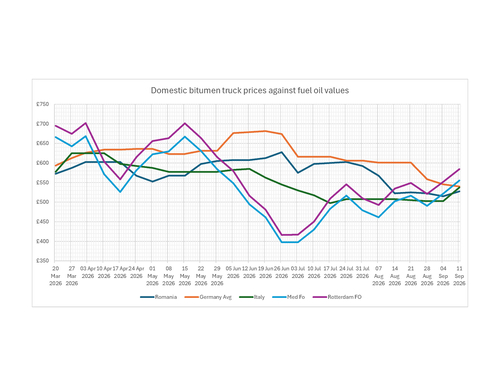
Domestic truck markets have also struggled to absorb the increase in crude and HSFO values, with refinery suppliers finding it difficult to raise bitumen prices in line with higher underlying costs.
Project activity in Germany has been slow to recover in September, resulting in falling truck prices despite gains in northwest European crude and HSFO markets.
Italian truck prices declined from €545/t ex-works, including the €31/t local tax, in late June to €500-505/t in early September, before recovering to an Argus-assessed €535-540/t last week.
Over the same period, fob Mediterranean HSFO cargo values rose from $420/t to $542/t. Iraq's bitumen-rich Basrah Heavy crude, among the grades most affected by restrictions through the strait of Hormuz, increased from $66/bl to $124/bl earlier this week.
Bitumen prices have lagged these increases partly because project activity has recovered more slowly than usual following the August holiday period.
Romania is the region's worst-affected market. It depends on truck supplies from regional suppliers and cargo deliveries into its Black Sea terminals, but limited government spending on road and motorway projects and reductions in EU funding have hit demand hard.
Romanian truck prices fell from €625-630/t ex-works in late June, their highest this year, to €515/t in early September, before rebounding modestly.
Some cargo and truck market participants are already looking ahead to the low-demand winter season. They expect refinery supply to be sufficient to meet requirements during the remainder of the September-November paving and construction season, when demand is likely to be largely covered by term or contractual volumes.