A US ban on diesel exports would expose Mexico to higher import costs and localized supply shortages, while testing the government's ability to hold pump prices below Ps27/liter ($5.80/USG) with little room left for further tax relief.
Record-high US prices of diesel prompted US Republican lawmakers to call for curbing exports of the fuel. US president Donald Trump publicly backed those calls on 22 September and said a decision would come "fast". Treasury secretary Scott Bessent said the administration was examining whether a full or partial ban would be feasible.
Energy secretary Chris Wright said on Wednesday that the administration would not halt diesel exports and instead favored voluntary adjustments to diesel flows. Refiners have warned that blocking exports would fill available storage within weeks and force them to cut overall fuel production, potentially raising gasoline prices. Wright's comments make voluntary restrictions more likely than a blanket ban, but Trump has yet to announce a final decision.
Mexico would be among the most exposed markets if shipments were restricted. US distillate exports to Mexico averaged about 220,000 b/d in 2025 and held close to that level in January-June 2026, US Energy Information Administration data show. Roughly 185,000 b/d came from the US Gulf coast and 35,000 b/d from the west coast during the first half of the year.
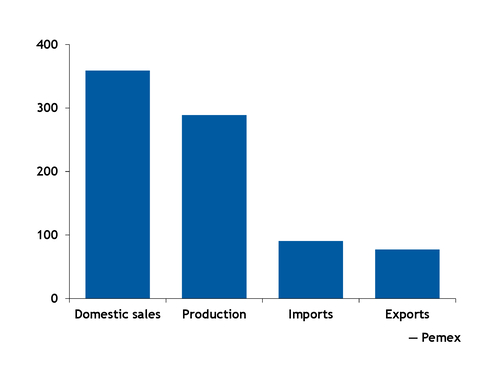
Domestic production would provide some support. Pemex produced 289,000 b/d of diesel in July, including 93,400 b/d at the Olmeca refinery, and sold almost 359,000 b/d domestically. But Mexico still exported 77,200 b/d that month, while Pemex imported 90,500 b/d. Olmeca's Gulf coast location can make waterborne exports commercially attractive, while moving large volumes to inland demand hubs can be costlier and constrained by existing infrastructure. Exported barrels therefore could not necessarily be redirected quickly to replace US supply.
The difference between Pemex's imports and total US shipments also reflects private-sector suppliers, which would have fewer options than Pemex to absorb a sudden disruption. Pemex holds a 70-80pc market share of Mexico's diesel market.
The immediate effect would likely be a sharp increase in replacement costs before a nationwide shortage. Importers could seek cargoes from Europe or Asia, but longer voyages, limited terminal capacity and a global shortage would make substitution expensive. Russia has restricted exports, Middle East refinery and shipping disruptions have reduced supplies and US inventories have fallen to historically low seasonal levels.
Northern Mexico and markets supplied through cross-border pipelines and tank trucks would be particularly vulnerable to a sudden halt. Pemex's 312,500 b/d Deer Park refinery in Texas would also remain subject to US export rules despite its Mexican ownership.
Price policy leaves Mexico with a second problem. The government has committed to keeping retail diesel prices below Ps27/liter and is already waiving the full excise tax for 19-25 September, plus complementary credit.
Trump's remarks this week suggest that his administration is seriously considering an intervention in fuel markets, although its eventual form is not clear. Refiners and the rest of the US energy industry have stepped up lobbying efforts in opposition to any limits on fuel exports.
But even partial controls could tighten Mexican supply if Washington prioritizes Europe or other allies, and uncertainty alone may encourage importers to build inventories. A policy aimed at lowering US diesel prices could transfer a significant part of the supply and fiscal burden to Mexico.
By Antonio Gozain and Haik Gugarats