

• 14. Juni 2024
  • Market: Chemicals, Chlor-Alkali

PVDF demand to increase chlor-alkali consumption

The demand growth of polyvinylidene fluoride (PVDF) is dependent on lithium-ion batteries for battery-operated electric vehicle (EV) demand and stationery electrical storage. Argus forecasts global lithium-ion battery demand in EVs to reach 3.8GWh by 2034 from 0.7GWh in 2023. EV sales are expected to rise at an average growth rate of 10pc in the next 10 years reaching more than 46mn units.

Global caustic soda demand into battery materials for leading regions is shown in the figure. Argus’s latest caustic soda analytics forecast explains an exponential rise in caustic soda consumption for battery material processing. Global caustic soda consumption in the processing of lithium hydroxide, lithium carbonate, cathode materials and recycled black mass was at 1.5mn dmt in 2023 and is expected to reach 3mn dmt in 2033 at a CAGR of 10pc in the first five years.
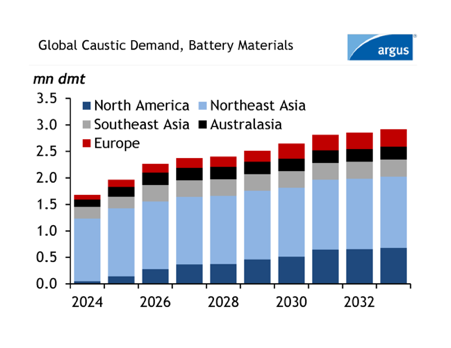
Global Caustic Demand

The relationship between chlor-alkali products and battery materials is gaining focus in the market. With increasing Lithium-based battery capacity globally, demand for associated battery materials is expected to rise. Among the other components of the Li-ion battery stack, PVDF plays an important role as a binder and separator coating, optimizing energy storage efficiency and reducing battery weight in EVs. 

PVDF utilizes caustic soda and chlorine in its production at different stages. Primary feedstock includes vinylidene chloride or vinylidene fluoride, which are derivatives of caustic soda and chlorine.

Some significant developments in PVDF capacity are taking place in North America and Northeast Asia. Belgian chemical company Solvay entered into a joint venture with Mexico-based PVC producer Orbia to build the largest production facility of battery-grade suspension PVDF in North America with a capacity of 20,000 t/yr. Commercial production is expected to start in 2026 and the expected caustic soda and chlorine demand can be 8,000 t/yr and 12,000 t/yr respectively. 

Solvay has doubled its capacity in Changshu, China in the past five years and raised its capacity in France by 35pc reaching 35,000 t/yr making it the largest production site in Europe. Another major producer French chemical company Arkema increased production capacity by 50pc last year at its Changshu site in China.

Japan-based producer Kureha is undergoing expansion at its Iwaki site in Japan, having a production capacity of 6,500 t/yr. The expansion is in two phases, first is a new capacity of 8,000 t/yr and another 2,000 t/yr in the second phase by debottlenecking resulting in a total capacity of 20,000 t/yr by 2026.

This article was created using data and insight from Argus Caustic Soda Analytics and Argus Battery Materials.


Teilen

Related news

News
15.12.25

Japan’s Mitsui Chemicals to raise S Korea MDI output

Japan’s Mitsui Chemicals to raise S Korea MDI output

Tokyo, 15 December (Argus) — Japanese petrochemical company Mitsui Chemicals plans to boost output capacity of its methylenediphenyl diisocyanate (MDI) plant in South Korea's South Jeolla province by May 2027. Mitsui Chemicals aims to raise MDI production capacity at the plant by 100,000 t/yr to 710,000 t/yr, from 610,000 t/yr, the company said on 15 December. Kumho Mitsui Chemicals, a 50:50 joint venture between Mitsui and South Korean chemicals firm Kumho Petrochemical, operates the plant. The company plans to begin construction in February 2026. It expects demand for MDI, a core material for polyurethane, to continue growing because of decarbonisation and economic growth, Mitsui Chemicals said. MDI is used for various products including automotive components, furniture, bedding and heat insulation for houses. The company believes the shift towards decarbonisation will drive MDI consumption for heat insulation, while economic growth will enhance demand for more comfortable cars and households. Mitsui Chemicals also expanded MDI production capacity at the plant by 200,000 t/yr to 610,000 t/yr in 2024 . The prospect of MDI demand growth has prompted fellow Japanese petrochemical producer Tosoh to build an MDI splitter in south Vietnam's Ba Ria–Vung Tau province, aiming to begin commercial operations by October 2026. By Nanami Oki Send comments and request more information at feedback@argusmedia.com Copyright © 2025. Argus Media group . All rights reserved.

Mehr erfahren
News

Viewpoint: Indonesian waste oil supply to fall in 2026


15.12.25
News
15.12.25

Viewpoint: Indonesian waste oil supply to fall in 2026

Singapore, 15 December (Argus) — Indonesia's implementation of a 50pc biodiesel (B50) blend mandate and ongoing palm plantation seizures may raise palm oil prices and reduce global waste oil supply, likely keeping palm oil mill effluent (Pome) oil prices supported in 2026. The country raised its biodiesel blend target by 5pc to 40pc starting from February 2025 and is targeting another 10pc increase to 50pc by the second half of 2026 . The higher blending mandate would lower total palm oil exports by about 11-12pc in 2026 compared with 2024 and 2025, Indonesian agriculture ministry official Baginda Siagan said at the 21st Indonesian palm oil conference (IPOC2025) in November. This would likely support an increase in crude palm oil (CPO) prices, industry analysts said. Prices of CPO and palm-based waste oil like Pome oil are linked because market participants historically priced Pome oil at a set discount to CPO values, and they are both feedstocks for biofuel production. But waste oil export values have mostly been at a premium to CPO this year due to Indonesia's move to suspend exports of unprocessed Pome oil and used cooking oil (UCO) since 8 January , tightening the global supply of waste oils. Indonesia has yet to resume issuing export permits. The restrictions have since driven exporters to explore refining Pome oil for exports. Refined Pome oil exports totalled 440,000t in January-November, according to Kpler data. No refined Pome oil was shipped in 2024 prior to the export pause because exporters directly shipped unrefined material. Refined Pome oil has lower metals and impurities than unprocessed material and can be used for hydrotreating to produce hydrotreated vegetable oil or hydroprocessed esters and fatty acids synthetic paraffinic kerosene (HEFA-SPK) with less processing than crude Pome oil. Argus launched the refined Pome oil fob Indonesia assessment on 15 October to reflect the value in this emerging export market, and it has since been priced above rival regional biofuels feedstock assessments. Indonesia's export pause was a key factor driving up waste oil prices in the region to three-year highs in September ( see chart ). The duration of Indonesia's ban on crude Pome oil and UCO exports remains uncertain, but the government may be tempted to maintain restrictions to keep more feedstocks available to expand domestic biofuels production. This would continue to limit seaborne supply and support prices on a fob basis. Speaking at IPOC2025, Indonesia's palm plantation fund (BPDP) head suggested exploring alternative waste feedstocks such as UCO for use in the B50 programme to reduce Indonesia's reliance on CPO as biodiesel feedstock. State-owned Pertamina is already trialling sustainable aviation fuel (SAF) production through co-processing UCO at its Cilacap refinery since the second quarter of 2025, and shipped about 32,000 litres of UCO-based HEFA-SPK in its first shipment in August . The country is targeting the production of 1mn kilolitres/yr SAF by 2030 . Plantation seizures may squeeze CPO output Palm oil production in Indonesia may be squeezed by the government's ongoing efforts to reclaim plantation lands it said were illegally acquired this year. The Indonesian government in January formed a forestry task force for this purpose and reclaimed over 3.3mn hectares of plantation land by August, according to its website. The land will be transferred to and managed by state-owned Agrinas Palma Nusantara, which was set up in February to oversee the confiscated land. Agrinas has been recruiting staff to operate its plantation business but the availability of harvesters still poses a challenge, it said in a press release on 1 December. Many in the sector expect the change in land management to reduce plantation efficiency starting in 2026. But the extent of yield and production losses caused by the land seizures remains uncertain, said industry analyst Thomas Mielke at IPOC2025. He estimated palm oil output in the country may decline to 49mn t in 2026 from 49.4mn t in 2025. Ministry officials at IPOC2025 did not comment on the ongoing palm plantation seizures. The collection and export of Pome oil from mills may also fall on the back of fewer fresh fruit bunches harvested from oil palm plantations due to the land seizures. Less CPO available for processing into palm olein for domestic cooking oil could also cause UCO supply to shrink. Traceability concerns continue to threaten demand Meanwhile, concerns surrounding Pome oil traceability have continued among European buyers this year, prompting some EU Member States including Portugal , Germany and Ireland to disincentivise Pome oil usage in their biofuels mandates. Most recently in October, the Dutch emissions authority (NEa) said that it will investigate the international Pome oil supply chain with a focus on "fraud risk", and that any findings could be used in policy recommendations. European Pome oil demand is currently expected to remain stable in the near-term at around 1.9mn t/yr, according to Argus Analytics, but removal of policy support by more markets in the new year could tip the balance. Higher demand for Annex IX Part A feedstocks under the RED III may drive other EU countries to absorb Pome oil volumes diverted from markets that have chosen to disincentivise the feedstock by removing it from the classification. By Malcolm Goh Asian waste oil prices ($/t) Send comments and request more information at feedback@argusmedia.com Copyright © 2025. Argus Media group . All rights reserved.

News

EU agrees recycled content for cars


12.12.25
News
12.12.25

EU agrees recycled content for cars

Brussels, 12 December (Argus) — The European Parliament and EU states have provisionally agreed on the end-of-life vehicles regulation. It will set mandatory targets for recycled content in new vehicles, phasing in 15pc recycled plastics content in 6 years and 25pc in 10 years. Targets for recycled steel and aluminium should also be established two years after the entry into force, after the European Commission undertakes feasibility studies. The regulation further stipulates that 20pc of the recycled plastics content targets will be achieved by plastics from end-of-life vehicles (ELVs) or from used parts and components. The provisional agreement still needs to be formally adopted over the coming months by majorities of EU states and also by the whole parliament. It will extend the regulation's provisions for collection, de-pollution and removal of parts, to all regular heavy-duty vehicles, motorcycles and both small and heavy-duty special purpose vehicles (SPVs). Danish environment minister Magnus Heunicke said the deal closes loopholes and "ensures valuable materials are kept within the EU economy, and curbs the export of polluting, non-roadworthy vehicles to third countries". Three years after entry into force, the regulation will establish a cross-border extended producer responsibility (EPR) scheme. Manufacturers will be financially and organisationally responsible for their vehicles over the entire lifecycle. And the new rules aim to better distinguish used from end-of-life vehicles (ELVs). Five years after entry into force of the regulation, exports of non-roadworthy used vehicles will be banned to in order to retain recycled materials within the EU. "This agreement sets realistic targets and minimises administrative requirements," said German centre-right EPP's Jens Gieseke MEP, parliament's lead negotiator from the environment committee. By Dafydd ab Iago Send comments and request more information at feedback@argusmedia.com Copyright © 2025. Argus Media group . All rights reserved.

News

US PET bottle recycling rate falls in 2024


11.12.25
News
11.12.25

US PET bottle recycling rate falls in 2024

Houston, 11 December (Argus) — The US recycling rate for PET bottles fell to 30.2pc in 2024 , down from 32.5pc in 2023, but remained higher than the 2014-2023 average of 29.5pc, according to the latest data from the National Association for PET Container Resources (NAPCOR). US PET bottle collection volumes fell 3.9pc in 2024 to 1,889mn lbs from 1,965mn lbs in 2023, which is the highest annual volume on record. The collection rate also slipped to 39.2pc in 2024, although it remained above the Ellen MacArthur Foundation's 30pc benchmark for recycling scale, NAPCOR said. PET bottle reclaimers processed 88pc of all PET bottles collected for recycling in 2024, up by 1pc from 2023. Reclaimers processed 1,966mn lbs of material in 2024, up by 1.5pc from 2023, by supplementing domestic bottle supply with imported material and alternative feedstocks. The rPET bottle content rate fell to 15.9pc in 2024, down from 16.2pc in 2023, but above the previous three-year average of 13.7pc. Sales of rPET to US and Canadian end-markets declined by 3pc from 2023 to 1,733mn lbs in 2024, while imports of rPET reached 395mn lbs, accounting for a record high of 23pc of the total rPET supply. Bottle applications represented more than 60pc of domestic rPET sales. The proportion of material successfully recovered during rPET reclamation in the US and Canada increased to 85.2pc in 2024 from 81.5pc in 2023. The increase reflects higher recovery and reuse of materials. Recovery of PET thermoform — a type of PET packaging made by molding plastic sheets into a container — increased by 52pc to 264mn lbs, which helped compensate for declines in bottle volumes. Reclaimers recycled four times more non-usual feedstock, such as post-industrial scrap and chemical recycling material , than in 2023, driven by chemical recycling technologies operating at scale. By Dona Davis Send comments and request more information at feedback@argusmedia.com Copyright © 2025. Argus Media group . All rights reserved.

News

Commodity rail shippers push for more train data


11.12.25
News
11.12.25

Commodity rail shippers push for more train data

Houston, 11 December (Argus) — Industrial shippers of commodities like grain and petrochemicals want federal regulators to widen the scope of proposed rules that would require Class I railroads to report more data on their on-time service performance. US rail regulator the Surface Transportation Board (STB) in September put the industry on notice that it intends to issue rules to require that each of the six biggest railroads, including Union Pacific and Norfolk Southern, report two new categories of performance data to the agency. The first would benchmark railroads' shipments against their original estimated time of arrival (OETA) and the second would measure "industry spot and pull" data, or ISP, to determine whether shipments are picked up and delivered within their planned service window. The board action aims to address rail shippers' long-running concerns that unpredictable rail service is a wild card in their supply chains, as many shippers rely nearly completely on rail to get their goods to market. The American Fuel and Petrochemical Manufacturers (AFPM), an industry group that lobbies for US refiners and petrochemical manufacturers, applauded the STB for working to address "chronic freight rail service failures." The OETA is meant to track a carrier's targeted arrival time when it dispatches a cargo and then flag the percentage of weekly shipments that reach their destinations no later than 24 hours after an intended target, the STB said in its proposal. The AFPM, whose members include companies like Dow, Occidental Chemical and Ineos who collectively ship about 2.5mn carloads a year, said OETA data should be broken out by region, terminal, and corridor "to reveal localized bottlenecks often masked by system averages." As proposed, the STB's OETA measurement would apply to manifest train service, where trains haul an assortment of railcar types, and not to unit trains, which exclusively haul one railcar type or bulk commodity, such as coal, grain or crude. Grain shippers and the US Department of Agriculture disagreed with the STB's decision to exclude unit train shipments from the OETA measurement. The National Grain and Feed Association, whose members include Archer Daniels Midland, Bunge and other biofuels makers, said that late unit train deliveries of commodities like grain, ethanol or coal "can result in proportionally greater harm to the shipper/receiver" than smaller manifest shipments. The USDA agreed that unit train shipments should be included in the OETA measurement, and pointed out that about 75pc of US railed corn and soybean shipments in 2023 traveled in trains hauling more than 75 railcars, which would not be captured by manifest shipment data. Demand for agricultural products is highly seasonal, and missed delivery windows "can halt processing lines, disrupt export programs, and force shippers to carry excess private car inventory to buffer uncertainty," the agency said. The Association of American Railroads (AAR), which lobbies on behalf of Class I railroads, pushed back on industry requests to widen the OETA to include unit train shipments, and told the STB that several railroads do not currently generate the metrics. Adding the reporting requirements "would add regulatory burden, waste resources, and misrepresent service on the network," the AAR said. By Chris Baltimore Send comments and request more information at feedback@argusmedia.com Copyright © 2025. Argus Media group . All rights reserved.