

• 14 de junio de 2024
  • Market: Chemicals, Chlor-Alkali

PVDF demand to increase chlor-alkali consumption

The demand growth of polyvinylidene fluoride (PVDF) is dependent on lithium-ion batteries for battery-operated electric vehicle (EV) demand and stationery electrical storage. Argus forecasts global lithium-ion battery demand in EVs to reach 3.8GWh by 2034 from 0.7GWh in 2023. EV sales are expected to rise at an average growth rate of 10pc in the next 10 years reaching more than 46mn units.

Global caustic soda demand into battery materials for leading regions is shown in the figure. Argus’s latest caustic soda analytics forecast explains an exponential rise in caustic soda consumption for battery material processing. Global caustic soda consumption in the processing of lithium hydroxide, lithium carbonate, cathode materials and recycled black mass was at 1.5mn dmt in 2023 and is expected to reach 3mn dmt in 2033 at a CAGR of 10pc in the first five years.
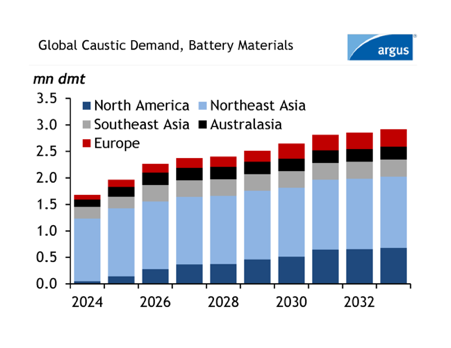
Global Caustic Demand

The relationship between chlor-alkali products and battery materials is gaining focus in the market. With increasing Lithium-based battery capacity globally, demand for associated battery materials is expected to rise. Among the other components of the Li-ion battery stack, PVDF plays an important role as a binder and separator coating, optimizing energy storage efficiency and reducing battery weight in EVs. 

PVDF utilizes caustic soda and chlorine in its production at different stages. Primary feedstock includes vinylidene chloride or vinylidene fluoride, which are derivatives of caustic soda and chlorine.

Some significant developments in PVDF capacity are taking place in North America and Northeast Asia. Belgian chemical company Solvay entered into a joint venture with Mexico-based PVC producer Orbia to build the largest production facility of battery-grade suspension PVDF in North America with a capacity of 20,000 t/yr. Commercial production is expected to start in 2026 and the expected caustic soda and chlorine demand can be 8,000 t/yr and 12,000 t/yr respectively. 

Solvay has doubled its capacity in Changshu, China in the past five years and raised its capacity in France by 35pc reaching 35,000 t/yr making it the largest production site in Europe. Another major producer French chemical company Arkema increased production capacity by 50pc last year at its Changshu site in China.

Japan-based producer Kureha is undergoing expansion at its Iwaki site in Japan, having a production capacity of 6,500 t/yr. The expansion is in two phases, first is a new capacity of 8,000 t/yr and another 2,000 t/yr in the second phase by debottlenecking resulting in a total capacity of 20,000 t/yr by 2026.

This article was created using data and insight from Argus Caustic Soda Analytics and Argus Battery Materials.


Related news

News
04/03/26

Brazil’s Jan PPI contracts on fuels, food

Brazil’s Jan PPI contracts on fuels, food

Sao Paulo, 4 March (Argus) — Prices paid to Brazilian producers fell by 4.33pc in January from a year earlier, mostly pushed down by the food sector and fuels, according to government statistics agency IBGE. The decline in the producer price index (PPI) slowed from a 4.51pc contraction in December but quickened from 3.36pc in November and smaller contractions the prior two months. The disinflation in PPI suggests that consumer price inflation, which accelerated to 4.44pc in January from 4.26pc in December, may soon be easing. The food sector, which accounted for more than half of the total PPI index result, fell by 9.84pc in January from a year earlier, after a 10.48pc annual loss in December, extending a negative streak begun in September, IBGE said. Sugar products and pork were among the main negative drivers, while falling sugar prices were mainly affected by a weakening dollar to the Brazilian real over the last year. IBGE's research manager Murilo Alvim said. As for crude and biofuels, producer prices for the sector fell by 7.64pc in the last 12-months, following a 5.64pc annual loss in December and marking an eight-month low, IBGE data show. Metallurgy producer prices fell by 4.91pc in January from a year earlier, following an 8.06pc annual loss in December. The index ticked up by 0.3pc from December. Brazil's PPI posted 10 consecutive monthly declines from February-November 2025, IBGE said. Copper and gold contributed the most to inflationary pressures within metallurgy in the monthly comparison, adding up to its 2.73pc. As for chemicals, sulfur-based fertilizers and other imported feedstocks raised producer prices to a 1.7pc gain from December, Alvim said. PPI measures average prices offered by suppliers to domestic producers of goods and services without considering taxes and freight costs. By João Curi Send comments and request more information at feedback@argusmedia.com Copyright © 2026. Argus Media group . All rights reserved.

News

Hormuz naval escort unlikely in the near-term: SSY


04/03/26
News
04/03/26

Hormuz naval escort unlikely in the near-term: SSY

London, 4 March (Argus) — A US plan for its navy to escort ships heading through the strait of Hormuz is unlikely to come to fruition any time soon because the fleet will be occupied with military operations, according to analysts at shipbroker SSY. Traffic through the strait, the world's most critical oil and LNG shipping lane at the mouth of the Mideast Gulf, has almost entirely stopped, with insurers unwilling to cover transit since Iran said it will "burn" any ship that tries to pass. A container ship was struck today in the strait, UKMTO said. US president Donald Trump stated on 3 March that "if necessary, the United States Navy will begin escorting tankers through the strait of Hormuz, as soon as possible." Europe is also looking at naval operations in the region, with French president Emmanuel Macron announcing on Tuesday the creation of a coalition to secure traffic through Hormuz. But SSY said the US Navy "has privately told the industry it will lack escort capacity until the initial stage of the military operation is complete. An additional issue is that US law does not allow the country's navy to escort ships that are not US-flagged or -owned, or have no US crew, the firm said. In addition to the legal issues, SSY pointed to the difficulty of actually protecting shipping in the strait. "Physical geography favours the attacker," it said. "[Shipping] lanes are 2 [nautical miles] wide each direction; vessels transit at 10–12 knots and must turn at the narrowest point adjacent to Iranian islands. "A destroyer can intercept missiles but cannot simultaneously sweep mines, counter drone-boat swarms from multiple bearings, and manage GPS disruption," SSY said. The firm pointed to recent US operations in the Red Sea at the height of attacks by Yemen-based Houthi militants, where "escorts failed to restore commercial traffic despite ~400 drones/missiles downed". But, SSY said, pressure to restore normality is greater this time, which could lead to a significantly different military strategy. By John Ollett and Andrey Telegin Send comments and request more information at feedback@argusmedia.com Copyright © 2026. Argus Media group . All rights reserved.

News

Mideast war to tighten LatAm polymer supply: Update


03/03/26
News
03/03/26

Mideast war to tighten LatAm polymer supply: Update

Add information on shipping at Strait of Hormuz, Red Sea and Mideast Gulf regions. Sao Paulo, 3 March (Argus) — The US-Iran war has heightened security risks across Middle East sea lanes and disrupted polyethylene (PE) and polypropylene (PP) flows into Brazil and the wider Latin American market as carriers suspend loadings, impose emergency surcharges and reroute vessels around the Cape of Good Hope. Some containership owners, such as CMA CGM, earlier announced an "emergency conflict surcharge" of $3,000/feu (forty-foot container), or $121/metric tonne (t), on all loadings from ports in the Mideast Gulf and Red Sea regions but have since suspended operations out of the Mideast Gulf. Shipping is now possible only from the Red Sea region and some ports outside of the Mideast Gulf, but the situation remains dynamic and it is unclear which carriers are still calling at these ports, particularly when sailings involve transiting through the Bab el Mandeb strait. Despite the cost surge, vessel space remains constrained as shipowners cut departures on high-exposure routes and roll bookings. Capacity tightness is most visible on short-notice shipments to South America's east coast, a global trader said. Rerouting vessels around the Cape of Good Hope is lengthening voyages and creating equipment imbalances, stretching lead times and undermining production planning for converters dependent on imported resin. Buyers report more blank sailings, delayed laycans and shifting arrival times as carriers adjust rotations. Additional insurance requirements and onboard security measures are adding time and cost, weakening schedule reliability into Santos, Manaus and other Brazilian ports. Transit through key canals is technically "restricted and unreliable" rather than fully closed, but the operational outcome is similar, with fewer departures from Gulf export hubs and fewer relay options into Mediterranean transshipment points, a source said. Equipment shortages on feeder services and rising premiums for guaranteed space are adding further friction. Higher landed polymer costs The conflict's immediate effect on Latin American polymer markets is rising landed costs. Import-parity formulas are absorbing new surcharges and longer routes, lifting cfr Brazil indications even without adjustments to fob values. If reduced departure frequency persists, participants expect spot tightness to surface into late March, particularly for PP grades with limited substitution options on the demand side. Domestic production can offset part of the shortfall but cannot fully cover a sharp reduction in Middle Eastern arrivals if carriers deepen schedule cuts. Middle Eastern suppliers remain central to Brazil's polymer balance. Saudi Arabia was Brazil's second-largest PP supplier in 2025, sending almost 140,080t, or 20pc of the country's imports. As for PE, Saudi Arabia ranked third at 56,445t, while Egypt placed fifth with nearly 47,795t last year. Brazilian polyvinyl chloride (PVC) buyers also increased purchases from Egypt by 68pc last year to around 100,090t. Converters are adjusting sourcing strategies by front-loading purchases, widening delivery windows and considering alternative origins with lower exposure to higher-risk routes, even when nominal resin prices are higher. "The situation will not normalize in one or two weeks," one source said. "News changes by the hour, owners are cautious, and freight alone will lift cfrs across Brazil and the rest of Latin America." Market participants describe the disruption as global. With elevated risk premiums and major carriers avoiding vulnerable passages, surcharges and extended transits are expected to persist, supporting delivered PE and PP values until security conditions allow a broader return to standard routes. Aiming to restore normal transits, president Donald Trump on Tuesday said the US will offer political risk insurance and naval convoys for ships transporting energy and other commodities through the Mideast Gulf. Meanwhile, Brazil petrochemicals giant Braskem has also adjusted its domestic pricing in response to the tighter logistics environment. The company withdrew the pricing policy it released on 28 February and issued a revised schedule on 2 March, increasing PE and PP prices across all grades. Braskem lifted LDPE, HDPE, LLDPE and metallocene PE values by R500/t ($95/t), with no bonuses applied. As for PP, the company raised homopolymer and copolymer prices by R250/t, also without bonuses. Market participants said the revision reflects both escalating freight costs and expectations of reduced availability from traditional import origins. Brazil's naphtha cost could rise The US–Iran conflict is adding pressure to Brazil's chemical chain through higher oil prices, exchange rate volatility and tighter availability of key feedstocks, chemical industry association Abiquim said on 3 March. While no physical disruptions have emerged, Abiquim warns that a sustained increase in Brent crude values will raise petrochemical naphtha costs, a structural vulnerability for a country that remains a net importer of derivatives. Rising energy benchmarks could narrow petrochemical margins and weaken Brazil's position against regions that produce more gas. Additional risks extend to nitrogen fertilizers and chemical intermediates, given Iran's role as an exporter of urea, ammonia, methanol and derivatives. Brazil imports about 85pc of its fertilizer needs, leaving agriculture and downstream producers exposed to potential price spikes. Abiquim also cited macroeconomic risks, with geopolitical uncertainty typically driving a stronger US dollar and raising import costs for industrial inputs and equipment. The situation underscores structural weaknesses in Brazil's chemical chain and the need for long-term policies that reduce dependence on imported naphtha, fertilizers and other strategic inputs, the group added. By Fred Fernandes and Isabela Mendes Send comments and request more information at feedback@argusmedia.com Copyright © 2026. Argus Media group . All rights reserved.

News

Caustic soda freight costs rise on Mideast Gulf war


03/03/26
News
03/03/26

Caustic soda freight costs rise on Mideast Gulf war

Houston, 3 March (Argus) — Freight costs for US caustic soda exports soared early this week as ship traffic through the strait of Hormuz is at a standstill after the US and Israel attacked Iran on 28 February, redrawing trade routes to key destinations and fueling higher energy costs. Caustic soda freight costs jumped by as much as 50pc from the US Gulf coast compared with last week, various suppliers said. Freight to Brazil topped as much as $180/dry metric tonne (dmt) on Tuesday, marking a 28-38pc increase from late-February estimates, sources said. Additionally, freight costs for transatlantic routes climbed by 37pc, a trader added. Escalating war in the Middle East does not threaten US caustic soda supply availability, nor does it immediately threaten global trade , but lends further support to rising spot values through logistical costs as global suppliers and shippers avoid the strait of Hormuz . Iran on Monday claimed it has "closed" the strait of Hormuz connecting the Mideast Gulf and Gulf of Oman and intends to burn any ship that tries to pass through. Vessel traffic through the key passage for crude, petrochemicals, fertilizers and other commodities has come to a virtual halt in the days after the US and Israel attacked. Higher freight costs from the US further increase net forwards to the Mediterranean and Brazil, but spot export availability from the US is expected to shrink in the next 30-45 days as producers undertake planned turnarounds. Elevated freight combined with seasonal maintenance increased early-week price discussions for new sales, with one source indicating offers could climb into the mid-$400s/dmt fob — a level last seen in June, Argus data show. By Connor Hyde Send comments and request more information at feedback@argusmedia.com Copyright © 2026. Argus Media group . All rights reserved.

News

Middle East shock to tighten LatAm polymer supply


03/03/26
News
03/03/26

Middle East shock to tighten LatAm polymer supply

Sao Paulo, 3 March (Argus) — Heightened security risks across Middle East sea lanes because of the US-Iran conflict could disrupt polyethylene (PE) and polypropylene (PP) flows into Latin America as carriers suspend sailings, impose emergency surcharges and reroute vessels around the Cape of Good Hope. Carriers have introduced emergency and war-risk fees on Middle East–Atlantic corridors, market participants said. Traders are citing initial guidance near $1,500/20ft equivalent units and prompt offers around $3,000/40ft container, according to a 2 March Hapag-Lloyd notice seen by Argus . Despite the cost surge, vessel space remains constrained as shipowners cut departures on high-exposure routes and roll bookings. Capacity tightness is most visible on short-notice shipments to South America's east coast, a global trader said. Rerouting away from high-risk zones is lengthening voyages and creating equipment imbalances, stretching lead times and undermining production planning for converters dependent on imported resin. Buyers report more blank sailings, delayed laycans and shifting arrival times as carriers adjust rotations. Additional insurance requirements and onboard security measures are adding time and cost, weakening schedule reliability into Santos, Manaus and other Brazilian ports. Transit through key canals is technically "restricted and unreliable" rather than fully closed, but the operational outcome is similar, with fewer departures from Gulf export hubs and fewer relay options into Mediterranean transshipment points, a source said. Equipment shortages on feeder services and rising premiums for guaranteed space are adding further friction. Impact on Latin America The conflict's immediate effect on Latin American markets is rising landed costs. Import-parity formulas are absorbing new surcharges and longer routes, lifting cfr Brazil indications even without adjustments to fob values. If reduced departure frequency persists, participants expect spot tightness to surface into late March, particularly for PP grades with limited substitution on the demand side. Domestic production can offset part of the shortfall but cannot fully cover a sharp reduction in Middle Eastern arrivals if carriers deepen schedule cuts. Middle Eastern suppliers remain central to Brazil's polymer balance. Saudi Arabia was Brazil's second-largest PP supplier in 2025, sending almost 140,080t, or 20pc of imports. As for PE, Saudi Arabia ranked third at 56,445t, while Egypt placed fifth with nearly 47,795t. Brazilian polyvinyl chloride (PVC) buyers also increased purchases from Egypt by 68pc last year to around 100,090t. Converters are adjusting sourcing strategies by front-loading purchases, widening delivery windows and considering alternative origins with lower exposure to higher-risk routes, even when nominal resin prices are higher. "The situation will not normalize in one or two weeks," one source said. "News changes by the hour, owners are cautious, and freight alone will lift cfrs across Brazil and the rest of Latin America." Market participants describe the disruption as global. With elevated risk premiums and major carriers avoiding vulnerable passages, surcharges and extended transits are expected to persist, supporting delivered PE and PP values until security conditions allow a broader return to standard routes. Meanwhile, Brazil's petrochemicals giant Braskem has also adjusted its domestic pricing in response to the tighter logistics environment. The company withdrew the pricing policy it released on 28 February and issued a revised schedule on 2 March, increasing PE and PP prices across all grades. Braskem lifted LDPE, HDPE, LLDPE and metallocene PE values by R500/metric tonne ($95/t), with no bonuses applied. As for PP, the company raised homopolymer and copolymer prices by R250/t, also without bonuses. Market participants said the revision reflects both escalating freight costs and expectations of reduced availability from traditional import origins. Chemicals The US–Iran conflict is adding pressure to Brazil's chemical chain through higher oil prices, exchange rate volatility and tighter availability of key feedstocks, chemical industry association Abiquim said on 3 March. While no physical disruptions have emerged, Abiquim warns that a sustained Brent increase will raise petrochemical naphtha costs, a structural vulnerability for a country that remains a net importer of derivatives. Rising energy benchmarks could narrow petrochemical margins and weaken Brazil's position against regions that produce more gas. Additional risks extend to nitrogen fertilizers and chemical intermediates, given Iran's role as an exporter of urea, ammonia, methanol and derivatives. Brazil imports about 85pc of its fertilizer needs, leaving agriculture and downstream producers exposed to potential price spikes. Abiquim also cited macroeconomic risks, with geopolitical uncertainty typically driving a stronger US dollar and raising import costs for industrial inputs and equipment. The situation underscores structural weaknesses in Brazil's chemical chain and the need for long-term policies that reduce dependence on imported naphtha, fertilizers and other strategic inputs, the group added. By Fred Fernandes and Isabela Mendes Send comments and request more information at feedback@argusmedia.com Copyright © 2026. Argus Media group . All rights reserved.