


Weight of Freight: TMX spurs new Aframax, VLCC trade in Pacific basin
The first three months of Canada's Trans Mountain Expansion (TMX) have sent a surge of crude to refiners in California and China, shifting tanker demand in the Pacific basin.
The 590,000 b/d TMX project nearly tripled the capacity of Trans Mountain’s pipeline system to 890,000 b/d when it opened on 1 May, linking Alberta's oil sands to Canada's west coast for direct access to lucrative Pacific Rim markets, where buyers are eager for heavy sour crude.
Between 20 May, when the first TMX cargo began loading, and 20 August, about 165,000 b/d of Vancouver crude exports landed at ports on the US west coast, primarily in California, up from about 30,000 b/d in that same span last year, according to data from analytics firm Kpler.
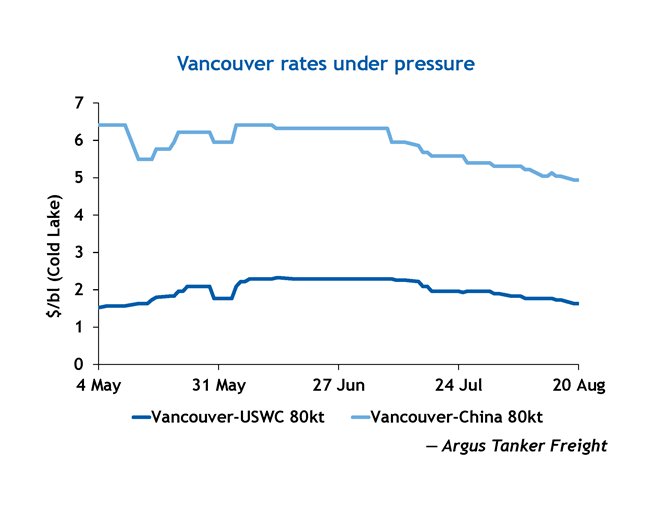
The freight rate for a Vancouver-US west coast Aframax shipment averaged $1.98/bl for Cold Lake between 1 May and 20 August. This ranged from a low of $1.50/bl from 1-3 May when shipowners repositioned to the region in anticipation of TMX to a high of $2.32/bl from 13-14 June, according to Argus data.
The new oil flow into the US west coast has displaced shipments from farther afield in Ecuador and Saudi Arabia. Crude exports from those countries into the US west coast averaged 110,000 b/d and 25,000 b/d, respectively, between 20 May and 20 August, down from 155,000 b/d and 135,000 b/d over the same stretch in 2023, according to Kpler.
The growth of the Vancouver market, which benefits from its proximity to California, has reduced tonne-miles, a proxy for tanker demand, into the US west coast. This has outpaced slightly lower crude demand, which fell in part due to Phillips 66 halting crude runs at its 115,000 b/d refinery in Rodeo, California, in February to produce renewable fuels, as well as weaker-than-expected road fuel demand this summer.
Tonne-miles for US west coast crude imports fell by 14pc to 106bn between 20 May and 20 August 2024 compared with the same period a year earlier, Vortexa data show, while overall crude imports declined just 8.6pc to 1.37mn b/d, according to Kpler.
PAL-ing around with VLCCs
Though much of Vancouver’s exports have been shipped to the US west coast, Canadian producers have found ready buyers in Asia-Pacific as well, where about 160,000 b/d of Vancouver exports went between 20 May and 20 August, compared with none a year prior, Kpler data show.Buyers and sellers have displayed a preference for using ship-to-ship transfers onto very large crude carriers (VLCCs) at the Pacific Area Lightering zone (PAL) off the coast of southern California, rather than sending Aframaxes directly to refineries in east Asia. Of the 30 Vancouver-origin Aframax cargoes that have landed in China, South Korea and India, 19 were transferred onto VLCCs at PAL, Kpler data show. Seven cargoes were sent directly to east Asia on time-chartered Aframaxes — the majority by Suncor — and just four were sent using spot tonnage, likely due to the expensive economics of trans-Pacific Aframax shipments.
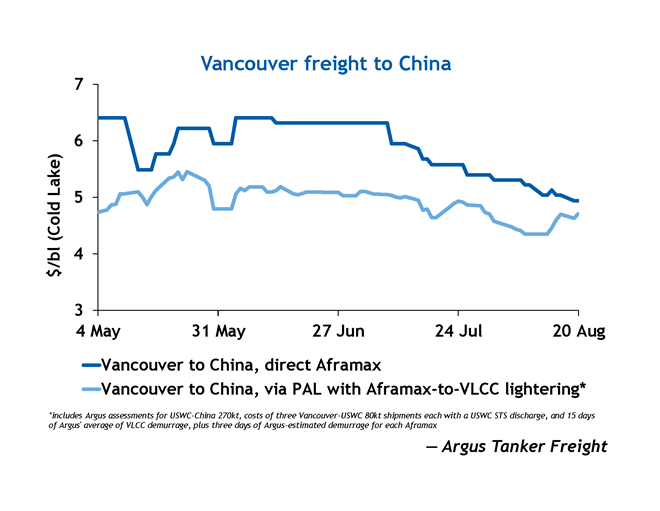
The Vancouver-China Aframax rate between 1 May and 20 August averaged $5.90/bl, with a low of $4.94/bl from 19-20 August and a high of $6.41/bl from 1-10 May and again from 4-12 June, according to Argus data.
Over the same time, the cost to reverse lighter, or transfer, three 550,000 bl shipments of Cold Lake crude from Vancouver onto a VLCC at PAL averaged about $8.055mn lumpsum, or $4.92/bl, with a low of $4.35/bl from 8-13 August and a high of $5.45/bl on 22 May, according to Argus data. This includes $150,000 ship-to-ship transfer costs at PAL, 15 days of VLCC demurrage and three days of Aframax demurrage for each reverse lightering.
VLCC costs could change preferences
Though it may have been cheaper to load TMX crude on VLCCs at PAL since May, volatility in the VLCC market — which often falls to yearly lows in summer before climbing to seasonal highs in the winter — could entice traders to opt for direct Aframax shipments if VLCCs hit their expected peak in the winter.
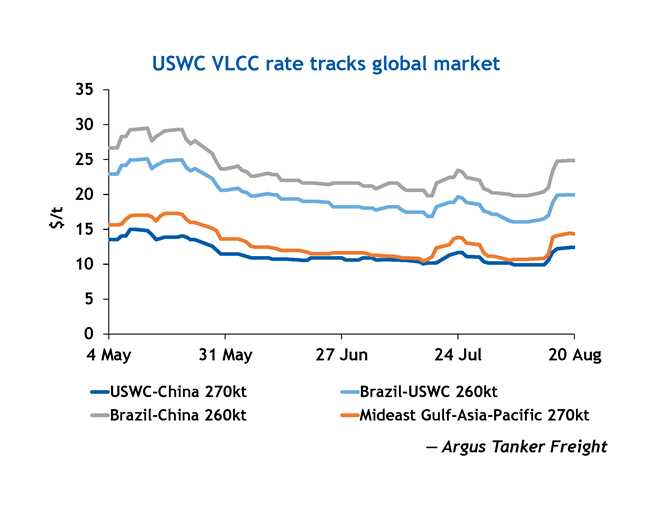
VLCC costs for shipments from the US west coast to China are influenced by the VLCC markets in the Mideast Gulf and Brazil, where ships look for their next voyage after discharging on the US west coast.
For now, Vancouver-loading Aframax rates are under pressure from the reemergence of VLCCs in what had become an Aframax trade in Thailand, boosting Aframax supply in the Pacific and pulling the class’s rate to ship crude from Vancouver to the US west coast to its lowest level in more than three months on 19 August.
In mid-July, VLCCs resumed discharging via single point mooring (SPM) at Thailand's port of Map Ta Phut for the first time since January 2022, ship-tracking data from Vortexa show. Prior to the SPM's return to service, VLCCs could discharge cargoes only by lightering onto smaller Aframaxes, which would then unload at a different berth in the port.
This created demand for about eight Aframax lighterings each month, but with VLCCs in Thailand again able to discharge directly, that demand is effectively halted, putting downward pressure in the broader southeast Asia Aframax market.
Since July, two Aframaxes have left the southeast Asia market for Vancouver, according to ship tracking data from Kpler: the Eagle Brisbane, which previously was used in lightering operations at Map Ta Phut, and the Blue Sea, which recently hauled fuel oil from nearby Singapore to China.


Spotlight content


Related news
US adds pressure on Iran after talks resume: Update
US adds pressure on Iran after talks resume: Update
Recasts, updates with secondary tariff on Iran oil. Washington, 6 February (Argus) — President Donald Trump's administration on Friday announced actions aimed to add economic pressure on Iran after another round of US-Iran nuclear talks concluded in Oman without much progress. An executive order by Trump, released by the White House Friday afternoon, pledges to impose additional tariffs on US imports from countries engaged in business with Iran. The penalty is not automatic and is not set at a specific amount — it could be "for example 25pc", the order states. The US administration will determine whether any country continues to engage in business with Iran after 7 February and will then decide whether to apply the additional tariff, according to the order. US presidential envoy Steve Witkoff and Iran's foreign minister Abbas Araqchi met in Muscat, Oman, on Friday and the two governments plan to hold additional meetings at a future date, according to the host country's foreign minister, Badr Albusaidi. Araqchi told Iranian reporters that he held firm to discussing only the nuclear portfolio — rather than also addressing Iran's missile program and other issues raised by the US. Araqchi said that he asserted "the rights that the Iranian people have", which is likely a reference to Tehran's demand to continue to have nuclear enrichment capacity. The US administration is eyeing permanent curbs on Iran's nuclear program. Also on Friday, the US Treasury Department announced sanctions on 14 additional tankers allegedly linked to a network transporting Iranian crude and LPG. Whether the negotiations will avert another round of US strikes against Iran remains to be seen. Diplomats from the two countries last engaged in talks in April-June 2025, before Trump ordered a bombing raid against nuclear facilities in Iran. The new tanker sanctions were announced shortly after the talks concluded in Muscat. The pattern of combining diplomacy and sanctions pressure continues the tactic deployed by Trump's administration during the previous round of US-Iran talks. Friday's sanctions also include 15 entities and individuals allegedly tied to the Iranian oil trade. The one major difference from last year's sanctions approach is a lack of enforcement against China-based entities involved in trading Iranian crude. Iranian crude cargoes mostly are delivered to buyers in China via a network of intermediaries and shadow fleet tankers and involve ship-to-ship transfers in international waters near Malaysia and Indonesia. The US is finding it difficult to fully enforce sanctions against Iranian crude because of Tehran's ability to retaliate, US secretary of state Marco Rubio said on 28 January. Trump, who had ordered a US naval buildup in the Middle East, threatened military strikes against Iran, but also expressed a willingness to negotiate with Tehran. By Haik Gugarats Send comments and request more information at feedback@argusmedia.com Copyright © 2026. Argus Media group . All rights reserved.
Algeria’s Saharan Blend export disruptions to continue
Algeria’s Saharan Blend export disruptions to continue
London, 6 February (Argus) — Algeria's state-owned Sonatrach expects weather-related disruptions to its Saharan Blend crude exports to continue in February, a source at the firm told Argus . Algeria's crude exports — made up entirely of the light sweet Saharan Blend — fell to a multi-year low of 201,000 b/d in January as bad weather delayed loadings, the source said. Argus estimates exports at 476,000 b/d in December. Spot prices for Saharan Blend rose to a $2/bl premium to North Sea Dated in mid-January, when European refiners — particularly in the Mediterranean — were seeking alternatives to light sour CPC Blend. But with Europe approaching spring refinery maintenance and CPC Blend exports picking up again , Saharan Blend has eased by 70¢/bl to a $1.30/bl premium to Dated. The Algerian grade, which trades on a fob basis, is also under pressure from rising freight rates. The cost of shipping an Aframax-sized cargo of Saharan Blend across the Mediterranean and to northwest Europe has averaged around 40pc higher in the second half of January into early February, compared with the first half of January. Sonatrach raised the official February formula price for Saharan Blend to a $2.50/bl premium to Dated, up by $1.50/bl from January and the highest since December 2022. The company typically circulates its retroactive official price after clearing most of its own supplies. By Aydin Calik and Lina Bulyk Send comments and request more information at feedback@argusmedia.com Copyright © 2026. Argus Media group . All rights reserved.
Crude Summit: Brazilian export logistics are stretched
Crude Summit: Brazilian export logistics are stretched
New York, 4 February (Argus) — Brazilian crude exporters are working to address bottlenecks that are becoming overburdened by the country's surging exports, according to speakers at the Argus Americas Crude Summit today. The potential lack of enough dynamic positioning (DP) tankers to ferry crude from the country's offshore production sites to the coast for transfer onto standard tankers for export is "something everyone has to be worried about," said Fernando Colares Nogueira, Petrobras' head of crude oil, said at the event. Brazil's crude production climbed by 12pc year over year to 3.77mn b/d in 2025 , and is expected to rise further this year . To meet the demand, Petrobras has six of these DP tankers on order, said Nogueira, which would add to the roughly 50 that already operate along the Brazilian coast. The port of Acu is the receiving port for much of these crude-laden DP tankers, but is struggling to keep up with the rising ship-to-ship transfers happening at the port and needs "relief", said PetroChina International Trading's vice president of crude Alipio Ferreira. Petrochina is investing in improving port infrastructure across the country, including building a new terminal in Puerto Central, said Ferreira. By Nicholas Watt Send comments and request more information at feedback@argusmedia.com Copyright © 2026. Argus Media group . All rights reserved.
Crude Summit: Canadian oil to Asia is ‘kicking up’
Crude Summit: Canadian oil to Asia is ‘kicking up’
Houston, 4 February (Argus) — Canadian crude highly sought by Asian refiners and the region will "pick up the slack" if Californian demand wanes, Trans Mountain said today at the Argus Americas Crude Summit in Houston, Texas. "We've been pleasantly surprised by the increase in demand, and it is primarily China and it is primarily petrochemical demand," Trans Mountain vice president of business development Jason Balasch said. "It's been kicking up lately." California has also been a key destination for Canadian crude after Trans Mountain's 590,000 b/d expansion came online in May 2024, but aging refineries and stringent state regulations are prompting downstream operators to shutter facilities. Chinese refiners meanwhile have taken a shine to Canadian crude, like Access Western Blend (AWB), which has both light and a heavy ends. The crude's ability to produce higher amounts of naphtha is especially of interest, as that is a key feedstock for the country's growing petrochemical industry. The now 890,000 b/d dual pipeline system has given Albertan oil producers a meaningful alternative to shipping almost all of its crude to US refiners, while removing any doubts over how willing Asian refiners would be to take Aframax-sized cargoes from Vancouver, British Columbia. "As we approached startup in late 2023, early 2024, it was viewed primarily as a California export play, but it's really becoming an Asian play," said Balasch. The demand for space on Trans Mountain's system is evident in utilization that averaged above 90pc in the fourth quarter, according to Balasch. This is up from 87pc in the third quarter and, coupled with restrictions on Enbridge's 3.1mn b/d Mainline that delivers crude into the US, is another signal more space out of the Western Canadian Sedimentary Basin will be needed. Further expansion of Trans Mountain system is being planned to help meet growing Asian demand. The federally-owned company is less than two years removed from bringing online its 590,000 b/d Trans Mountain Expansion (TMX) project, and this week applied to the regulator to increase capacity by 90,000 b/d using drag reducing agent (DRA). The DRA project could be online as early as January 2027, according to the application. Trans Mountain is considering another 210,000 b/d expansion after that, which could be brought online in either 2029 or 2030, Balasch said. That would bring total pipeline capacity up to about 1.19mn b/d, with another 35,000 b/d potentially flowing "seasonally". Moving mountains Even with optimization projects, a pipeline pinch is expected by many forecasters, including RBN president David Braziel, who said rising Canadian production may outpace egress as early as 2027 or 2028. Politically, energy security is now top of mind, which has shone a bright light on the missteps by Canada's approach to oil and gas development over the past decade, Braziel said, but political will is not all that is required. "Politics is politics," said Braziel. "It's really the economics of projects and the markets that are going to fundamentally decide what gets built." Optimization projects by Trans Mountain and Enbridge are expected to give some relief, but yet another supply crunch may develop beyond 2030, raising the need for another pipeline altogether. If Trans Mountain's two optimization projects are completed, the pipeline will be physically maxed out with no other low hanging fruit left to deliver large tranches of capacity. The Alberta government has long-called for more pipeline capacity and is planning to submit a proposal to the federal government by June. Alberta premiere Danielle Smith said previously a 1mn b/d pipeline to British Columbia's north coast would be ideal and has made an arrangement with Canada's prime minister Mark Carney to pursue those plans, but that will be no small feat. Carney wants to further diversify trade away from a hostile US administration and energy is a key component of talks, making strides with other countries who have also been caught up in US president Donald Trump's trade wars. By Brett Holmes Send comments and request more information at feedback@argusmedia.com Copyright © 2026. Argus Media group . All rights reserved.