For some, the heightened focus on energy security threatens climate goals, while others see it as accelerating decarbonisation, writes Georgia Gratton
The war in Ukraine, and the consequent revival of concerns around energy security, has had major implications for climate policy, pushing advanced economies to intensify existing climate goals, but also giving fossil fuel producers an argument for their continued use.
OECD leaders, as well as the group's influential energy watchdog, the IEA, moved rapidly to stress that a pivot away from Russian oil and gas and increased deployment of renewables would address all three aspects of the "energy trilemma" — decarbonisation, affordability and security of supply. But leading oil and gas producers have emphasised their credentials as reliable suppliers, while some have placed the focus on tackling emissions, not stigmatising their source.
And those OECD governments have faced multiple challenges and criticism, with some bringing coal-fired power generation back on line and extending the life of nuclear power plants — controversial in certain jurisdictions — as well as because of the rocketing energy prices faced by consumers.
In Europe, the EU presented its REPowerEU plan in May, designed to wean the bloc off imports of Russian fossil fuels but equally to address the climate crisis, through energy efficiency improvements and investment in renewables. The EU has been unswerving in its certainty that the war and subsequent phasing out of Russian fossil fuel imports is an opportunity to speed up the energy transition.
The early rhetoric has filtered through into concrete legislation. The EU now plans to step up the ambition of its climate targets once all elements of its Fit for 55 package have been agreed. It will increase its legally binding target for reducing greenhouse gas (GHG) emissions to 57pc by 2030, from a 1990 baseline, up from the previous 55pc. These emissions cuts will afford the EU a strong geopolitical advantage, commission executive vice-president Frans Timmermans said last week.
The US swiftly followed suit. President Joe Biden unveiled the Inflation Reduction Act (IRA) in August — generating sweeping tax incentives and direct spending to cut GHG emissions and drive renewables and green industry. The IRA is the largest climate measure ever to pass in the US, and how it "came about was because of the Ukraine war, let's be honest", US senator Joe Manchin told delegates at the World Economic Forum in January.
Dash to splash cash
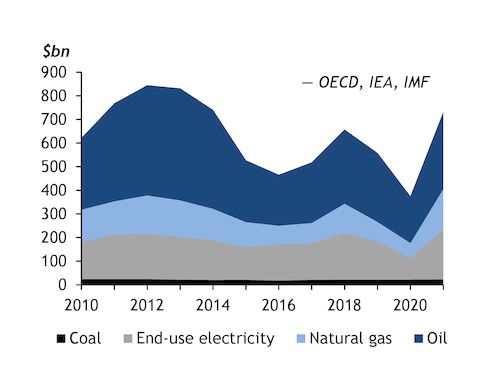
The new climate policy initiatives from the US and the EU have resulted in significant amounts of cash for the energy transition — $369bn from the IRA and up to €270bn ($290bn) from the REPowerEU, although this is in a context of high inflation for both jurisdictions. The policies should hasten decarbonisation for both, notwithstanding some concern among EU leaders that the mammoth scope of the IRA might trigger a "green subsidy race".
The US and the EU have not been alone in taking steps over the past 12 months to accelerate decarbonisation — the IEA's projections of a substantial rise in renewables capacity over the next five years are also driven by China's latest five-year plan. But the US and EU measures have been notable for their direct link to tackling long-term energy security concerns triggered by the Ukraine war.
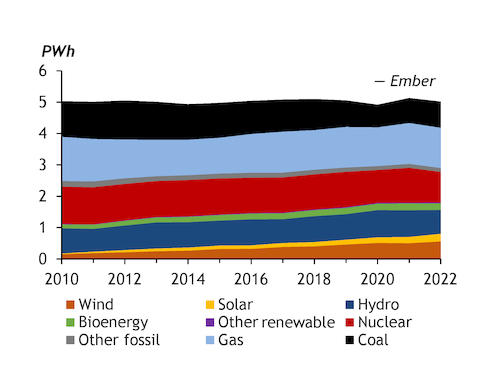
In the shorter term, the EU's return to coal has been a bitter pill to swallow for many governments, some of which — such as Germany's Green coalition — were elected on the back of their environmental pledges. But increased coal burn in winters 2022-23 and 2023-24 is unlikely to affect countries reaching climate goals in the long term, a study by climate and energy think-tank Ember found. European coal phase-out dates, which are some of the earliest in the world, remain largely unchanged, while some coal-fired plants, kept on reserve by governments to meet power demand, have not yet been used.
But Europe scrambled to replace its imports of Russian gas. The region ramped up LNG deliveries, and some countries were forced to rapidly add infrastructure — Germany built its 5.8mn t/yr Wilhelmshaven LNG import terminal in a matter of months. EU leaders have stressed that new gas infrastructure will be future-proofed to carry hydrogen once that nascent sector develops.
Natural gas development was a key topic at November's UN Cop 27 climate summit at Sharm el-Sheikh in Egypt. A reference to low-carbon fuels added to Cop 27's final text at the last minute rekindled a debate about support for gas and exposed unfulfilled pledges made a year earlier to end international financing for fossil fuel projects. "The Egyptian [Cop 27] presidency produced a text that clearly protects oil and gas petro-states and the fossil fuel industries," noted Laurence Tubiana, chief executive of net zero advocacy group the European Climate Foundation.
Fossil fuels were a focus at Cop 27 from the start, as producers flagged their positions as reliable suppliers. At the summit's opening session, UAE president Mohammed bin Zayed al-Nahyan told delegates that his country would continue to supply oil and gas "for as long as the world needs".
Cop 27 tackled several complex issues, including loss and damage — which refers to the destructive effects of climate change that communities cannot adapt to, such as rising sea levels — and how best to ensure a just transition for developing economies. Talks on mitigation took place behind closed doors, but ministers told Argus that it was a battle even to avoid backsliding on commitments made in 2021, let alone go further on scaling back use of fossil fuels. Developing and climate-vulnerable countries scored a victory in the agreement to establish a loss and damage fund, but missed out on their push for emissions reduction. Reduced action on mitigation will simply push the bill for loss and damage higher.
It is difficult to ascribe the outcome of Cop 27 wholly to the war in Ukraine. But the increased focus on and concern around energy security has provided producers and those supportive of fossil fuels with a ready-made argument for their continued use, albeit one that overlooks the energy security problems that oil and gas' geopolitical risk profile has often caused, not least in the current crisis.
Keeping 1.5 alive
Cop 28, scheduled for December in the UAE, will set the next steps for global climate policy. The decision to name the chief executive of Abu Dhabi's state-owned oil company Adnoc, Sultan al-Jaber, as the summit's president rang alarm bells for environmental campaigners. But al-Jaber has emphasised the need to slash emissions and expressed a firm commitment to keeping alive the UN Paris climate agreement's goal of limiting global warming to 1.5°C. "The goal of keeping 1.5°C alive is just non-negotiable," he told this week's World Sustainable Development Summit in New Delhi.
Al-Jaber may have his work cut out. Cop 28 will see the outcome of the first global stocktake measuring countries' progress against the Paris accord, but the backdrop is bleak. Climate pledges put the world on track for around 2.5°C of warming by the end of the century, according to the UN. But UN Framework Convention on Climate Change executive secretary Simon Stiell last week reminded parties of the final Cop 27 text, which stressed that the "increasingly complex and challenging global geopolitical situation… should not be used as a pretext for backtracking, backsliding or deprioritising climate action".